KEF survey of 601 firms: 14.2% to take 5 or more days off
45.2% say Chuseok business conditions worse than last year, but an improvement from 2025
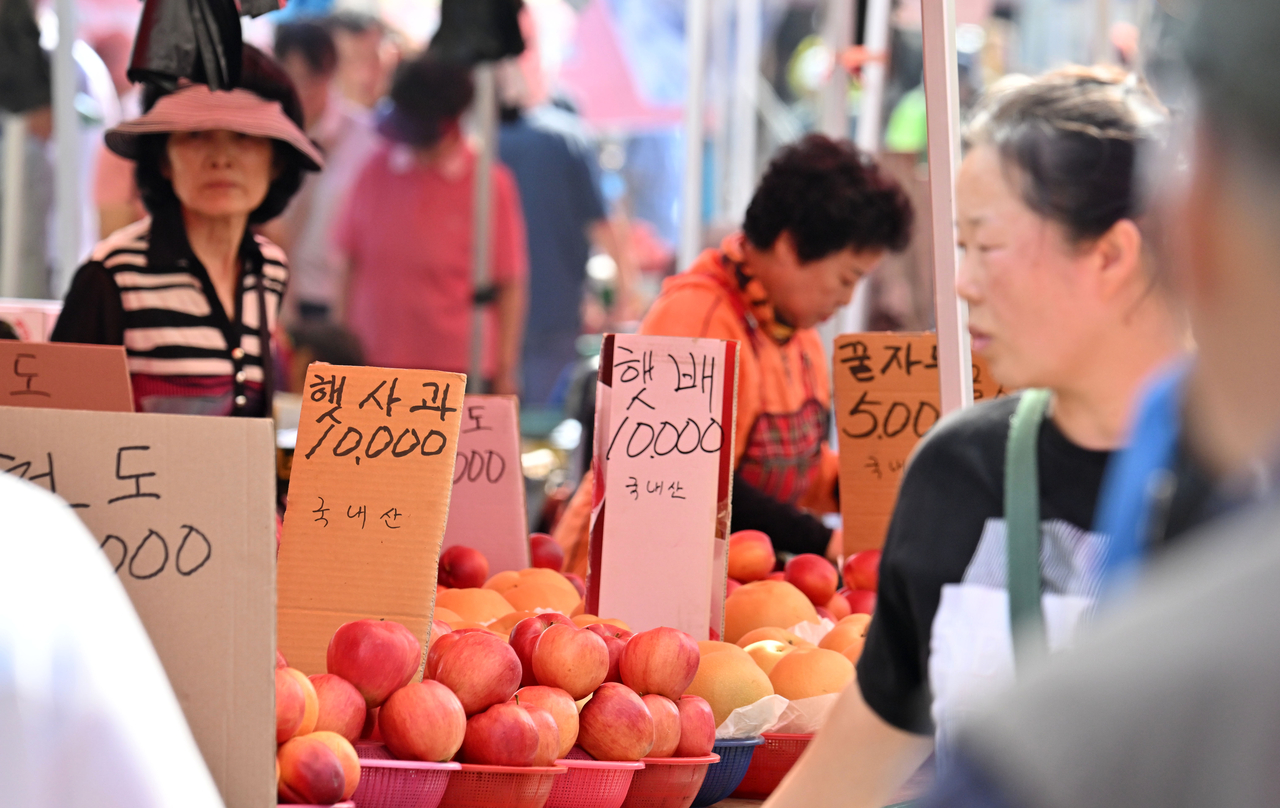
About 8 in 10 companies taking time off for this year's Chuseok holiday will give employees four days off, while the share of firms paying Chuseok bonuses has edged down from last year and nearly half say business conditions have worsened, according to a survey by the Korea Enterprises Federation.
The Korea Enterprises Federation released the results of its "2026 Chuseok Holiday Survey" Thursday, covering 601 companies nationwide with five or more employees.
According to the survey, 97.0 percent of respondents said they would observe a Chuseok holiday break this year, with 76.5 percent of those planning four days off. This year's Chuseok public holidays run from Sept. 24 through Sept. 26, with the following Sept. 27, extending the block to a four-day consecutive break.
Among companies observing a Chuseok break, 14.2 percent said they would take five or more days off — 9.1 percent for five days and 5.1 percent for six or more. By contrast, 9.3 percent said they would take three days or fewer.
Among companies taking three days or fewer, the most common reason — cited by 46.0 percent — was that workloads were not particularly heavy but work was unavoidable due to delivery deadlines. Another 14.0 percent said they had too much work to take more time off.
For companies taking five or more days, the leading reason was mandatory leave under collective agreements or employment rules, cited by 41.7 percent. That was followed by providing employee convenience at 19.4 percent, reducing costs such as annual leave allowances at 16.7 percent, and adjusting output due to slack demand at 8.3 percent.
![[Provided by the Korea Enterprises Federation]](https://wimg.heraldcorp.com/news/cms/2026/09/17/news-p.v1.20260917.7d9d8400aa0f4e22907a34ae3b78dd91_P1.png)
Some 61.0 percent of companies said they planned to pay a Chuseok bonus this year, down 2.0 percentage points from 63.0 percent last year.
By company size, 66.7 percent of firms with 300 or more employees said they would pay a Chuseok bonus, compared with 60.3 percent of firms with fewer than 300 employees. However, the share paying bonuses fell from the previous year in both groups — from 68.1 percent to 66.7 percent among larger firms, and from 62.3 percent to 60.3 percent among smaller ones.
Among companies paying bonuses, 65.3 percent said they would do so through regular scheduled bonuses only, while 30.8 percent said they would pay a separate one-time bonus only, and 3.9 percent said they would pay both.
The share paying through regular scheduled bonuses was higher among firms with 300 or more employees at 95.7 percent, compared with 65.3 percent for smaller firms. Conversely, the share paying a separate one-time bonus was higher among smaller firms at 37.9 percent, versus 13.0 percent for larger firms.
Among companies paying a separate Chuseok bonus, 85.4 percent said the amount would be similar to last year. Some 10.6 percent said they would pay more than last year, while 4.1 percent said they would pay less.
Business sentiment around Chuseok remains subdued. Some 45.2 percent of companies said conditions this Chuseok were worse than last year, roughly on par with the 45.7 percent who said conditions were similar. Only 9.1 percent said conditions had improved.
Smaller firms were more pessimistic: 47.2 percent of companies with fewer than 300 employees said conditions had worsened, compared with 29.4 percent of larger firms.
Still, the share of companies reporting deteriorating conditions fell from last year, when 56.9 percent said Chuseok business conditions had worsened — 11.7 percentage points higher than this year's 45.2 percent. The improvement was particularly pronounced among larger firms, where the share reporting worsening conditions dropped 19.9 percentage points, from 49.3 percent last year to 29.4 percent this year. Smaller firms also saw a decline, from 57.9 percent to 47.2 percent over the same period.
The Korea Enterprises Federation attributed the improved sentiment in part to a higher economic growth rate outlook for this year compared with last year.
eyre@heraldcorp.com