299 deaths in construction, manufacturing — 81% of total
Falls account for 140 deaths, most of any cause
Integrated support roadmap due in June still delayed
Experts call for native-language, hands-on safety training
![A memorial service for construction workers killed in industrial accidents is held in front of Hyundai Engineering & Construction's headquarters in Seoul. [Yonhap]](https://wimg.heraldcorp.com/news/cms/2026/09/16/rcv.YNA.20260423.PYH2026042312700001300_P1.jpg)
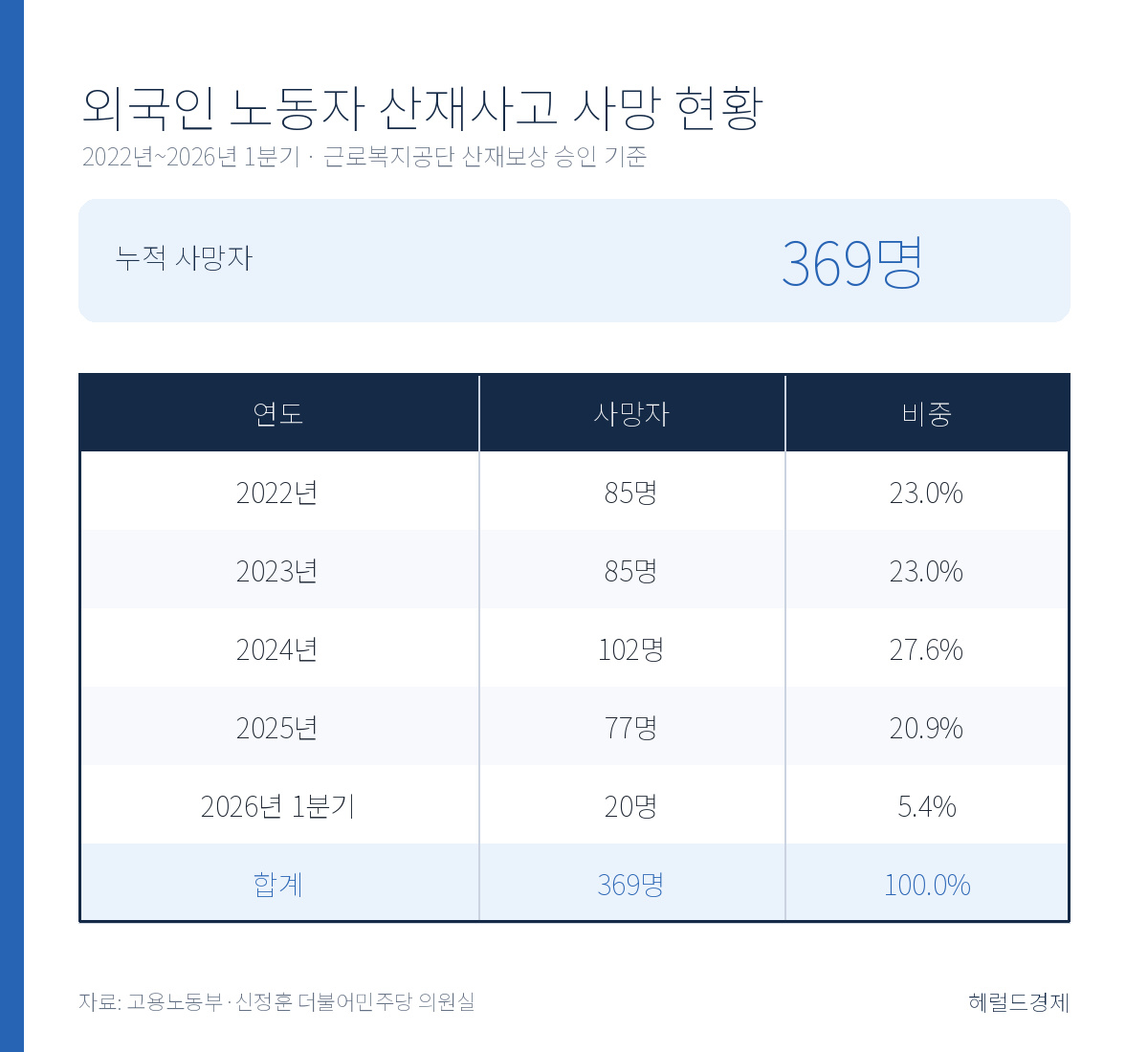
A total of 369 foreign workers died in industrial accidents from 2022 through the first quarter of this year, with eight in 10 fatalities occurring at construction or manufacturing sites. A government support roadmap that had been due in June remains stuck in interministerial consultations three months later.
The figures, submitted to Democratic Party of Korea lawmaker Shin Jeong-hun of the National Assembly's Climate, Energy, Environment and Labor Committee by the Ministry of Employment and Labor, are based on industrial accident compensation approval data from the Korea Workers' Compensation and Welfare Service.
Annual deaths rose from 85 in each of 2022 and 2023 to 102 in 2024. Last year, 77 workers died, and 20 more lost their lives in the first quarter alone this year.
By industry, construction accounted for the largest share at 194 deaths, or 52.6 percent of the total. Manufacturing followed with 105 deaths, or 28.5 percent. Combined, the two sectors claimed 299 lives — 81.0 percent of all fatalities.
Other sectors recorded 45 deaths (12.2 percent), followed by agriculture with 11 (3.0 percent) and forestry with 6 (1.6 percent).
Falls were the leading cause of death, killing 140 workers, or 37.9 percent of the total. Entrapment followed with 56 deaths (15.2 percent), then being caught under or overturned by objects with 31 (8.4 percent), being struck by objects with 28 (7.6 percent), and fires with 27 (7.3 percent). Collisions and collapses each claimed 24 lives, accounting for 6.5 percent apiece.
Despite the mounting toll, the government's response has fallen behind schedule. On April 30, the government announced the direction of a foreign workforce integrated support roadmap and pledged to release the final version in June. According to the Ministry of Employment and Labor, however, the roadmap remains at the draft preparation and interministerial consultation stage.
"Life and safety are not issues that can be deferred over disagreements between ministries," Shin said, adding that foreign workforce policy must shift its focus from the scale of recruitment to worker protection and the development of skilled labor.
"Given that 81 percent of industrial accident deaths among foreign workers occur in construction and manufacturing, exceptional safety measures are needed," Shin said. "The government must put in place measures that actually work on the ground — native-language safety education, hands-on training for each type of task, guaranteed adaptation and skill-building periods, and the placement of interpreter safety managers at high-risk worksites."
fact0514@heraldcorp.com