Based on home-rearing of a first child in Greater Seoul — monthly gap of 100,000 won widens after age 2
Third or more children in preferential regions face gap of 34.28 million won
Ministry of Health and Welfare reviewing retroactive application to January births, at additional cost of about 250 billion won
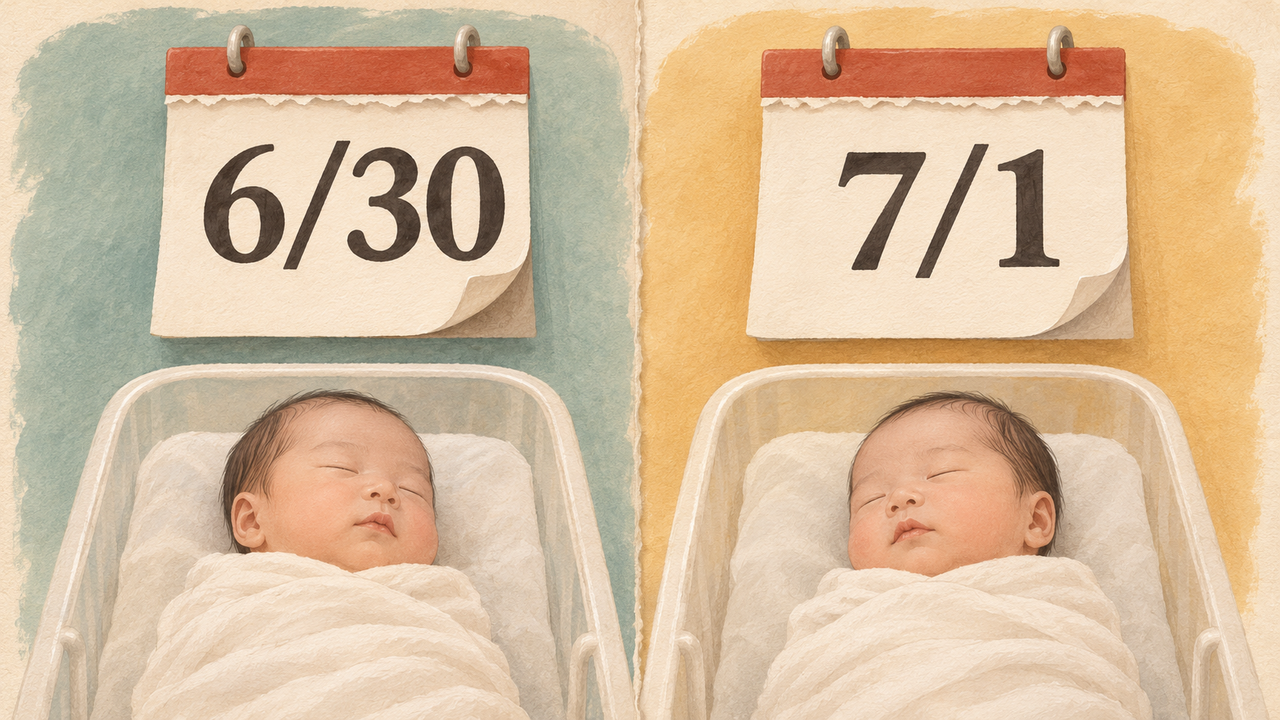
A child born on June 30 next year and one born the very next day, July 1 — under the government's proposed child-rearing support overhaul, the two would receive a cumulative difference of 12.8 million won ($9,620) in benefits by age 12.
The comparison assumes a first child raised at home in Greater Seoul. Support amounts during the first two years after birth are similar, but the monthly allowance diverges by 100,000 won after the child turns two. The Ministry of Health and Welfare is reviewing whether to apply the new system retroactively to children born from January next year onward, to narrow the support gap among children born in the same year.
According to the November issue of "Budget Chunchu," a publication released Wednesday by the National Assembly Budget Office, Im Myeong-hyeon, director of the budget analysis division, compared cumulative child-rearing support from birth to age 12 based on the government's fiscal 2027 budget proposal — arriving at 35.6 million won for children born in June next year and 48.4 million won for those born in July. The government's plan calls for replacing the existing First Meeting Voucher, parental pay and child allowance with a new Child Welcome Grant and Child Basic Allowance for babies born from July next year onward.
Similar support for first 2 years — gap of 13.2 million won over 11 years after age 2
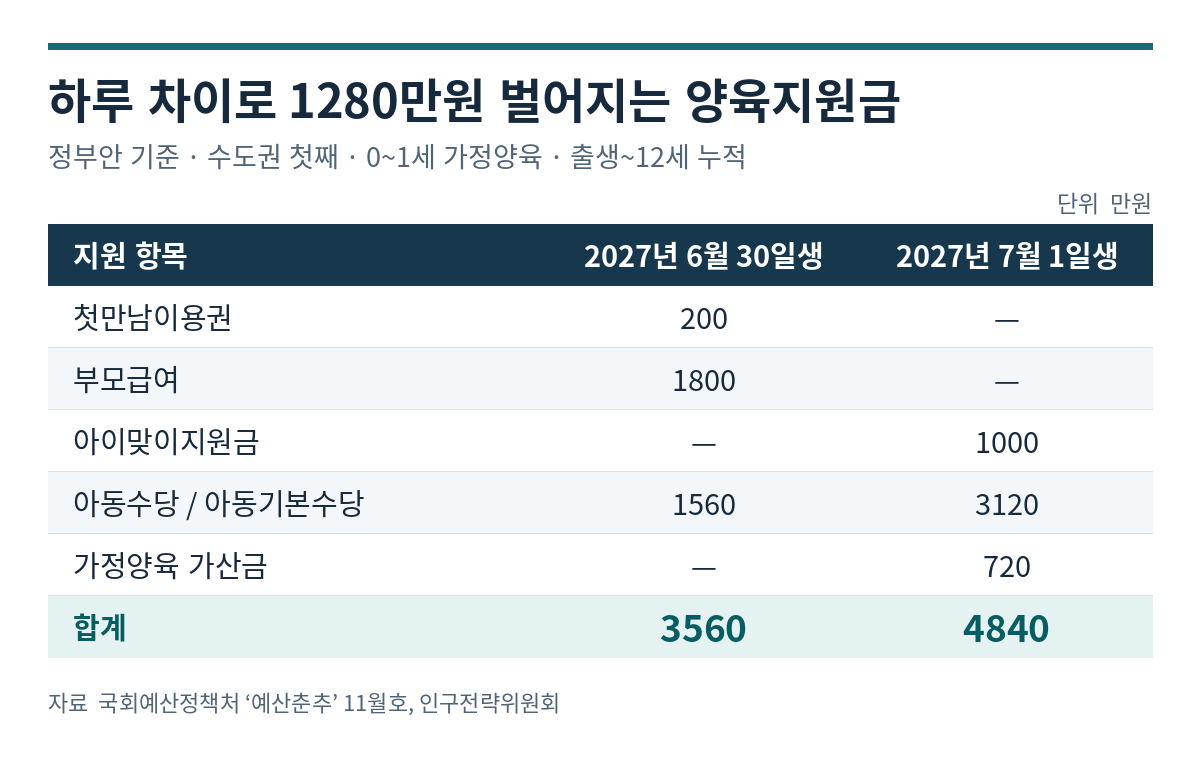
For a first child raised at home in Greater Seoul for the first two years, a family with a June-born child receives 2 million won through the First Meeting Voucher and 18 million won in parental pay. Adding the child allowance of 15.6 million won — paid at 100,000 won per month — brings the total to 35.6 million won through age 12. The existing child allowance's eligible age is also set to rise by one year annually, reaching children through the final month of age 12 from 2030 onward.
A family with a July-born child receives 10 million won through the Child Welcome Grant, paid in four installments over the first year after birth. The Child Basic Allowance amounts to 31.2 million won in total, paid at 200,000 won per month. Families who raise their child at home rather than using a daycare center during the first two years receive an additional home-rearing bonus of 7.2 million won — 300,000 won per month for 24 months — bringing the cumulative total to 48.4 million won.
Combining support for the first two years, June-born children receive 22.4 million won and July-born children 22 million won. After age two, June-born children receive 100,000 won per month while July-born children receive 200,000 won. Over the 11 years from age 2 to 12, the monthly allowance alone accounts for a gap of 13.2 million won. To narrow the gap with children born in the first half of the year, policymakers say the scope of the Child Basic Allowance — paid monthly — must be examined alongside the lump-sum Child Welcome Grant paid in early infancy.
The gap also varies by birth order and place of residence. The Child Welcome Grant is set at 10 million won for a first child, 12 million won for a second child and 15 million won for a third or subsequent child in standard regions. Families in preferential regional areas receive an additional 5 million won per child, and the Child Basic Allowance in those areas is 300,000 won per month — 100,000 won more than in standard regions. For home-reared children, the support gap between June and July births amounts to 13.8 million won for a second child and 16.8 million won for a third or subsequent child in Greater Seoul. In preferential regional areas, the gap widens to 30.28 million won for a first child and 34.28 million won for a third or subsequent child.
Retroactive application to January births would cost about 250 billion won — a key issue in parliamentary review
The Ministry of Health and Welfare set the new system's start date at July next year when drawing up the budget, citing the time needed to build IT systems and for local governments to prepare. President Lee Jae-myung raised the issue at a Cabinet meeting in September, pointing out that children born in the same year could receive different levels of support depending on an administrative cutoff date. In a work report submitted to the National Assembly's Health and Welfare Committee last month, the ministry said it would keep the July implementation date but was reviewing whether to extend eligibility to children born on or after Jan. 1 of the same year.
Retroactive application to January births is estimated to require about 250 billion won in additional funding. The government's budget proposal for next year allocates 2.93 trillion won for the Child Basic Allowance and 698.1 billion won for the Child Welcome Grant, both under the Future Response Fund. The scope of any retroactive application and the source of additional funding are matters to be addressed during the National Assembly's budget review and the amendment process for the Child Allowance Act.
If the new system applies from January next year, children born in both the first and second halves of the year would receive support under the same standard. However, as the transition date shifts to somewhere between the end of this year and early next year, managing the transition for children born just before the cutoff remains a challenge. "The Child Independence Fund also limits eligibility to households with children born after September this year," Im said. "We need to review ways to address the equity issues that arise from the policy transition."
fact0514@heraldcorp.com