Artria AI drives real roads from Pangyo to Gwanghwamun
System handles sudden lane cuts, parked vehicles; imperfections shown too
10 edge cases demonstrated on live Seoul streets
![An Ioniq 6-based software-defined vehicle testbed equipped with Artria AI slows down in response to a sudden lane cut. [Hyundai Motor Group]](https://wimg.heraldcorp.com/news/cms/2026/09/12/news-p.v1.20260912.278a9b5dde8944e1b9a45b530d18e47f_P1.gif)
On a lightly rainy day, an Ioniq 6 makes its way from Pangyo toward Seoul. When an SUV abruptly cuts into its lane, the car swiftly reduces speed on its own — from 100 kilometers per hour to around 80. When a vehicle in an adjacent lane encroaches on its path, the Ioniq 6 steers gently in the opposite direction and continues safely.
Behind the wheel is not a seasoned driver but Artria AI, Hyundai Motor Group's autonomous driving AI, operating an Ioniq 6-based software-defined vehicle testbed.
Hyundai Motor Group unveiled footage of the Ioniq 6-based SDV testbed driving on live urban roads Friday at the Hyundai Motor Group Autonomous Driving Media Day, held at 42dot's headquarters in Pangyo, Seongnam, Gyeonggi Province. The video captures the vehicle responding to a range of unexpected situations on actual roads — not a controlled test environment — including sharp lane changes, vehicles stopped on the shoulder and lane encroachments.
Slowing for cut-ins, steering around parked cars — first public urban drive revealed
![An Ioniq 6-based software-defined vehicle testbed equipped with Artria AI makes a left turn to avoid a bus pulling out on a Seoul street. [Hyundai Motor Group]](https://wimg.heraldcorp.com/news/cms/2026/09/12/news-p.v1.20260912.ed0020b162164a96b17065033af968ae_P1.gif)
The technology shown in the footage operates at Level 2++, meaning the driver retains legal responsibility but the vehicle handles a substantial portion of the driving task. Rather than showcasing runs on a pre-designated test track, the company put the emphasis on how the system responds to unpredictable situations on real Seoul roads.
Three videos were released in total. In the first, Park Min-woo, head of Hyundai Motor and Kia's AVP division and chief executive of 42dot, and Jeong Seong-gyun, group leader of 42dot's Artria group, rode in the vehicle themselves. It departed from Pangyo and traveled via the Gyeongbu Expressway, Olympic-daero and Dongjak Bridge to Sungnyemun and Gwanghwamun.
In the footage, Artria AI handled unexpected situations with the composure of an experienced driver. When another vehicle cut sharply into its lane, the system decelerated to respond safely. When it encountered cars parked on the shoulder or protruding across lane markings, it nudged the steering in the opposite direction and continued on its way.
The footage also showed Artria AI's mistakes without editing them out. Jeong said the system had been improved to change lanes proactively before a lane ends, yet during the exit onto Olympic-daero, the vehicle waited until the lane had nearly disappeared before moving over. While the maneuver posed no safety issue, it differed from how a typical driver would handle the situation. During a right turn, the car also remained stationary after all other vehicles had already moved, pulling forward only after a delay.
The company also demonstrated numerous "edge cases" that tend to challenge self-driving cars. The footage covered 10 scenarios that can arise in real urban driving: avoiding vehicles stopped on the shoulder, responding to sudden lane cuts while in motion, making unprotected left turns, recognizing pedestrians in congested areas, and detecting oncoming vehicles on narrow side streets.
![An Ioniq 6-based software-defined vehicle testbed equipped with Artria AI changes lanes just before its lane disappears. [Hyundai Motor Group]](https://wimg.heraldcorp.com/news/cms/2026/09/12/news-p.v1.20260912.9ddc73db201d41b1a471db75e0538ee2_P1.gif)
Eight cameras on the Ioniq 6 — Artria AI learns through a data flywheel
The vehicle from the footage was on display at a vehicle workshop on site. The workshop at 42dot's Pangyo headquarters serves as the first validation space where software-developed technology is tested in actual vehicles. In addition to the 1,818-square-meter facility at its Pangyo office, 42dot operates a separate vehicle workshop spanning 9,889 square meters in Sujeong-gu, Seongnam.
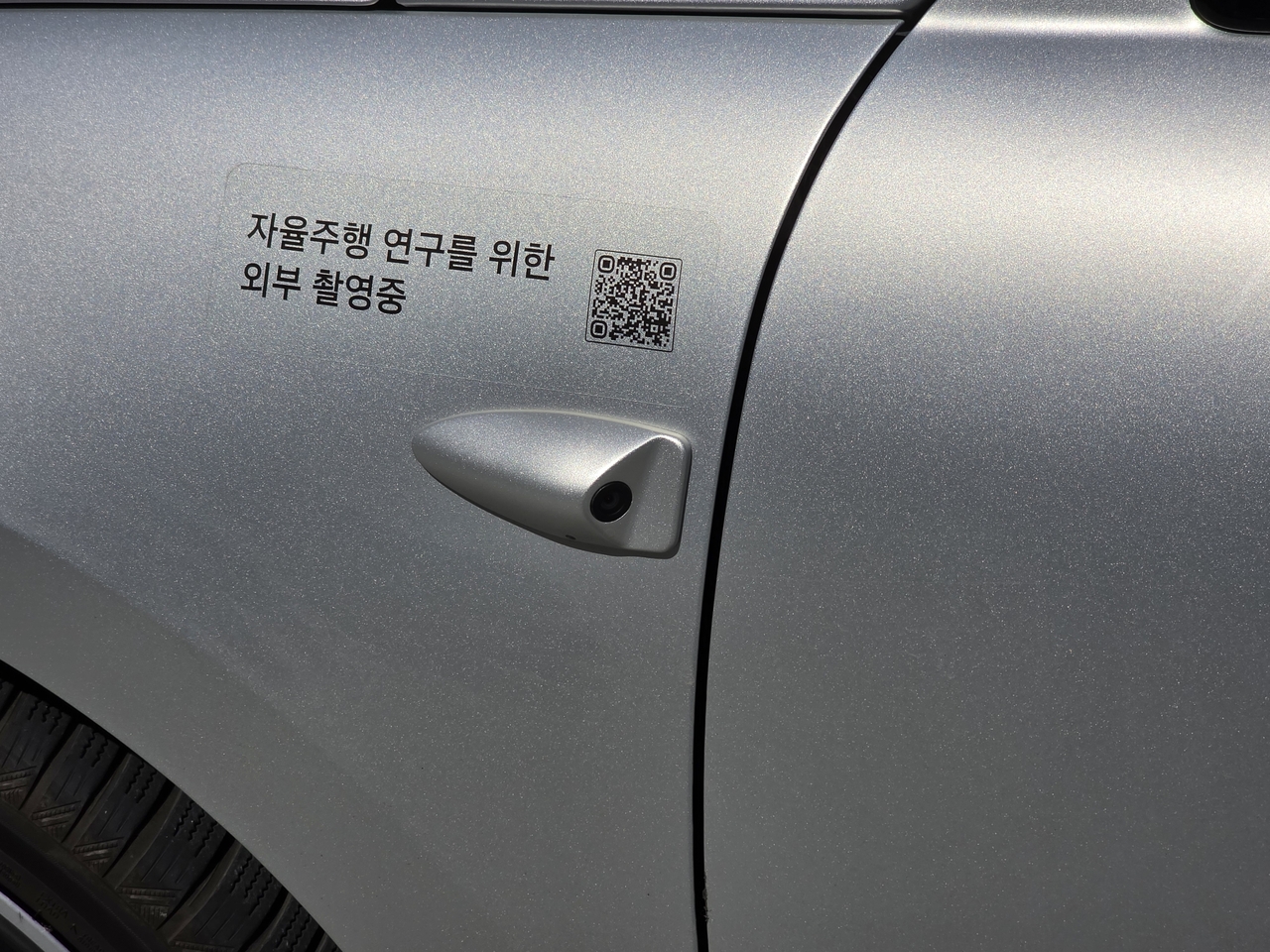
One corner of the workshop held the Ioniq 6-based SDV testbed featured in the videos. From the outside it looks little different from a standard Ioniq 6, but the vehicle is fitted with eight cameras and one front-facing radar. Two cameras are mounted on the windshield, four on the sides, and two ultra-wide-angle cameras at the front and rear. Each camera covers a field of view of 60 to 180 degrees at 2 to 3 megapixels.
The glove box houses a high-performance automotive computer that processes the data stream from the sensors, while the trunk holds a zonal controller that manages the vehicle's systems. 42dot said that while the body of the vehicle used in Friday's footage is an Ioniq 6, more than half of its internal systems and components incorporate the company's own proprietary technology.
![Vehicles on display at the Hyundai Motor Group Autonomous Driving Media Day on Friday, from left: the SDV testbed, the Gwangju autonomous driving pilot project vehicle, and a data-collection vehicle. [Hyundai Motor Group]](https://wimg.heraldcorp.com/news/cms/2026/09/12/news-p.v1.20260912.1bbe1952190045848c8a0fdbb17c0e35_P1.jpg)
Also on display was an Ioniq 5 fitted with lidar, used for data collection. In addition to the roof-mounted lidar unit, the vehicle can be equipped with up to 12 cameras, one lidar, five radars and 12 ultrasonic sensors depending on the task. 42dot operates about 40 such data-collection vehicles around the clock. As the Ioniq 5 gathers data on real roads, Artria AI learns from it through what the company calls a "data flywheel."
The test vehicle fleet is set to expand significantly. Jeong said the vehicle in the footage is an "SDV testbed," one generation behind the SDV pace car, with 10 to 20 units currently dedicated to autonomous driving. He added that the group's affiliates will soon begin using SDVs to collect data and put the data flywheel into operation. The SDV pace car is also slated for deployment in a Level 4 autonomous driving pilot project to be launched in Gwangju at the end of the year.
Hyundai Motor Group plans to bring Artria AI's core functions — including driving, parking and active safety — to full maturity by 2027, then focus intensively on accumulating a wider range of edge cases through 2028. After obtaining certification in North America, Europe and other markets, the group aims to launch a Level 2++ production vehicle based on Artria AI in the second half of 2029.
"The more edge cases we discover and learn from, the safer autonomous driving can become," Park said. "Under the principle of applying only sufficiently verified technology to vehicles, we will continue to raise both development speed and safety together."
eyre@heraldcorp.com