
Total revenue rises W71.1tr, narrowing deficit by W22tr
Central government debt grows W15.7tr in a month
South Korea's managed fiscal balance — a gauge of the government's real fiscal health — posted a deficit of 64.8 trillion won ($48.4 billion) through July this year, narrowing by 22 trillion won from the same period last year. National tax revenue, driven by income tax and value-added tax, grew by more than 41 trillion won, improving the fiscal balance.
The Ministry of Economy and Finance and the Ministry of Planning and Budget released the "Monthly Fiscal Trends" report for September on Friday. The report showed the managed fiscal balance posted a deficit of 64.8 trillion won for the January-July period this year. The deficit for the same period last year stood at 86.8 trillion won.
The managed fiscal balance is calculated by excluding social security fund balances, such as the national pension and employment insurance, from the consolidated fiscal balance. It is used as an indicator of the government's actual fiscal condition.
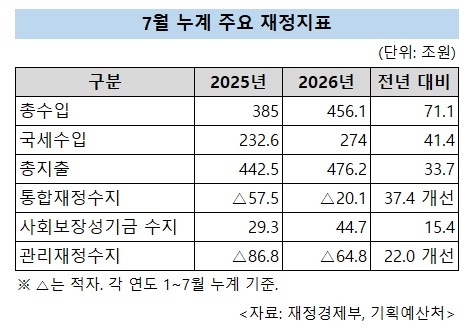
The consolidated fiscal balance for the same period posted a deficit of 20.1 trillion won. That narrowed by 37.4 trillion won from the 57.5 trillion won deficit recorded in the same period last year. The social security fund balance posted a surplus of 44.7 trillion won, with the surplus expanding by 15.4 trillion won from a year earlier.
The improvement in the fiscal balance came as the increase in total revenue significantly outpaced the increase in total expenditure. Total revenue for the January-July period this year came to 456.1 trillion won, up 71.1 trillion won from a year earlier. Total expenditure came to 476.2 trillion won, up 33.7 trillion won.
National tax revenue rose particularly sharply. Cumulative national tax revenue through July reached 274 trillion won, up 41.4 trillion won from the same period last year. This represented 66.0 percent of the annual national tax revenue budget of 415.4 trillion won, a progress rate 3.4 percentage points higher than last year.
By tax category, income tax rose 12.2 trillion won amid an increase in performance bonuses and real estate transactions. Value-added tax rose 8.1 trillion won on higher private consumption and imports, while corporate tax rose 4.4 trillion won on improved corporate earnings.
The securities transaction tax rose 6.4 trillion won from a year earlier, driven by higher trading volumes and the restoration of the tax rate. The special tax for rural development rose 8.5 trillion won, helped by increased Kospi trading value. Non-tax revenue rose 9 trillion won to 30.1 trillion won, while fund revenue rose 20.7 trillion won to 152 trillion won.
On the spending side, transfer expenditures led the increase. Cumulative transfer expenditure through July came to 357.7 trillion won, up 30 trillion won from a year earlier. Personnel costs rose 900 billion won, while asset acquisitions and goods and services expenses each rose 500 billion won.
Despite the narrower fiscal deficit, central government debt increased. Central government debt stood at 1,354.2 trillion won at the end of July, up 15.7 trillion won from the previous month. That was also up 86.1 trillion won from the end of last year. This increase reflects a rise in the outstanding government bond balance, which grew 86.1 trillion won from the end of last year.
fact0514@heraldcorp.com




