277 citizens deliberate, identify 6 core tasks; proposal due in December
Kim Ji-hyung calls for redesign of job ecosystem to bridge generational divide
![Kim Ji-hyung, chairman of the Economic, Social and Labor Council [Newsis]](https://wimg.heraldcorp.com/news/cms/2026/10/06/news-p.v1.20261006.2716974aef9e49928ceea90b2aa038c9_P1.jpg)
Citizens have called for expanding quality jobs in regional areas and creating an environment where workers can balance childcare and caregiving responsibilities with employment as key solutions to the job challenges posed by the country's low birth rate and aging population. Intergenerational communication, skills and technology transfer, and the redesign of job duties, working hours and compensation systems were also selected as core discussion topics.
In a survey of citizens participating in a public deliberation on employment organized by the Economic, Social and Labor Council, 74.3 percent identified "creating quality regional jobs and fostering employment industries by region" as the top priority for discussion.
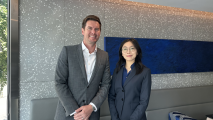
Council Chairman Kim Ji-hyung held a press briefing Tuesday at the council's main conference room in Jongno-gu, Seoul, to announce the results of the first phase of public deliberation by the Special Committee on Demographic Change and Employment, along with plans for the next phase.
The special committee held deliberative forums at Yonsei University on Aug. 30 and at Korea University of Technology and Education on Sept. 5. Of the 300 citizens on the panel, 277 attended to hear expert presentations and take part in discussions, a participation rate of 92.3 percent.
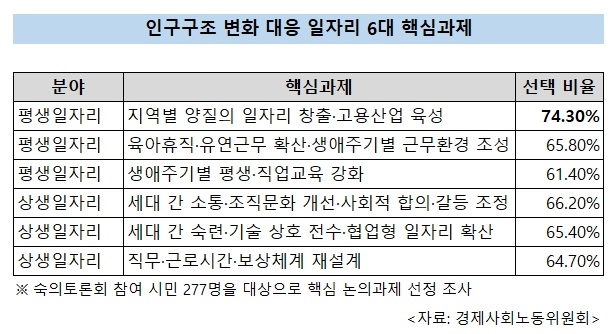
The special committee compiled 10 tasks in total — five each in the categories of "mutually beneficial employment" and "lifelong employment" — drawing on more than 4,600 citizen opinions. It then surveyed the 277 attending citizens to identify which tasks warranted deeper discussion, selecting three from each category for a total of six core tasks.
In the lifelong employment category, "creating quality regional jobs and fostering employment industries by region" received the highest selection rate at 74.3 percent. "Expanding parental leave and flexible work arrangements and building a life-cycle-appropriate work environment" came in at 65.8 percent, followed by "strengthening lifelong and vocational education across life stages" at 61.4 percent.
In the mutually beneficial employment category, "intergenerational communication, organizational culture, and mechanisms for social consensus and conflict resolution" ranked highest at 66.2 percent. "Mutual transfer of skills and technology across generations through mentoring and the spread of collaborative employment" followed at 65.4 percent, with "redesigning job duties, working hours and compensation systems" at 64.7 percent.
"Citizens clearly recognize that employment challenges stemming from demographic change cannot be resolved through any single, piecemeal policy — whether setting a retirement age or hiring a few more young workers," Kim said.
He added that intergenerational relations, organizational culture, job duties and compensation, education and training, childcare and caregiving, and regional employment are all closely interlinked. The country needs to "redesign the entire job ecosystem to match the changing demographic structure," he said.
The special committee, launched July 16, will operate through Jan. 15 next year. It is tasked with discussing ways to build a lifelong employment framework — covering job entry, retention, transition, retirement and re-entry — as well as mutually beneficial employment arrangements for young and older workers in response to the shrinking working-age population.
A second-phase intensive deliberation involving 100 citizens will be held at Korea University of Technology and Education on Oct. 24-25. After discussing improvement measures for the six core tasks, the committee will hold a comprehensive deliberation in November and a final deliberation in December before submitting a citizen proposal to the special committee.
fact0514@heraldcorp.com