About 6.89 million two-person households projected for next year; 44.3% headed by someone 65 or older
Aging couples face growing 'elder-on-elder care' burden as identifying households in need becomes key challenge
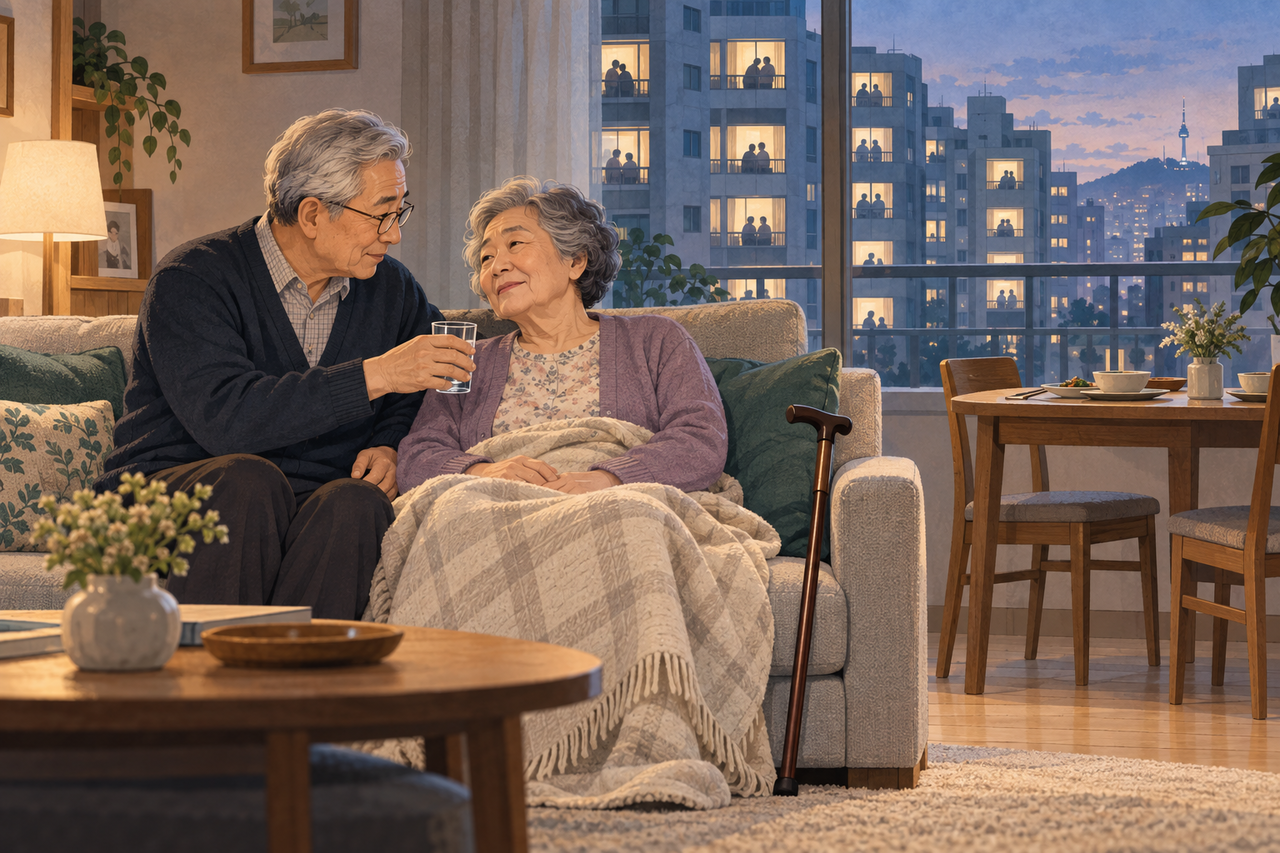
The share of two-person households in South Korea is projected to exceed 30 percent for the first time next year.
That would put two-person households ahead of three- and four-person households combined — a milestone that underscores the decline of the traditional family unit. With more than 44 percent of two-person households headed by someone aged 65 or older, experts say the country must address the growing care burden falling on elderly couples.
According to household projections released Tuesday by the Ministry of Statistics, total households nationwide are expected to reach about 22.807 million next year, up 0.9 percent from this year.
One- and two-person households are driving that growth. Single-person households are projected to rise 2.3 percent from this year to about 8.553 million, while two-person households are expected to grow 2.1 percent to about 6.89 million. By contrast, three-person households are forecast to shrink 0.4 percent to about 4.121 million, and four-person households to fall 2.9 percent to about 2.609 million. Households of five or more people are projected at 634,000.
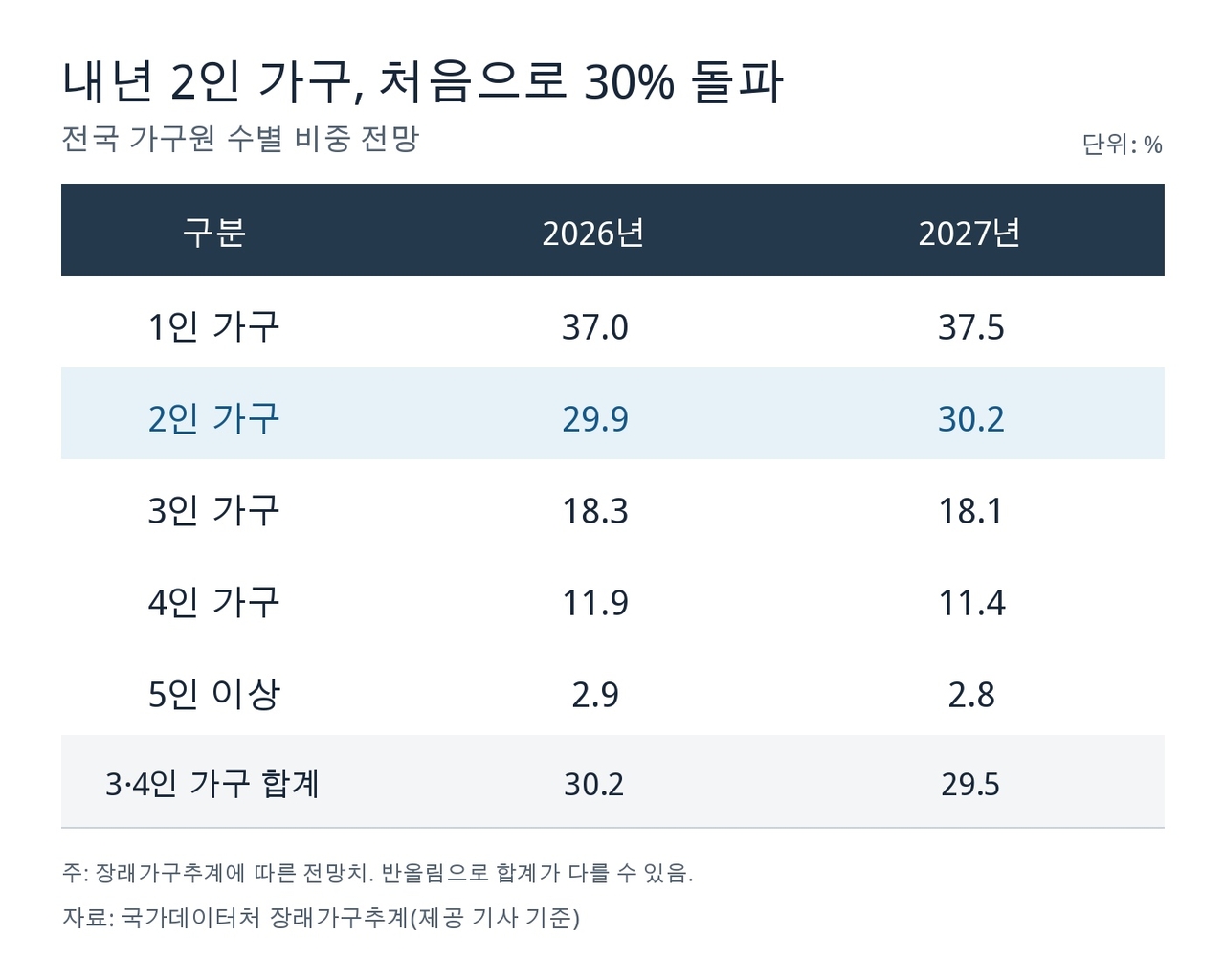
The share of two-person households is set to climb from 29.9 percent this year to 30.2 percent next year — the first time the figure has crossed 30 percent since the projections series began in 2000.
Next year will also mark the first time two-person households outnumber three- and four-person households combined. Three-person households are projected to account for 18.1 percent of all households next year and four-person households 11.4 percent, for a combined 29.5 percent. In raw numbers, that amounts to about 6.73 million households — roughly 160,000 fewer than the two-person total.
Single-person households remain the largest category, projected to account for 37.5 percent of all households next year, up 0.5 percentage points from this year. Together, one- and two-person households will make up 67.7 percent of all households next year.
The trend toward smaller households is expected to continue. The shift — with three- and four-person households shrinking while one- and two-person households grow — is projected to persist through 2043, when the breakdown is forecast at 40.9 percent for single-person, 34.2 percent for two-person, 15.6 percent for three-person and 7.7 percent for four-person households.
After that point, population decline will gradually reduce the absolute number of one- and two-person households as well, pulling total household counts down. Their share of all households, however, will keep rising: by 2052, the final year of the projection series, single-person households are forecast to reach 41.3 percent and two-person households 35.5 percent, while three-person households fall to 15.2 percent and four-person households to 6.7 percent.
Alongside the rise in two-person households, aging is emerging as a critical concern. Next year, 44.3 percent of two-person households will be headed by someone aged 65 or older — up 1.3 percentage points from this year — and a significant share of those are believed to be elderly couples living together.
As more older couples live apart from their children, the burden of so-called "elder-on-elder care" — where the healthier spouse looks after the ailing one — is expected to grow. Even when a family member is present in the home, that caregiver is often elderly themselves, making it a key challenge to identify households that need outside support.
Jung Soon-dool, a professor at Ewha Womans University, said the government's tailored elderly care service has already expanded its scope beyond single elderly residents to elderly households more broadly, putting a support system for elder-on-elder care households in place.
She added, however, that communities must do more to reach elderly couples who may be unaware of such programs — actively identifying those in need and connecting them with information and assistance.
fact0514@heraldcorp.com