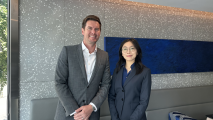
Interview with Kim Young-ok, HD Hyundai chief AI officer (CAIO, managing director)
Names shipbuilding as leader in manufacturing AI
Highlights industry's potential to generate national wealth on par with semiconductors
Calls for turning shipbuilding's accumulated experience and know-how into AI-based knowledge assets
AI tutoring for executives on design, logistics optimization accelerates companywide AI transformation

"Manufacturing AI is an area where Korea must absolutely secure competitiveness. I believe shipbuilding is the industry that can lead the way."
Kim Young-ok, HD Hyundai's chief AI officer, doubled down on the idea that "manufacturing AI is Korea's dream" in an interview Thursday at HD Hyundai's Global R&D Center in Pangyo. She said the point is not merely to apply technologies such as generative AI or large language models on factory floors. Instead, the goal is to turn the experience, knowledge and process know-how accumulated by Korea's manufacturing industries -- shipbuilding among them -- into AI-based intellectual assets. This could generate national wealth on par with semiconductors.
Shipbuilding best positioned to lead in manufacturing AI
Kim majored in computer science and AI, and has spent about two decades working with AI on manufacturing floors, earning her a reputation as a "manufacturing AI expert." She has served as HD Hyundai Group's CAIO since September 2022, leading the group's AI transformation for four years. "I do not see AI merely as a technology, but think about how to combine it with business to create national wealth," she said. "That is the role manufacturing AI should play."
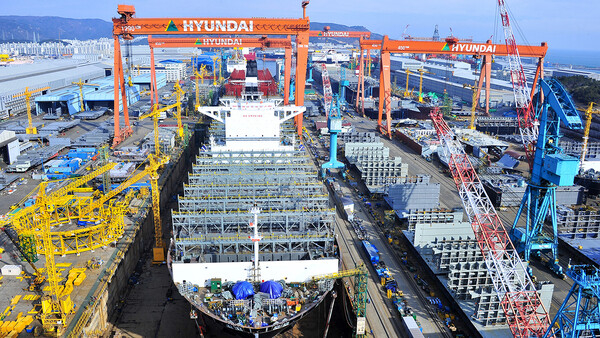
The reason she named shipbuilding as the leading industry for manufacturing AI lies in the sector's unique "long-term value chain." While a car takes only a few hours to produce, with highly standardized and automated processes, building a single ship takes about a year and a half. Ships require tens of thousands of parts, and many manual processes are difficult to automate. Throughout this long process, skilled workers have accumulated knowledge and know-how on site over decades.
"If we can turn the knowledge and know-how that people hold across this long-term value chain into knowledge and assets, and properly weave AI into the process, the information from the beginning will connect with the information at the end," Kim said. "As data flows, we can secure transparency in the process and raise overall production efficiency." She also stressed that AI should not replace people but instead fuse with them to expand the shipbuilding industry's competitiveness and business scope. "We are thinking in the direction of people and AI together creating more business and growing the shipbuilding industry," she said.
AI key to outpacing China and winning US MASGA project
She said such manufacturing AI competitiveness could be a key tool to outpace China, which is catching up at a rapid pace. "Could China's physical AI models weld, paint and carry out quality inspections in confined spaces on a shipyard floor right now?" Kim said. Although China is rapidly advancing in general-purpose AI and physical AI, she judged that Chinese AI models are unlikely to catch up with skilled workers on the shop floor anytime soon.
Still, she said, "Time is not on our side. We need to properly internalize this without being exposed to China and build a knowledge-industrialization model. If we do that, shipbuilding has plenty of opportunity." To that end, she said Korea should treat its shipbuilding competitiveness as a strategic asset. The government, she added, needs to actively invest in and support the AI transformation of numerous partner companies and the recruitment of regional talent.

She predicted that such manufacturing AI competitiveness could usher in a new golden age for Korea's shipbuilding industry. "If we turn the experience we have accumulated into knowledge assets and optimize the entire process, it could well become a second shipbuilding renaissance -- an area capable of generating national wealth on par with semiconductors," she said.
She also forecast that AI would become a critical competitive edge in the MASGA project to revive US shipbuilding. "Labor costs for US workers are four to five times higher than in Korea, yet it is still hard to secure manpower," Kim said. "To revive shipbuilding in that kind of environment, we ultimately need to digitize and AI-ify the know-how that people hold." She added, "What matters is how we package the know-how and assets we have, and how we combine them with digital platforms and physical AI."
AI applied across design and production floors -- even tutoring for top executives
HD Hyundai has already applied AI throughout its design and production processes. Unlike cars, no two ships are ever identical, making "modification design" -- adapting drawings from previously built, similar vessels to meet a new shipowner's requirements -- a crucial step. HD Hyundai has developed and uses a module in which AI compares past designs with a new shipowner's specifications, identifies differences and recommends what is needed during the design process. The company is also working to optimize AI by design function.
"There are various functions within design, and we are optimizing AI for each of them -- an internal project we are fundamentally calling the 'Shipbuilding Master AI Agent,'" Kim said. On the production floor, AI is used to optimize the logistics of blocks stacked across the shipyard. Since ships are massive structures, where blocks are stored and in what order they are moved directly affects production efficiency. "AI optimization must be part of shipyard logistics as well," Kim said.
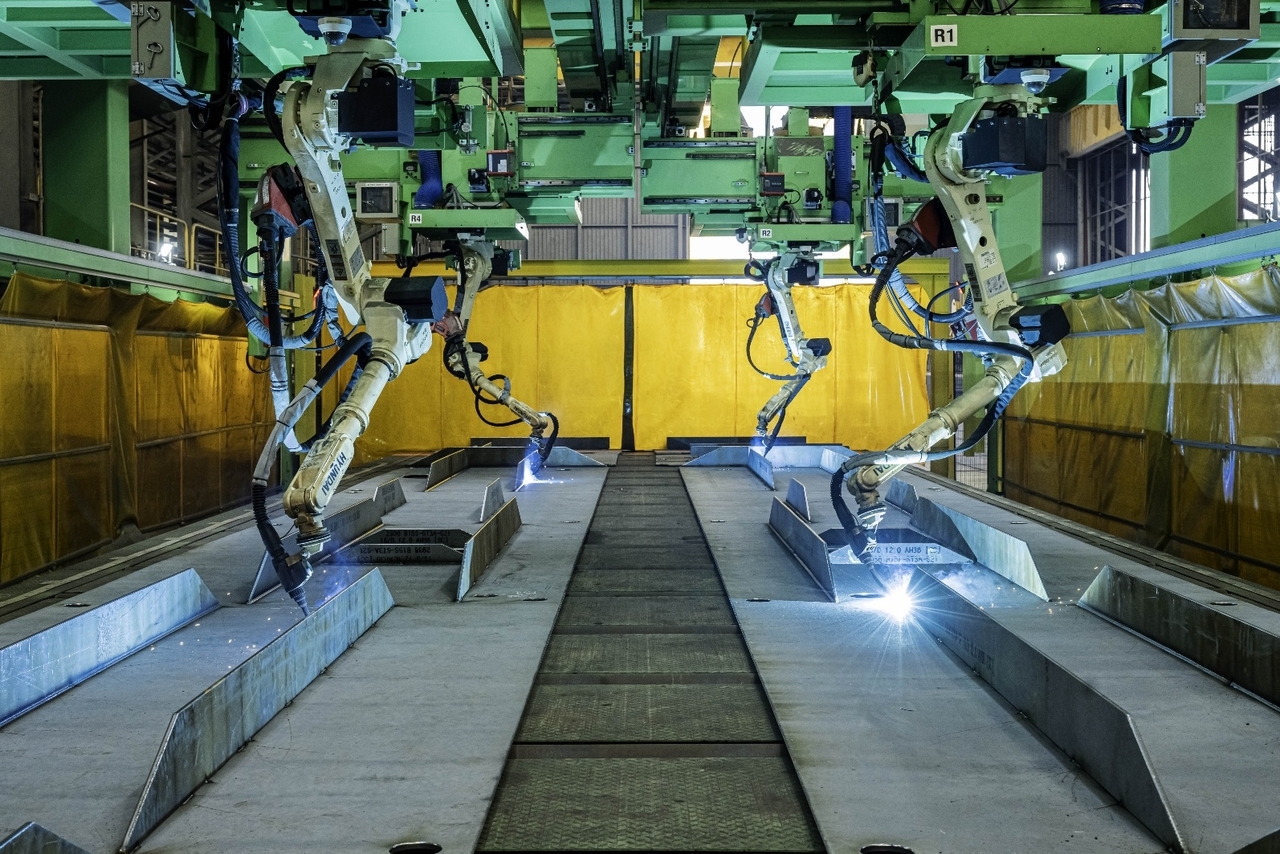
To help this AI transformation take root on the ground, Kim did the legwork herself. In her first year at HD Hyundai, she visited shipyard sites more than 70 times while pushing the AI transition. She talked and communicated with employees, explaining and training them on what role AI could actually play in their work. Asked why she focused so much on the field, she said, "Because the hardest part is not the technology, but how to bring about change in people and how to handle data."
When Kim first joined HD Hyundai, many on the floor were skeptical about what role AI could play in production and design. Now, all employees acknowledge the need for the AI transition. This year, the company launched one-on-one mentoring sessions -- an "AI tutoring" program -- for top executives, who went beyond simply listening to explanations and experienced "vibe coding" firsthand. "We have now reached the point where even people on the floor think for themselves about how to innovate through AI and apply it directly to their own work," she said.
Meanwhile, Kim will speak at the Herald Corporate Forum 2026, to be held Sept. 29 at the Shilla Hotel in Jung-gu, Seoul, where she will present a more detailed account of her journey toward manufacturing AI. Registration is available on the Herald Corporate Forum website.

keg@heraldcorp.com