Some 80 days into his term, Kim delivers results on real estate tax response and faster reconstruction
District mayor personally leads 'Sinhwa TF,' directly overseeing progress on 103 redevelopment projects
Proactive acquisition tax refunds, AI-powered administration bolster resident-focused governance
Gangnam Festival trimmed to three days, balancing resident convenience with event impact
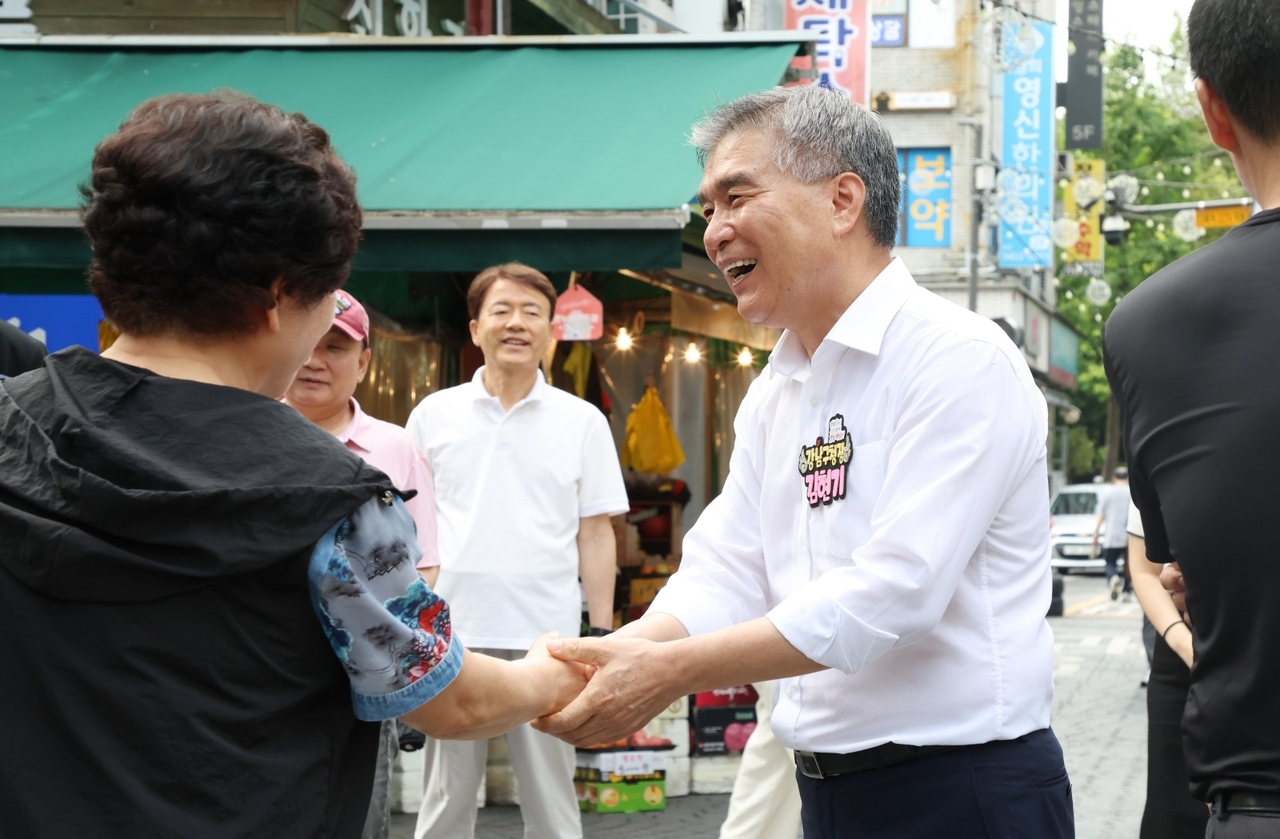
Some 80 days into his term, Gangnam-gu District Mayor Kim Hyun-ki's campaign slogan for the ninth popularly elected local government — "Energize Gangnam, delight residents, transform Gangnam" — is materializing into concrete policies and results.
What sounded somewhat abstract before he took office is now taking shape through measures addressing real estate taxation, accelerated reconstruction projects, resident-focused tax administration, and AI-driven administrative innovation.
Kim has made it a top priority to ease the burden on residents from the government's Aug. 3 real estate tax reform plan and to speed up reconstruction projects across the district, concentrating administrative resources on both fronts.
"Tax reform harm must be minimized": District collects 1,208 resident opinions for government
Gangnam-gu collected 1,208 opinions from residents on the government's "2026 Tax Reform Plan." After expert review, the district compiled the input into six policy recommendations and submitted them to the Ministry of Economy and Finance on Aug. 19.
The district received the opinions from Aug. 12 to Aug. 18 — 918 concerning the comprehensive real estate holding tax and 290 concerning the capital gains tax.
On the proposal to raise the fair market value ratio applied to the officially assessed price from 60 percent to 70 percent when calculating the tax, many residents said the ratio should either stay at its current level or be adjusted gradually.
Beyond policy recommendations, the district also arranged a session to address residents' tax questions.
The district will hold a "Resident Briefing on Real Estate Taxes" for 500 residents at 2 p.m. on Sept. 18 in the main hall of the Gangnam Community Center. Experts will explain the key provisions of the Aug. 3 tax reform plan — including the capital gains tax and comprehensive real estate holding tax — and outline steps residents should take in response.
District finds and refunds overpaid acquisition tax without requiring applications
The district also launched proactive refunds for overpaid acquisition tax, aiming to ensure no taxpayer misses out simply because they were unaware of the relevant rules.
The district is reviewing all 3,981 cases of gratuitous acquisition reported between Jan. 1, 2023, and Dec. 31, 2025. Among these, it is cross-checking filed data against subsequently confirmed price data for 576 cases reported based on the prices of similar properties.
If a taxpayer is found to have overpaid, the district will identify them and proceed with the refund without waiting for a separate application.
Conversely, if the officially recognized market price turns out to be higher than the reported price — meaning the taxpayer paid less than owed — the district plans to guide them through an amended filing to prevent future penalties and complaints.
The initiative amounts to proactive administration that protects taxpayers' rights while supporting accurate filing.
Reconstruction push begins on day one, with district mayor personally leading 'Sinhwa TF'
Kim's commitment to reconstruction was clear from his very first day in office.
His first official act as district mayor was approving the "Gangnam Reconstruction Rapid Reconciliation Project," and he personally took charge of the "Sinhwa TF" — a task force under his direct supervision dedicated to speeding up reconstruction. Rather than only receiving reports on individual projects, he visits sites in person to hear from unions and residents.
One flagship achievement is the approval of the project implementation plan for the Eunma Apartment reconstruction.
On Tuesday, Kim visited Eunma Apartment in person to hand residents the project implementation plan approval and held a meeting with union officials. He then convened a working-level progress meeting to review compliance with post-approval conditions, key construction schedules, and coordination with relevant agencies.
The district does not consider its role finished once approval is granted — it intends to continue managing the entire process through ground-breaking.
Approval for preparatory committees cut from 30 days to 10
Administrative procedures for reconstruction have also sped up significantly.
Gangnam-gu issued approval for the preparatory committee to establish a reconstruction union at Ilwon Hansol Apartment just 10 days after receiving the application — 20 days ahead of the 30-day statutory deadline. Approval for the preparatory committee at Daechi Sunkyung Apartment was processed within the same time frame.
The district replaced its previous sequential review process, in which staff examined documents one after another, with a "team-based integrated review" in which multiple staff members review documents simultaneously. This cut waiting time between departmental reviews and sped up processing.
Approval of the Eunma Apartment project implementation plan was likewise processed roughly 40 days after the application was filed.
The significance lies not in simply telling civil servants to work faster, but in changing the way work itself is done to shorten administrative procedures.
41-member expert support group launched; office installs board tracking 103 projects
The district also strengthened its support system for resolving conflicts and technical disputes that arise during reconstruction.
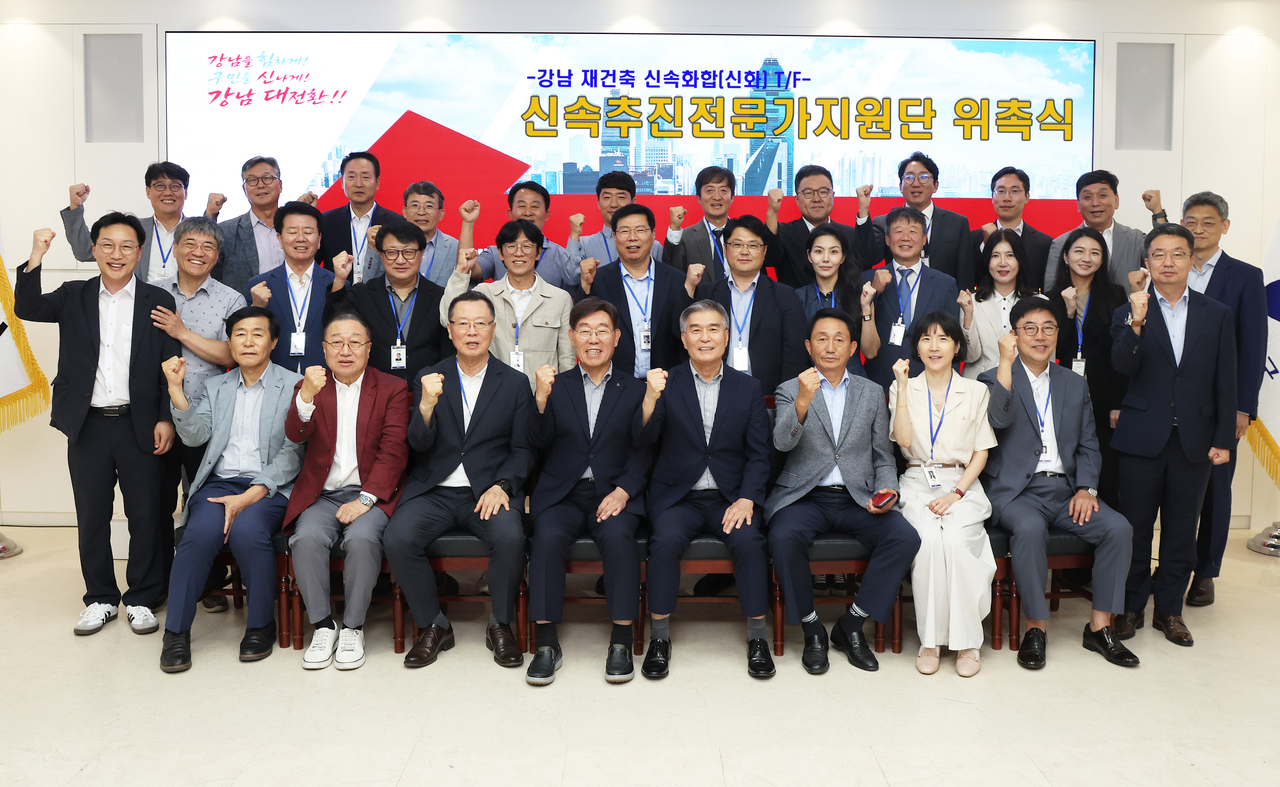
On July 29, Gangnam-gu launched the "Expert Support Group for Accelerated Reconstruction," made up of 41 specialists in fields including redevelopment, law, architecture, urban planning, and tax and accounting.
Operating under the Sinhwa TF, the group handles conflict mediation, expert consultation, and resident counseling. Lawyers, certified judicial scriveners, architects, and appraisers help residents and unions resolve issues related to redevelopment projects.
Starting Tuesday, in-person expert consultations expanded from once a week to twice a week. In addition to the existing Thursday sessions, the district added a Tuesday session specializing in tax and accounting, allowing residents to consult experts directly on complex tax, legal, and procedural questions.
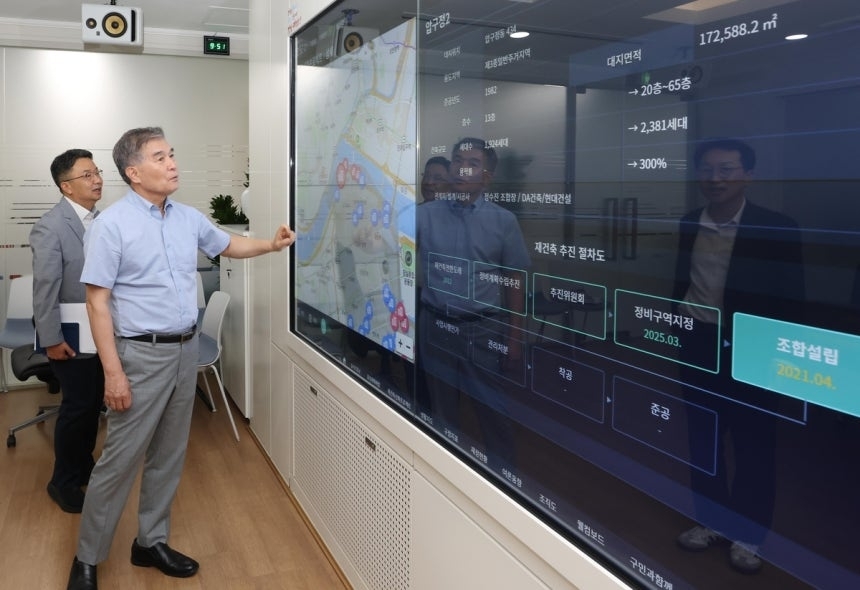
Kim's office also installed a "Reconstruction Progress Management Board" that lets him check the status of all 103 redevelopment projects in the district at a glance.
The system lets the district mayor personally track each project's progress and the reasons for any delays, and immediately direct relevant departments to act when problems arise.
District also moves to fill vacant retail units in reconstructed apartment complexes
Gangnam-gu is also improving procedures for changing the designated use of commercial units to address the problem of retail spaces sitting vacant for extended periods even after residents move into reconstructed apartment complexes.
Until now, reconstructed apartment complexes could not have their building registers created — and thus could not change the designated use of their retail units — until the relocation notice and preservation registration of ownership were completed after completion approval. Because this process took anywhere from several months to more than a year, clinics, hagwon and other convenience facilities could not open for business even after residents had already moved in.
The district plans to revise the procedure so that, if certain conditions are met, the designated use of retail units within a complex can be changed even before the relocation notice is issued.
The measure addresses not only the pace of reconstruction but also the practical inconveniences faced by residents and retail unit owners.

Gangnam Festival trimmed to three days, with greater resident participation
The "delight residents" slogan also takes concrete form in festival policy.
The Gangnam Festival, marking its 15th edition this year, will expand its venue from its traditional home along Yeongdong-daero to the area around Dosan-daero. It will center on the first grand parade featuring residents from all 22 dong, combining K-pop, fashion, food and performances into an urban festival.
The district plans to turn Gangnam's streets into a large festival venue, with parades and street programs during the day and concerts at night.
However, the event's duration has been shortened from the previous four to five days to three, aiming to preserve the festival's energy while minimizing inconvenience to residents from traffic control and noise.
'AI assistant' at civil complaint desks finds relevant regulations
The district has introduced AI into its administrative operations.
Since Aug. 20, Gangnam-gu has deployed an "AI Work Assistant" for civil petition administration and local tax work. When staff enter a work-related question, the system searches official administrative materials registered by the district, provides a sourced answer, and allows users to check the original document.
The system is expected to reduce the time staff spend searching for materials while improving the accuracy and consistency of responses to civil petitions.
Since taking office, Kim's approach can be summed up in three words: on-site, speed and pragmatism.
He has gathered resident opinions to push for improvements to the government's tax reform plan and has changed administrative procedures and review methods to speed up reconstruction. The district proactively finds and refunds overpaid taxes, and while expanding resident participation in the festival, it shortened the event's duration out of consideration for inconvenience.
The slogan that was once just an inauguration declaration — "Energize Gangnam, delight residents, transform Gangnam" — is now taking shape, one policy and administrative achievement at a time, in residents' daily lives.
seouldream01@heraldcorp.com