
'The answer for a minority ruling party is persuasion' — engaging the opposition with humility
Pushing to restore youth AI, night economy budgets by persuading the opposition
Supply is the answer to Seoul's housing problem — bolstering support for redevelopment projects
From Jamsil Jugong Complex 5 to turning local complaints into city policy
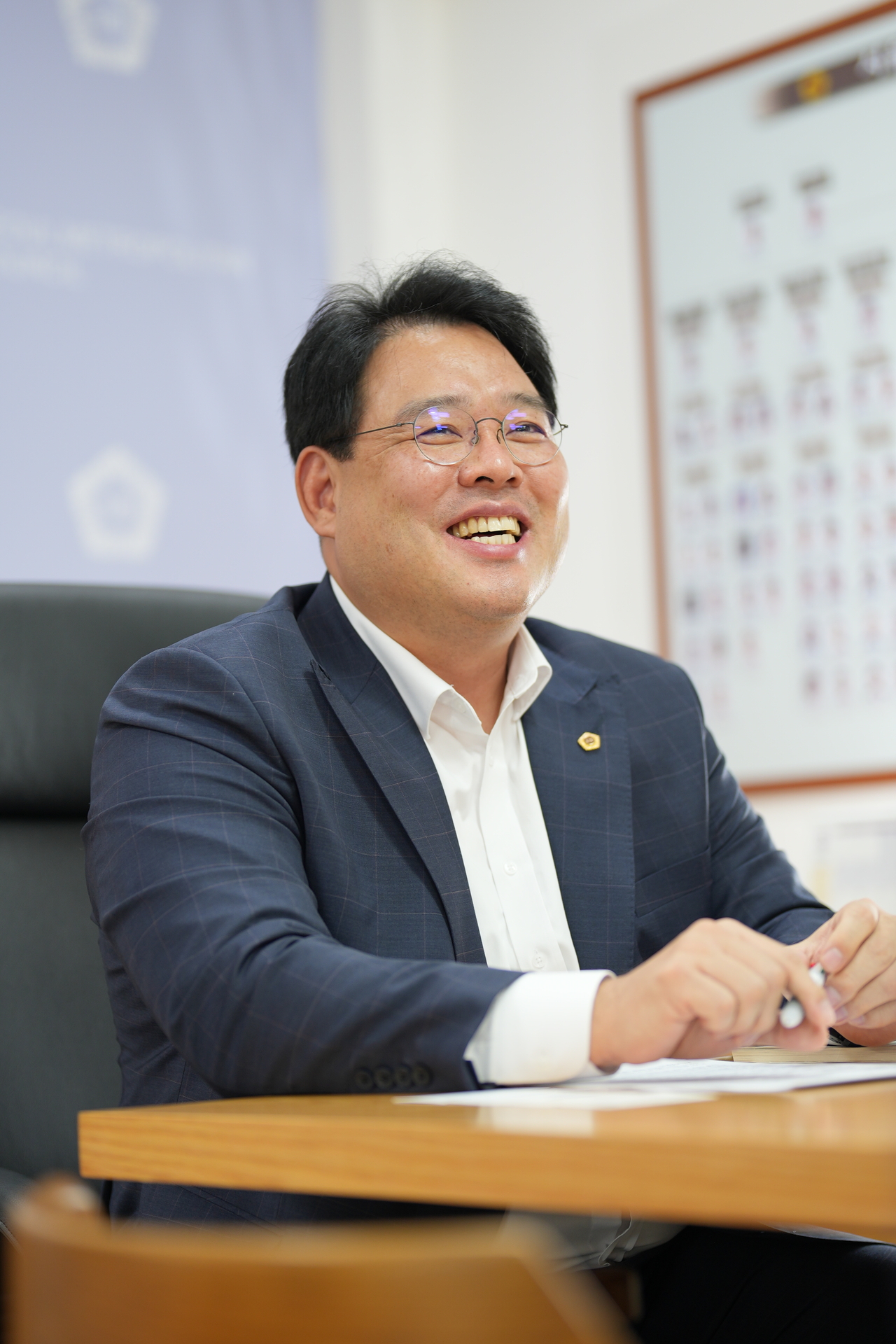
Lee Sung-bae, second deputy speaker of the Seoul Metropolitan Council and a People Power Party lawmaker representing Songpa's 4th constituency, understands the limits of being in a minority party better than most. He served in the 10th council, when his party held a mere six seats as a tiny opposition bloc, and in the 11th council, he chaired the Special Committee on Budget and Accounts and led the majority People Power Party as its floor leader. In the 12th council, he plays a key role in negotiations between the ruling and opposition parties and in council operations as deputy speaker of a minority ruling party with just 38 seats.
His solution is what he calls "persuasion with humility." Publicly pressuring the opposition alone, he said, cannot secure livelihood-related budgets and key policies. Building trust over time and diligently taking part in council work while persistently explaining why policies are needed is essential, he said.
"A minority ruling party is bound to be outnumbered by the opposition due to the seat structure, so we ultimately have to persuade them to get policies through," Lee said in an interview with The Herald Business at his office in the Seoul Metropolitan Council's main building on Tuesday. "To persuade them, we need good relationships, and to maintain good relationships, we need to diligently take part in all legislative activities, including standing committee sessions and meetings."
Unless he has a special schedule, he stays from morning meetings through the end of standing committee sessions. He said he now examines council issues more closely and has broadened his contact with fellow lawmakers compared with his time as floor leader.
Full cut to youth AI budget risks blocking future readiness
Lee expressed strong disappointment that the Seoul Metropolitan Council recently cut the entire budgets for a youth AI support project and a night economy revitalization project during budget deliberations. While the scale of an unnecessary or excessive project can be adjusted, he said, a complete cut that blocks a project's potential altogether should be reconsidered.
He said the youth AI support project, in particular, is not simply a welfare measure but a policy aimed at building the capacity to respond to future industries. How often and how skillfully young people use artificial intelligence, he said, can determine their competitiveness in job-seeking and entrepreneurship as well as their ability to perform their jobs.
"In the past, people worried that using calculators would weaken mental arithmetic skills, but now those who use calculators skillfully solve problems faster," Lee said. "AI is the same — we need to give young people the chance to fully experience its various functions and learn how to use them."
Because free services alone have limits in exposing users to advanced features, he said support is needed to allow young people to use paid AI services. He said fully cutting the Seoul Metropolitan Government's youth AI budget runs counter to policy direction at a time when the central government is emphasizing growth of the AI industry.
However, he said restoring the budget requires continuously meeting with opposition lawmakers to explain the project's effects. Rather than resorting to combative political language, he said, the focus should be on presenting concrete evidence of the project's necessity and the practical benefits young people would gain.
"Many lawmakers, regardless of party affiliation, agree on the need to cultivate AI talent and support young people," he said. "Rather than cutting off dialogue, I will keep meeting with them, explaining the policies, and finding reasonable common ground."
Night economy means culture, tourism, lifestyle — not entertainment industry
Lee said the night economy revitalization project also needs to be viewed from a broader perspective. Rather than limiting it to support for restaurants or entertainment venues, he said, it should be approached as a lifestyle-economy policy that enriches citizens' evening hours through nighttime exercise, cultural performances, tourism, shopping and family leisure.
Since the COVID-19 pandemic, nighttime culture centered on company dinners and drinking has declined, while demand for exercise, hobbies and family leisure has grown. He said Seoul's policies need to adapt to this shift in lifestyle.
"Seoul has many spaces where nighttime content can be created — the Han River, plazas, parks, traditional markets and special tourism zones," Lee said. "If we encourage citizens and tourists to enjoy festivals and performances in the evening and use nearby commercial districts, it will genuinely help the local economy."
As a prime example, he cited the media facade at the Shinsegae department store in Myeong-dong. He said citizens and tourists visit Myeong-dong to watch the display, and their use of nearby restaurants and shops before and after viewing spreads consumption across the wider commercial district.
"The night economy is not simply a policy of extending business hours," he said. "It is a policy that uses cultural and tourism content to extend the time people stay and channel that into spending in surrounding commercial districts." He added that the related budget should be discussed again to boost both Seoul's urban competitiveness and small-business sales together.
Housing problem's core issue is supply — redevelopment must move faster
Lee named housing supply as Seoul's most urgent issue. With few large tracts of land available for new development, he argued, the city needs to speed up reconstruction and redevelopment projects to secure a real increase in supply.
"It is a basic market principle that prices fall when supply increases and rise when it is scarce," Lee said. "Above all, we need to increase supply to stabilize housing in Seoul."
He took a cautious stance on converting public spaces for citizens, such as Yongsan Park, into housing sites. Once supply begins through the removal of park designations, he said, development pressure could spread to other parks and green spaces, so it would be better to expand supply in the city center by revitalizing existing redevelopment and reconstruction projects.
He said the Seoul Metropolitan Government has shortened permitting timelines through fast-track planning and Moa Town programs, but many projects still stall due to internal conflicts within associations or delays in administrative procedures. Since improvements by the city alone have their limits, he proposed that autonomous districts (gu) get involved as mediators between associations and the city from the early stages of a project.
"Rather than having association heads or contractors individually approach the city for consultations, we need to form a redevelopment support task force that includes district civil servants and experts," he said. "If districts review issues at each stage of a project in advance and accompany associations to consultations with the city, project timelines can be shortened considerably."
He also called for expanding a redevelopment coordinator system. In areas where complex conflicts of interest among union members have caused projects to stall for long periods, he said, the public sector should actively step in to mediate disputes and guide administrative procedures.
"Even if residents have agreed to move forward with a project, if establishing a management plan and other steps take more than a year, residents' views can change due to relocations, generational turnover, or shifts in the market," Lee said. "Since new conflicts tend to emerge as time passes, projects should move quickly once residents have reached a consensus."
Three reviews for Jamsil Jugong Complex 5 — problem-solving experience from the field
Lee's housing policy ideas grew out of his direct experience supporting a reconstruction project in Songpa. Jamsil Jugong Complex 5 went through three rounds of Urban Planning Committee review as it worked through issues including school land, land owned by the Ministry of Economy and Finance, retention of an existing school, and the application of fast-track planning.
"Getting a large-scale reconstruction project through even one Urban Planning Committee review is not easy," he said. "Jamsil Jugong Complex 5 passed three reviews by resolving, one by one, issues involving the relocation of school land, retention of an existing school and the application of fast-track planning."
The reconstruction of Jamsil Woosung Apartments 1, 2 and 3 and the Moa Town project in Jamsilbon-dong have also been major issues on which he has consistently communicated with residents. He said he provided practical support to keep the projects on schedule, including urging residents to file applications promptly and directly taking part in the city's review process.
"Reconstruction is not a problem that gets solved by showing interest only around election time," Lee said. "We have to meet with associations, residents and the city government regularly and find solutions whenever issues arise in order to keep projects moving forward."
His experience chairing the Special Committee on Budget and Accounts also helped him resolve constituent complaints. Because he understands how budgets are formed and executed, he said, he could quickly identify the department responsible and the funding needed to propose solutions once a complaint was filed.
"Rather than just saying 'I'll look into it' after hearing a complaint, I approach it with the intent to solve it," he said. "Even when an issue is difficult to resolve right away, thoroughly checking every possible administrative procedure and alternative is a matter of respect for residents."
From proportional representative to reelected district lawmaker — the era of 'straight-ticket voting' is over
Lee entered the 10th council as a proportional representative and was then elected twice in a row in the Songpa 4th constituency. Through that process, he said, he came to feel that so-called "straight-ticket voting" — in which voters choose candidates based on party alone — is gradually weakening.
While party support still has a major influence on elections, he said, what a lawmaker has actually accomplished locally and how faithfully they have addressed residents' complaints have become important criteria in choosing a candidate.
"There is no special trick to being a district lawmaker. The most important thing is the basics — carefully attending to local affairs and keeping promises made to residents," Lee said. "Rather than showing your face only ahead of an election, you need to consistently visit senior centers, resident self-governance committees and local events throughout all four years."
He said lawmakers should neither neglect areas where support is strong nor give up on areas where it is weak. Visiting every neighborhood in person, listening to complaints, and answering with budgets and policies builds up over time into political trust, he said.
Becoming a three-term lawmaker has also broadened his view of council work, he said. As a first-term lawmaker he focused on learning systems and procedures; as a second-term lawmaker he led major policies and budgets; now, he said, he can take in the varied positions of fellow lawmakers and the overall flow of the council.
"Now that I am serving a third term, I can advise junior lawmakers comfortably and take on a mediating role that would have been difficult during my second term," he said. "I feel the weight of responsibility that comes with being a three-term lawmaker."
Since becoming deputy speaker, his schedule has been packed into 30-minute blocks throughout the day. He tries to attend standing committee site visits, Special Committee on Budget and Accounts meetings and various council events in person as much as possible to increase communication with fellow lawmakers.
Lee described this approach as "politics run like sales work." To push a policy forward, he said, one has to meet the other side and explain it, and building personal trust in ordinary times is what keeps the door to dialogue open even in difficult negotiations.
Aiming for policies judged well 10 years from now, not just popular today
Lee stressed that a policy's success should not be judged solely by its immediate reception. A policy that draws praise now but becomes a burden on the city 10 years later is a mistaken policy, he said, while one that is controversial today but raises Seoul's long-term competitiveness is worth pursuing.
He cited Nodeul Island and urban regeneration projects as examples. Had an earlier plan to build cultural facilities on Nodeul Island continued, he said, the island could have grown into a world-class cultural destination. He said urban regeneration should not be applied uniformly without considering an area's physical environment and residents' living conditions.
"Europe's old buildings, built mainly of stone, often last for centuries, but Seoul's aging low-rise residential areas face both convenience and safety problems," Lee said. "We need to clearly separate areas that should be preserved from those that need development, and focus our efforts accordingly."
He said applying regeneration projects that focus only on exterior renovation to aging, steeply sloped residential areas cannot fundamentally solve the mobility and housing-safety problems faced by elderly residents. The appropriate approach — regeneration or redevelopment — should be chosen based on each area's characteristics, he said.
Lee said that over the next two years, he will focus on building a council in which individual lawmakers' capabilities are fully realized, rather than one in which he himself stands out. He said the council leadership should act as facilitators so that the fresh perspectives of first-term lawmakers and the experience of second- and third-term lawmakers can come together, centered on standing committees.
"Seoul city council members' expertise, policy capacity and attitude toward citizens have improved greatly compared with the past," he said. "Supporting lawmakers so they can fully exercise their abilities in legislation, budget review and administrative audits is the most important responsibility I now carry."
"Rather than setting grand political goals first, I will do my best with the tasks in front of me each day," he added. "If we keep the promises made to citizens and solve local problems one by one, those results will add up and lead to change across Seoul."
7toy7@heraldcorp.com




