Seoul Metropolitan Council's PPP caucus holds policy meeting with education office ahead of 340th regular session; reviews AI assessment system, Goryeo palace exhibition hall and other new initiatives
Kim Gil-young, floor leader, says strengthening public education fundamentals must come first
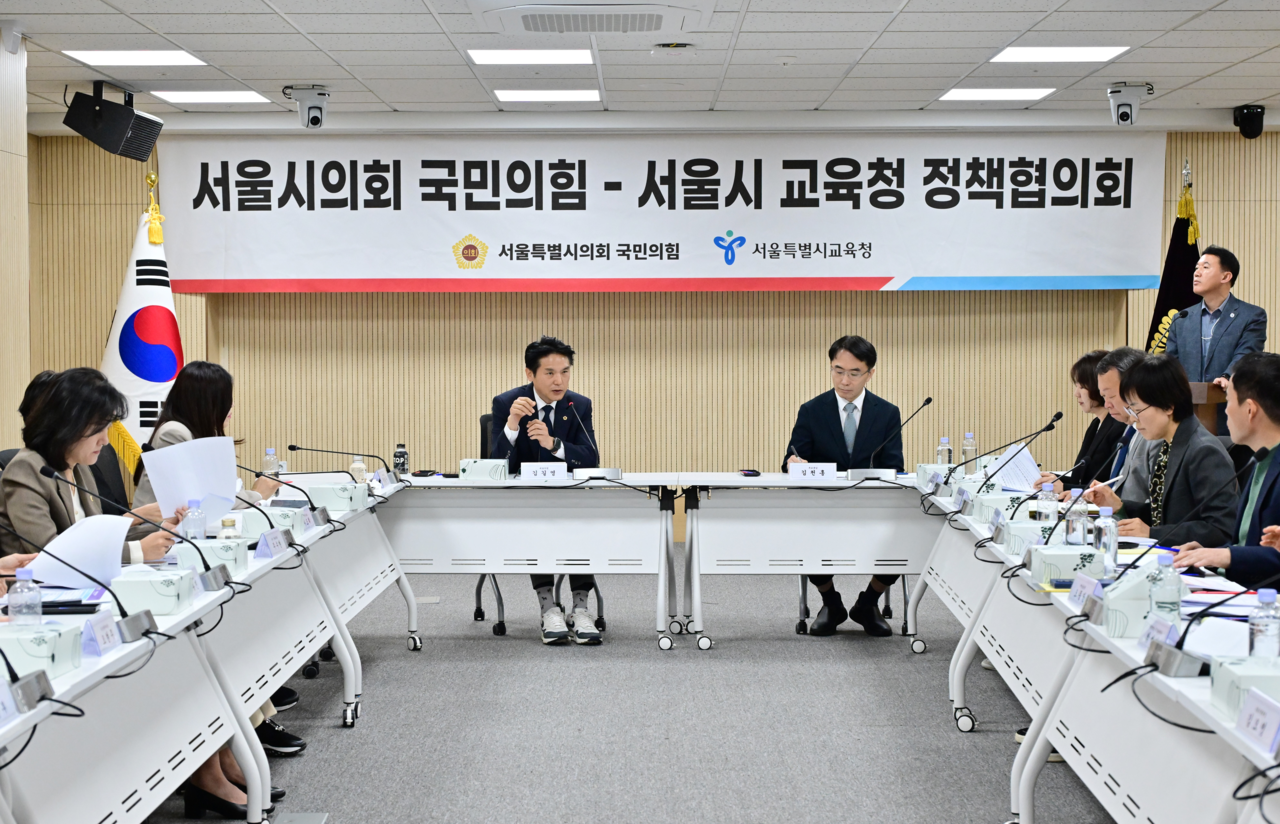
The People Power Party caucus of the Seoul Metropolitan Council has launched a review of the Seoul Metropolitan Office of Education's key policies and new projects ahead of the 340th regular session. The caucus is scrutinizing the feasibility of budget-intensive initiatives — including the construction of an AI-based assessment system and an exhibition hall at the Goryeo palace site of Manwoldae in Gaeseong — while calling on education authorities to concentrate their efforts on urgent classroom problems such as declining basic academic skills and weakening teacher authority.
The PPP floor leadership held a policy meeting with the Seoul Metropolitan Office of Education on Monday to review education issues in preparation for the administrative audit and deliberation of ordinance bills scheduled for the 340th regular session.
The meeting focused on agenda items submitted by the education office for the regular session, with participants discussing the necessity of each policy, the efficiency of budget use and the impact on schools. Particular attention was paid to whether the expansion of new projects would translate into genuine improvements in students' right to learn and their educational environment.
The floor leadership said it plans to closely examine proposals for large-scale in-house system development — assessing the risk of overlap with existing systems, post-implementation operating costs and educational effectiveness. Proposals for private-sector outsourcing agreements, the creation of new organizational units and staff increases will also be evaluated against objective criteria, with the aim of identifying reasonable alternatives.
The most contentious issue was the education office's plan to overhaul its essay and descriptive assessment framework and introduce an AI-based evaluation system.
Deputy floor leaders Choe Jong-bu, Lee Do-hee and Ju Su-hyeon said they supported the idea of applying AI technology to educational assessment in principle, but called for careful review of whether the system would deliver the expected results in actual school settings.
Choe said the overhaul of the assessment method should not be limited to simply reducing student ranking pressure. He said it was particularly problematic that if AI drafts initial scores for essay and descriptive answers but teachers must still review and revise them, the workload-reduction benefit could be limited.
The plan to build an exhibition hall at the Manwoldae site of the Goryeo palace in Gaeseong was also placed under review.
Deputy floor leader Oh Hyeon-ju said the timing of the project and the prioritization of fiscal resources needed to be carefully weighed in relation to the plan to build and privately operate a permanent exhibition hall dedicated to the Goryeo palace site at Manwoldae in Gaeseong.
Regardless of the project's stated aims of historical education and cultural heritage preservation, Oh said it was necessary to verify whether building a separate exhibition facility and operating it through private outsourcing was appropriate at a time when schools face a backlog of pressing challenges.
The floor leadership also said it would comprehensively examine the education office's major initiatives — including publicly supported lifelong education programs — looking at their stated objectives, operational structures and fiscal burden. The caucus said it intends to assess the necessity of new policies based on actual educational demand and practical utility in schools, rather than on the outward scale of expansion.
The policy meeting also carried significance as a gauge of the direction the administrative audit during the regular session will take. The PPP said it will focus on verifying whether the education office's policies are being carried out in line with their original goals and whether the limited education budget is delivering tangible benefits to students.
The caucus identified declining basic academic skills and weakening teacher authority as priority issues to be resolved in order to restore public confidence in education. It said evaluating the outcomes of existing policies and addressing difficulties in schools is just as important as introducing new ones.
"This regular session is an important opportunity to confirm whether the education office's major projects are genuinely contributing to strengthening students' future capabilities and improving the quality of public education," floor leader Kim Gil-young said. "We will work closely with the relevant standing committees to ensure the education office's resources are directed first toward solving the urgent problems in our schools — declining basic academic skills and weakening teacher authority — and we will propose effective policy alternatives while safeguarding the political neutrality of education."
Based on the discussions from the meeting, the PPP caucus of the Seoul Metropolitan Council said it will use the regular session's administrative audit and bill deliberations to intensively examine the appropriateness of education policies, the accountability of fiscal management and the tangible impact felt in schools.
7toy7@heraldcorp.com