
Existing promotion criteria to remain after merger
Korean Air says over 90% of pilots to advance faster
Union demands priority over Asiana pilots
Management rejects call to disregard Asiana pilots' experience, qualifications
Wage, rest-time issues near agreement
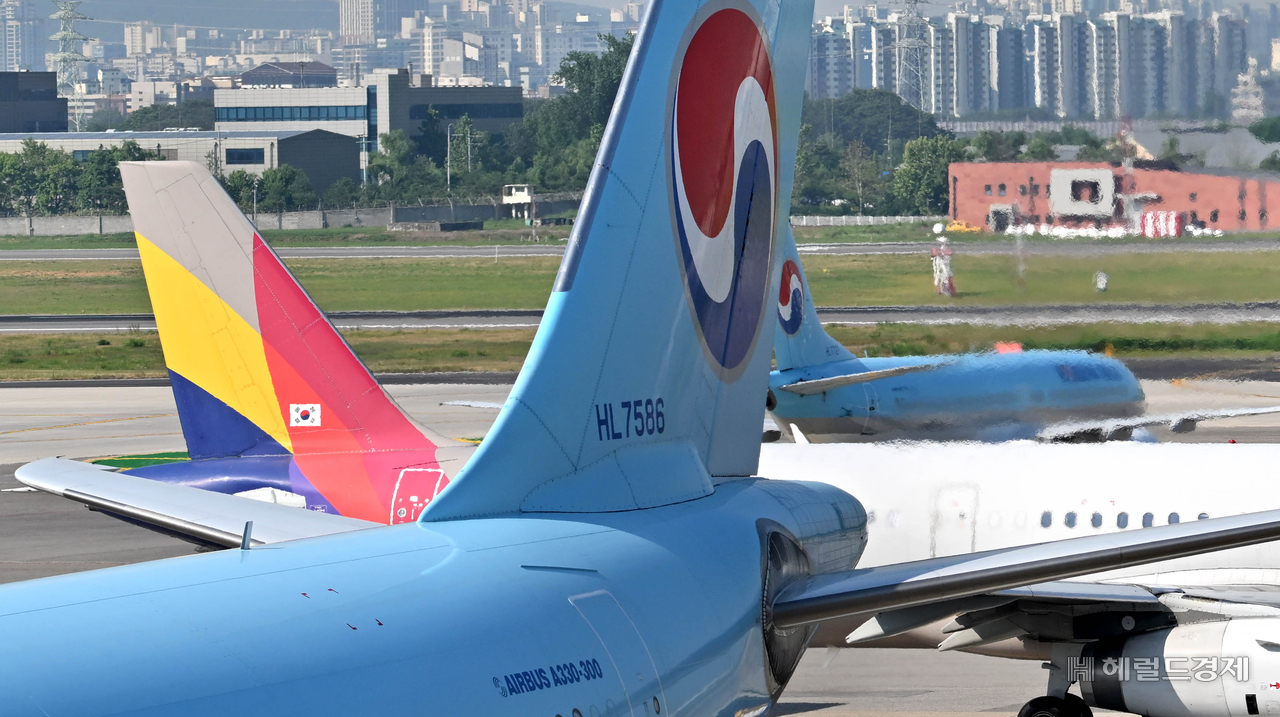
As Korean Air and Asiana Airlines prepare for their merger, labor tensions over pilot promotion seniority are intensifying. Korean Air continues to maintain that existing pilots will face no disadvantages, as their promotion requirements and internal seniority will remain unchanged after the merger. The pilots' union, however, maintains that Korean Air pilots should be ranked ahead of those from Asiana Airlines.
According to industry sources on Tuesday, the Korean Air Pilots Union (KAPU) filed for labor dispute mediation with the Seoul Regional Labor Relations Commission on Monday. The filing came after negotiations over the 2024 collective bargaining agreement and 2025 wage agreement failed to reach a final settlement.
The dispute centers less on wages than on the pilot promotion order that will apply once the merged carrier is launched. Korean Air maintains that no pilots will face a disadvantage in promotions. It plans to preserve current Korean Air pilots' captain promotion requirements and their internal relative seniority throughout the integration process.
The company analyzed future promotion timelines based on the merged airline's fleet size and captain staffing needs. It found no Korean Air pilots whose captain promotions would be delayed beyond initial projections. In fact, more than 90 percent of pilots are expected to be promoted earlier than they would have been before the merger, according to Korean Air.
"Through outside consulting and other measures, we have devised an objective and reasonable promotion seniority plan that avoids any disadvantage to Korean Air pilots while minimizing conflict between pilots from both carriers," a Korean Air official said.

The union is demanding that Korean Air pilots be placed uniformly ahead of their Asiana counterparts in the seniority ranking. To that end, it is also calling for Asiana pilots' existing flight experience and qualifications to be excluded when calculating promotion seniority.
Korean Air argues that accepting such demands could spark fresh conflict during the integration process.
The company plans to preserve each carrier's existing internal seniority structure as much as possible after the merger. Currently, Korean Air has an average nine-month gap in promotion seniority between pilots with military backgrounds and those with civilian flight experience. Asiana Airlines has an average four-year gap under the same standard. Korean Air has decided to maintain each carrier's respective internal seniority system after the merger.
As a result, a civilian-background pilot who joined Korean Air with 1,000 flight hours will be promoted to captain sooner than one who joined Asiana Airlines with 300 flight hours. The gap averages three years and three months. Korean Air stressed that the merger will not push back the promotion of its existing civilian-background pilots.

The two sides also disagree over the interpretation of Article 24 of the collective bargaining agreement, which the union cites as its basis for the demand. The union cites language in the clause stating that "the company shall comply with the flight crew seniority ranking system determined by labor-management agreement." It argues that this means the promotion order must be set through negotiation between labor and management.
Korean Air rebuffed this, saying the clause effectively lost its force after being voted down at a union general meeting in 2003, with no new agreement reached since. The company also pointed to a 2004 case in which the union sought an injunction based on the same clause during collective bargaining. The court rejected the injunction, ruling that authority over personnel matters such as captain promotions rests with the employer.
Management also said the union's claims regarding captain promotion requirements, known as FOAM, do not reflect the facts. It said that after the merger, Asiana Airlines pilots will be subject to the same captain promotion requirements as Korean Air pilots. These include the same training and evaluation standards Korean Air currently applies to its own pilots.
Meanwhile, according to industry sources, labor and management have reached broad agreement on other collective bargaining issues, including wages and rest time. The union is seeking a 3.3 percent wage increase, an expanded 30-hour local rest period after flights of 10 hours or longer, and changes to how flight allowances are calculated.
"The captain promotion order is a matter of inherent personnel authority that rests with the employer, to be determined under reasonable standards," a Korean Air official said. "The union is trying to push through a matter that cannot be subject to dispute mediation by making it appear that the conflict extends to other bargaining issues as well."
The union plans to hold rallies from Monday to Sept. 20 at Korean Air's headquarters and Incheon International Airport's Terminal 2, among other locations. If mediation by the labor commission fails, the union could secure the legal right to strike based on the results of a strike vote it has already conducted.
kwater@heraldcorp.com



