105 agencies moved in first round at cost of 9.18 trillion won
Actual spending exceeded plan by around 650 billion won
Second round covers three times as many agencies; simple projection puts cost at 30 trillion won
14 agencies have lease contracts extending past 2030
![Prime Minister Han Seong-sook holds a press conference at Government Complex Seoul in Jongno-gu, Seoul, on Thursday to announce plans for the relocation of administrative and public institutions and reform of public agency functions. [Yonhap]](https://wimg.heraldcorp.com/news/cms/2026/09/04/rcv.YNA.20260903.PYH2026090309180001301_P1.jpg)
With the government announcing a "minimum retention" policy for public agencies remaining in Seoul, analysts warn that lease termination costs alone could run into the hundreds of billions of won — and that the total fiscal burden of a second round of relocations could far exceed initial estimates. The first round cost more than 9 trillion won to move 105 agencies, already surpassing the original budget by more than 640 billion won. Applying that per-agency cost to the roughly 350 institutions targeted in the second round puts a rough estimate at around 30 trillion won.
First round cost 6.15 billion won more per agency than planned — second round could cost three times as much
The government plans to announce its second-round relocation schedule in the fourth quarter of this year, targeting more than 350 public agencies in the greater Seoul area, according to related ministries. That is more than three times the 105 agencies moved in the first round.
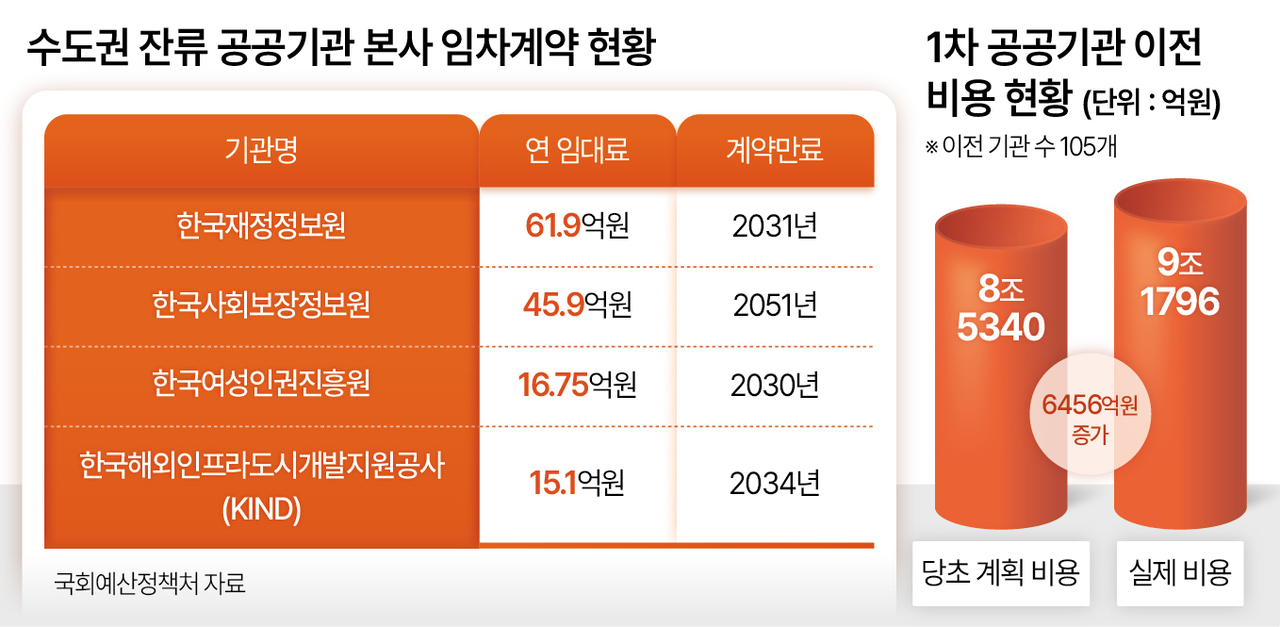
The larger pool of agencies raises the prospect of significantly higher costs. According to the National Assembly Budget Office, the originally planned total project cost for the first round was 8.53 trillion won, but actual spending reached 9.18 trillion won — an increase of about 645.6 billion won. On a per-agency basis, average spending came in 6.15 billion won above plan.
The overruns were driven by factors beyond the originally budgeted construction of new office buildings — among them changes in the number of relocating staff, relocation support payments, and increases in floor area and construction costs. Project timelines also stretched an average of 28.6 months beyond original schedules on a per-agency basis.
With more than 350 agencies in scope — over three times the first-round total — analysts say total project costs could rise sharply depending on the scale and method of relocation. Applying the per-agency spending from the first round to all 350 institutions yields a rough projection of about 30.6 trillion won.
"The first round was a long-term plan with ample lead time built in," a government official said. "This round is set to move quickly starting next year, so if regions begin competing aggressively to attract agencies, additional costs could balloon." The official added that expanding the pool of relocating staff and enlarging existing innovation cities could push total costs to roughly three times what was spent in the first round.
Lease penalties could reach hundreds of billions of won — analysts say first-round cost-benefit review should come first
Lease termination costs are emerging as another major variable. A significant number of public agencies that rent their headquarters in the greater Seoul area have signed long-term lease agreements. Under the Act on the Management of Public Institutions, 14 agencies — including the Korea Foundation for International Healthcare, the Korea Social Security Information Service, and Korea Overseas Infrastructure and Urban Development Support (KIND) — have lease contracts running past 2030, with the longest expiring as late as 2051.
According to data submitted by the agencies to the National Assembly Budget Office, the combined annual rent for the 14 institutions totals about 26.83 billion won. While actual damages from early termination will vary by contract depending on penalty clauses, even a simple calculation based on annual rent suggests costs could reach hundreds of billions of won.
"The specific costs can only be determined after each agency draws up a relocation plan and the relevant ministries review it," a Ministry of Land, Infrastructure and Transport official said. "For agencies that cannot relocate immediately, we will make reasonable adjustments taking each institution's circumstances into account."
![Site preparation work is underway at the planned location of the presidential Sejong office and the National Assembly's Sejong chamber. [Yonhap]](https://wimg.heraldcorp.com/news/cms/2026/09/04/rcv.YNA.20260903.PYH2026090316410001300_P1.jpg)
Alongside the push for a second round of relocations, some experts say a comprehensive review of the costs and outcomes of the first round is overdue. While the first round aimed to stimulate regional economies and promote balanced national development, they argue that an objective assessment of its actual impact — factoring in costs, employee commuting burdens, and residential disruptions — must underpin any further moves.
The innovation cities that received agencies in the first round have seen net population outflows since 2025. The growth in the greater Seoul area's share of the national population slowed temporarily through the mid-2010s, but inflows from the capital region to innovation cities began declining after 2017. The trend has since reversed, with more people now moving back toward Seoul and its surroundings.
"Now that the first round of public agency relocations is complete, we need to take a comprehensive look at the economic revitalization effects and the costs involved," a former senior government official said. "An analysis of the first round's outcomes is essential to ensuring that the relocation of public agencies actually translates into regional economic growth — and to making the next round more efficient."
hss@heraldcorp.com