
Data from DNV's 'Maritime Forecast to 2050' report shows the share of alternative-fuel vessel orders fell to 39.3% from 49.5% the previous year, as shipowners hold back amid uncertainty over IMO regulations. DNV projects eco-friendly orders could rebound as early as 2029.
![An LNG-powered bulk carrier. (Photo is not directly related to this article.) [Provided by Korea Ocean Business Corp.]](https://wimg.heraldcorp.com/news/cms/2026/09/01/news-p.v1.20250228.b46124520c82459c9033fb0bbba9eb70_P1.jpg)
Global orders for eco-friendly vessels are expected to resume as early as three years from now after a brief pause, according to a new industry analysis. The slowdown has been driven in part by delays in establishing international environmental regulations, as the United States under the current administration has pushed back against green shipping policy, prompting shipowners worldwide to hold off on placing orders.
Why the drop in green ship orders may not be cause for alarm
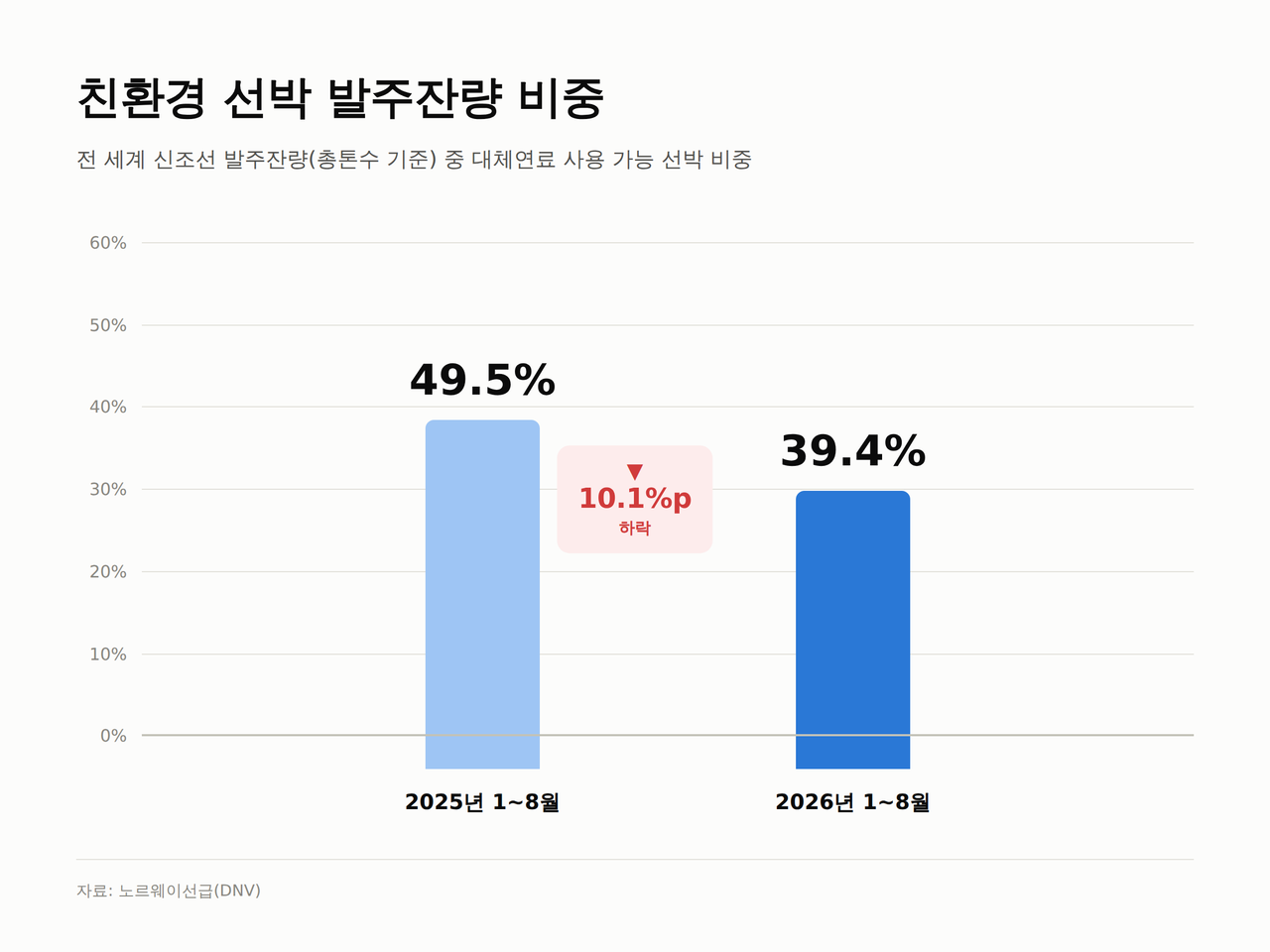
According to DNV's "Maritime Forecast to 2050" report released Tuesday, alternative-fuel vessels — commonly referred to as eco-friendly ships — account for 39.4% of all vessels currently on order worldwide, down roughly 10 percentage points from 49.5% the previous year. In practice, 137 eco-friendly vessels have been ordered so far this year, an 11.6% decline from the year before.
However, DNV said the drop does not reflect a decline in underlying demand, but rather a decision by global shipping companies to delay the timing of their orders. "This decline in orders is partly due to regulatory uncertainty," DNV said, adding that "many shipowners have postponed ordering decisions until there is clearer direction on the International Maritime Organization's net-zero framework."
DNV added that recent orders have been increasingly dominated by tankers and bulk carriers, vessel types with lower rates of alternative-fuel adoption. Of late, orders have been gravitating toward ships subject to comparatively looser environmental standards.
IMO delayed regulations after Trump called them a 'Green New Scam'
The IMO had originally planned to finalize its greenhouse gas reduction regulatory framework last year, but shelved the effort in the face of US opposition. The organization had been set to adopt a "net-zero framework" in October last year that would have imposed full emissions controls on the shipping industry by 2050 and levied fines on non-compliant carriers. US President Donald Trump, citing concerns about the burden on American shipping companies, called the framework a "Green New Scam" and pressured the IMO, ultimately causing discussions to collapse on the day of the meeting.
DNV projected that IMO regulations would not be ready until 2029 at the earliest. "The process of negotiating, approving and circulating new legal text requires at least six additional months after adoption," DNV said. "This means the earliest possible date for the regulations to enter into force is 2029."
DNV added that negotiations could extend beyond 2026, in which case the effective date would be pushed back further. If disagreements among IMO member states persist, the regulations could be delayed until as late as 2032 — after which a surge in eco-friendly vessel orders could follow, DNV said.
China's advancing shipbuilding technology warrants close watch
How far China's shipbuilding capabilities will have advanced in a few years is also a key variable. Chinese shipyards have historically built eco-friendly vessels mainly for domestic clients, but they have recently accumulated enough technical expertise to win a growing number of overseas contracts. A state-owned shipping company from the UAE recently commissioned two LNG carriers worth $444 million from China's Jiangnan Shipyard.
"Domestic shipyards are so backlogged with orders, and Chinese eco-friendly shipbuilding technology has improved so much, that shipping companies are now actively placing orders with China," an industry official said. "It is hard to say South Korea's edge in eco-friendly vessels is still secure."

klee@heraldcorp.com



