![An aerial view of the innovation city in Jung-gu, Ulsan, where Korea East-West Power and other public institutions are located. This photo is unrelated to the article. [Provided by Jung-gu District Office, Ulsan]](https://wimg.heraldcorp.com/news/cms/2026/08/25/news-p.v1.20260819.beaa6f84c56b48099ce4d111c81c1867_P1.png)
What good is being designated an innovation city? Those who bought commercial units are seeing negative premiums of 30 to 40 percent, and the properties are going to auction. This place is hell.
As the government's second round of public institution relocations comes under scrutiny, complaints from first-round relocation sites continue to mount — falling real estate transactions, vacant storefronts and a growing sense that the promised benefits of balanced regional development have yet to materialize. Critics say that simply moving jobs without ensuring employees fully relocate their families does little to revitalize local economies.
Govt eyes second round of relocations as first-round sites still cry 'hell'
The government is preparing to announce the criteria for selecting public institutions to be moved in the second round of relocations, according to government sources Tuesday. During the first round in the early 2000s, a special committee on public institution relocation drew up standards for which agencies would move and which would stay, reviewing 180 to 200 of the 268 public institutions based in the greater Seoul area as candidates for relocation. Final decisions on whether each institution would move — and where — were made after deliberation by the Presidential Committee for Balanced National Development. The government is now understood to be scrapping all of those earlier criteria and starting from scratch to develop new standards.
Yet in areas where the first round of relocations has already been completed, frustration is running high over the lack of any tangible "balanced development" effect. Even where jobs have moved, living conditions have not improved enough to attract residents, and commercial vacancy rates have continued to climb — leaving locals with little sense of economic progress.
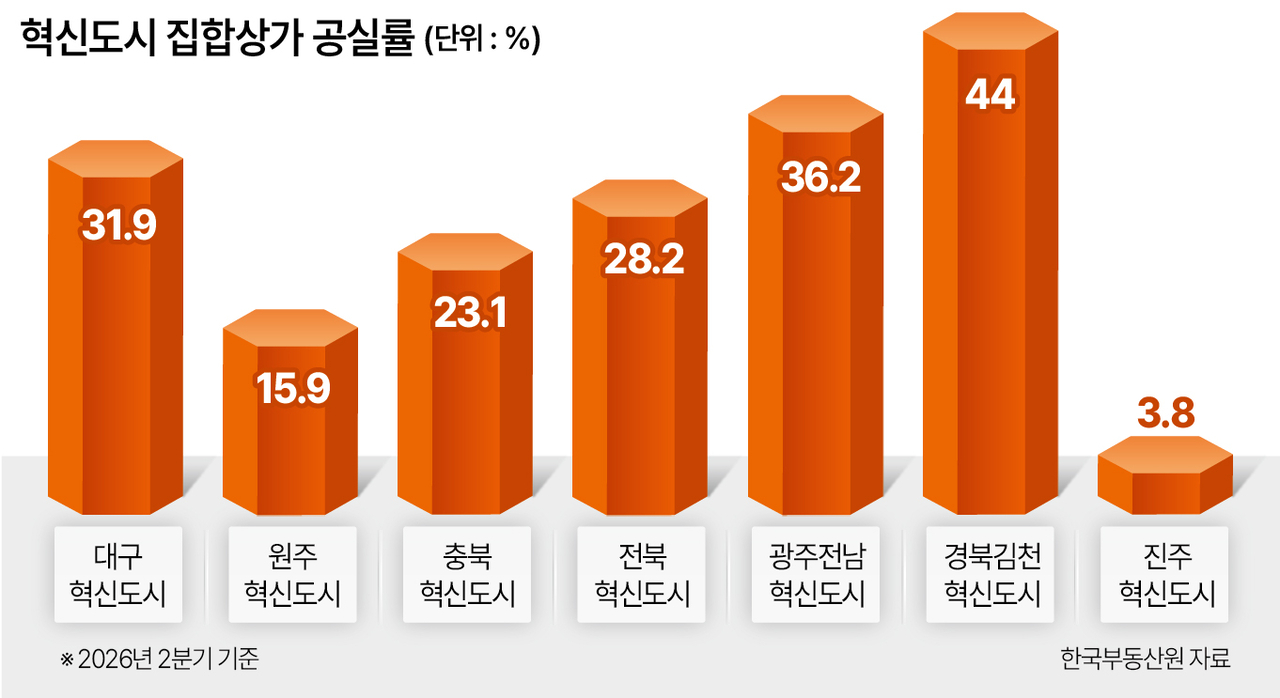
The Gwangju-Jeonnam innovation city is a prime example. According to the Korea Real Estate Board, the vacancy rate for commercial properties there stood at 36.2 percent in the second quarter of this year, up 0.2 percentage points from 36 percent in the first quarter. The rate had reached 39.2 percent in the third quarter of 2024, prompting the Naju city government to make reducing vacancies a campaign pledge — yet nearly four in 10 units remain empty.
A real estate agent in Bitgaram-dong, the neighborhood within Naju where the Gwangju-Jeonnam innovation city is located, said those who bought commercial units are barely holding on. "It's not just a matter of high vacancy rates — here in the Naju innovation city, people are giving up on their livelihoods one after another," the agent said.
An already sluggish real estate market has been further constrained by the government's designation of the area as a land transaction permit zone. The government had announced plans to develop a large-scale advanced semiconductor industrial complex — dubbed a "mega project" — on the site of a relocated military airfield in Gwangju and surrounding areas. To block outside speculators from rushing in on the back of that development news, it designated Naju's Bitgaram innovation city, Nampyeong-eup and Geumcheon-myeon as land transaction permit zones, requiring official approval for property purchases.
Another real estate agent in Naju said the designation has made an already difficult market nearly impossible to navigate. "Transactions were already dead, and now the land transaction permit zone has made things even harder," the agent said. "The only buyers you occasionally see are newlyweds who are forced to buy because there are no jeonse and monthly rent options available. There is no investment demand coming into this area no matter how much it's called an innovation city — I simply cannot understand why they are imposing these regulations."
The situation is similar across other innovation cities. The vacancy rate for commercial properties in the Gimcheon innovation city in North Gyeongsang Province has reached 44 percent, rising consistently since 2024 to hit an all-time high. Vacancy rates at other sites stand at 31.9 percent in Daegu, 15.9 percent in Wonju, 23.1 percent in North Chungcheong Province, 28.2 percent in North Jeolla Province and 3.8 percent in Jinju.
Family relocation rates drop to around 50% outside Busan and Jeju — experts stress medical, cultural infrastructure
The high vacancy rates stem in large part from the difficulty employees face in relocating their entire families, even when their jobs have moved.
Data submitted by the Ministry of Land, Infrastructure and Transport to the office of People Power Party lawmaker Jeong Hui-yong show that as of June 30 this year, 71.1 percent of employees at relocated public institutions had moved — either with their families or as single-person households. Excluding Busan, which posted the highest relocation rate at 86.4 percent, and Jeju Island at 82.4 percent, the average rate across all other regions falls to just 68.2 percent. That means roughly 30 percent of employees still keep their primary residence in Seoul or commute from the greater Seoul area.
![The central building of Government Complex Sejong [Yonhap]](https://wimg.heraldcorp.com/news/cms/2026/08/25/news-p.v1.20260805.f25f1c3c55e64a05a36740229ffe47b6_P1.jpg)
The rate was even lower among married employees who relocated with their families. Across all relocated institutions, only 60.6 percent of married employees had moved with their families — a figure that drops to 56.7 percent when Busan and Jeju Island, which are geographically distant from the Seoul area, are excluded. Barely half of married workers have put down roots near their new workplaces.
Experts say relocating public institutions alone is not enough to achieve balanced national development. Improving living conditions — including medical and cultural infrastructure — must go hand in hand with any relocation effort if regional populations and economies are to be revitalized.
Kim Jin-yu, a professor of urban and transportation engineering at Kyonggi University, said a thorough assessment is needed of what infrastructure would actually satisfy employees who relocate with their families. "If the medical and cultural infrastructure found in the greater Seoul area is not replicated, it will be hard to live there no matter how many apartments are built," Kim said.
Kim also stressed the importance of developing public institutions in concentrated clusters. "For a cluster to generate economies of scale in a given region, relocations cannot be parceled out piecemeal to individual local governments — what is needed is the creation of cluster-type innovation cities," he said.
hss@heraldcorp.com