New minimum support payment and advance payment systems introduced
Shortfall coverage added for victims who recovered less than a third of deposit
LH to notify applicants of payment decision within 90 days
![[Yonhap]](https://wimg.heraldcorp.com/news/cms/2026/10/06/news-p.v1.20250417.2630e741d0574c848756210fe0b814eb_P1.jpg)
Starting Nov. 13, jeonse fraud victims will be guaranteed the return of at least one-third of their lease deposit through newly introduced minimum support payments and advance payments.
The Ministry of Land, Infrastructure and Transport said Tuesday that a partial amendment to the enforcement decree of the Special Act on Support for Jeonse Fraud Victims and Residential Stability was approved at a Cabinet meeting.
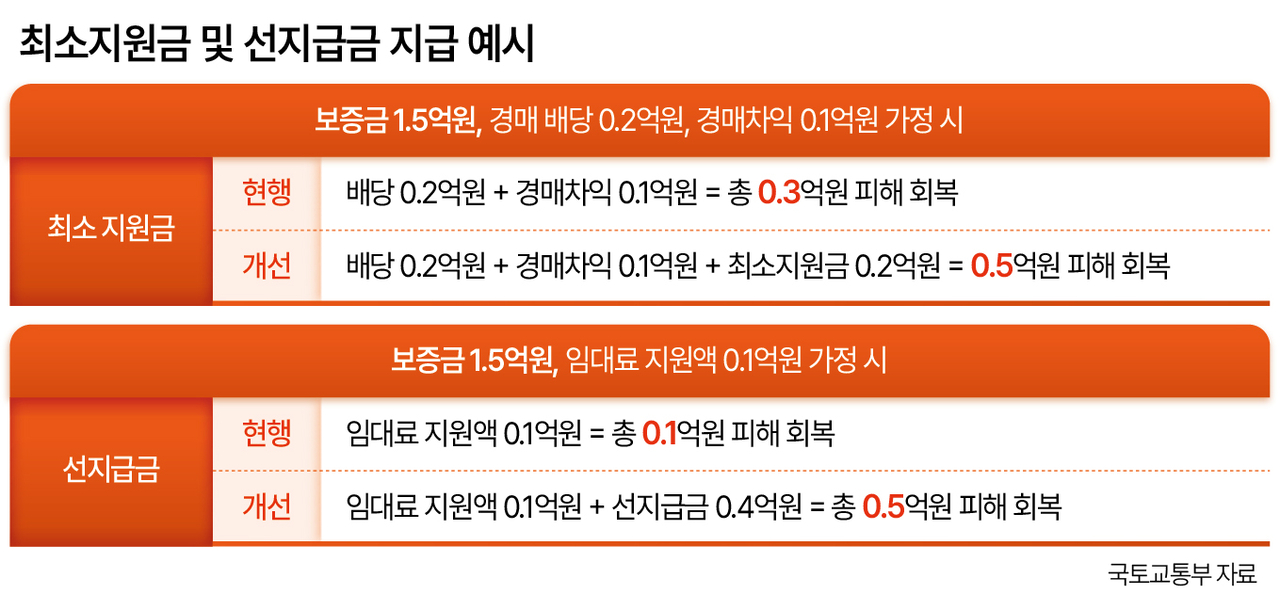
Under the amendment, a minimum guarantee system will take effect that covers the shortfall when a victim's recovered amount — after the completion of a court-ordered auction or public sale — falls short of one-third of the original lease deposit. The minimum support payment is calculated by subtracting from the guaranteed minimum amount any funds already recovered through priority repayment rights or preferential reimbursement rights under the Housing Lease Protection Act, amounts repaid through lease deposit return bonds, and any auction surplus proceeds or rental support already received.
For example, a victim who lost a 150 million won ($110,000) deposit to fraud and recovered 20 million won through auction dividends and 10 million won in auction surplus proceeds — previously limited to 30 million won in total recovery — would receive an additional 20 million won in minimum support payments under the amended decree, bringing total recovery to 50 million won.
In addition, a "pay first, settle later" system will be introduced for victims of trust fraud and other cases involving unauthorized contractors. The advance payment is disbursed before the completion of an auction or public sale, and is calculated by deducting from the guaranteed minimum amount any repayments made through lease deposit return bonds and rental support paid prior to the advance disbursement. A settlement process will allow for adjustments based on any additional amounts recovered after the advance payment is made.
A victim who lost a 150 million won deposit to fraud and had previously been eligible to receive only 10 million won in rental support will now be able to recover 50 million won in total through a 40 million won advance payment.
The amendment also sets out detailed procedures for applying for and receiving the minimum support payment and advance payment, covering application timing, required documents, disbursement, appeals and repayment. The Korea Land and Housing Corporation (LH) will be entrusted with handling the related administrative and settlement work.
Victims may apply for the minimum support payment after the auction surplus calculation is complete, if they have requested LH to purchase the affected property, or after the disposal process for the property is otherwise finalized. Applications for the advance payment must be submitted before LH completes its purchase of the affected property or before the property's disposal is finalized.
Applicants must submit a victim determination notice, a copy of the lease contract, a resident registration abstract, a certified copy of the property register, an auction dividend table or distribution statement, and documents related to repayment of the lease deposit return bond. Those unable to apply in person due to illness or overseas residence may designate a representative.
LH must notify applicants of its payment decision and the amount within 90 days of receiving an application. Applicants who dispute the decision or the amount may file an appeal within 30 days of receiving the notification, in accordance with Article 36 of the Framework Act on Public Administration. LH may extend the notification deadline by up to 30 days once in unavoidable circumstances.
The amendment also establishes a procedure requiring recipients to report and return any minimum support or advance payments if grounds for repayment arise — such as recovering the lease deposit after receiving the funds. Fines of up to 30 million won, scaled to the number of violations, will apply to those who fail to return the funds within the designated period.
To facilitate the smooth purchase of properties affected by jeonse fraud, the amendment also clarifies the criteria for real estate investment companies that local governments may support on behalf of jeonse fraud victims. When a public housing operator acquires a jeonse fraud property through auction or public sale and assumes the obligation to return the deposit of a non-victim tenant residing in that property, the associated costs may be included in the acquisition cost, enabling faster purchase of the affected property.
The amendment also sets criteria allowing local governments to provide administrative and fiscal support to real estate investment companies in which cooperatives established by jeonse fraud victims hold 50 percent or more of total issued shares.
The minister of land, infrastructure and transport will also be authorized to request debt and delinquency data on landlords from the heads of credit information agencies, speeding up support for jeonse fraud victims. The minister may request credit information by submitting the landlord's name, resident registration number, the reference date or period, and the purpose of the inquiry. Credit information agencies will be able to provide data including outstanding loans, delinquency records and unpaid credit card balances.
Baek Seung-rok, director of the ministry's Victim Support Coordination Division, said the full implementation of the minimum guarantee system and the pay-first, settle-later system would ensure that jeonse fraud victims receive at least one-third of their deposit back, providing meaningful help for their residential stability and financial recovery. "We will make every effort to build the necessary systems and inform victims so that the program can be rolled out without a hitch," he said.
hss@heraldcorp.com