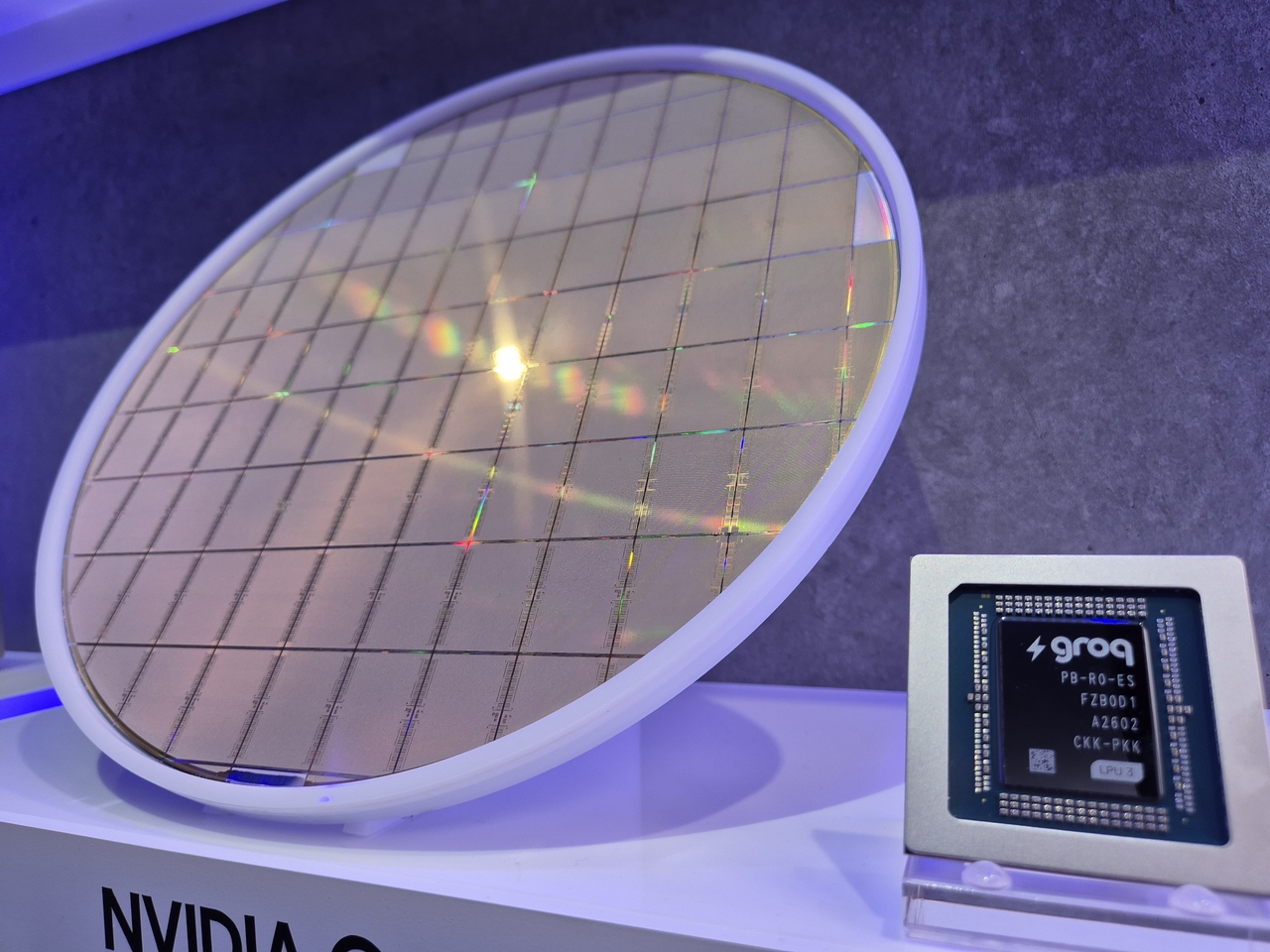
Nvidia's inference-dedicated chip, the Groq 3 LPX, manufactured by Samsung Electronics, has secured customers and entered full-scale mass production. The LPU at the heart of the Groq 3 LPX is produced on Samsung Electronics' foundry 4-nanometer process. As demand for AI chips surges, expectations are growing for meaningful profitability improvement at Samsung Electronics' foundry business.
Nvidia announced Monday (local time) that the Groq 3 LPX — optimized for running AI agents and built for faster inference — had entered full production. The Groq 3 LPX is a cabinet-sized rack system that bundles 256 LPUs manufactured at Samsung Electronics' foundry.
Nvidia has designed its AI systems so that conventional GPUs handle general-purpose computing tasks such as AI model training, while the Groq 3 LPX — built for high processing speed — handles the inference stage, where a trained AI generates actual responses. AI cloud provider Nebius is the first customer for the Groq 3 LPX.
"Inference is the growth engine of AI," Nvidia CEO Jensen Huang said. "At a time when AI computing demand is accelerating worldwide, this will bring another giant leap in AI throughput, efficiency and responsiveness."
Huang had earlier made the partnership public at his keynote address at GTC 2026 in San Jose, California, in March, saying, "Samsung is manufacturing the Groq 3 LPU chip for us. The Groq chip is now in production, and shipments will begin in the second half of this year — probably around the third quarter."
The ramp-up of Groq 3 mass production is expected to further strengthen Samsung Electronics' foundry business, which has been recovering rapidly. Demand for semiconductors for AI and high-performance computing is currently outpacing Samsung Electronics' foundry production capacity.
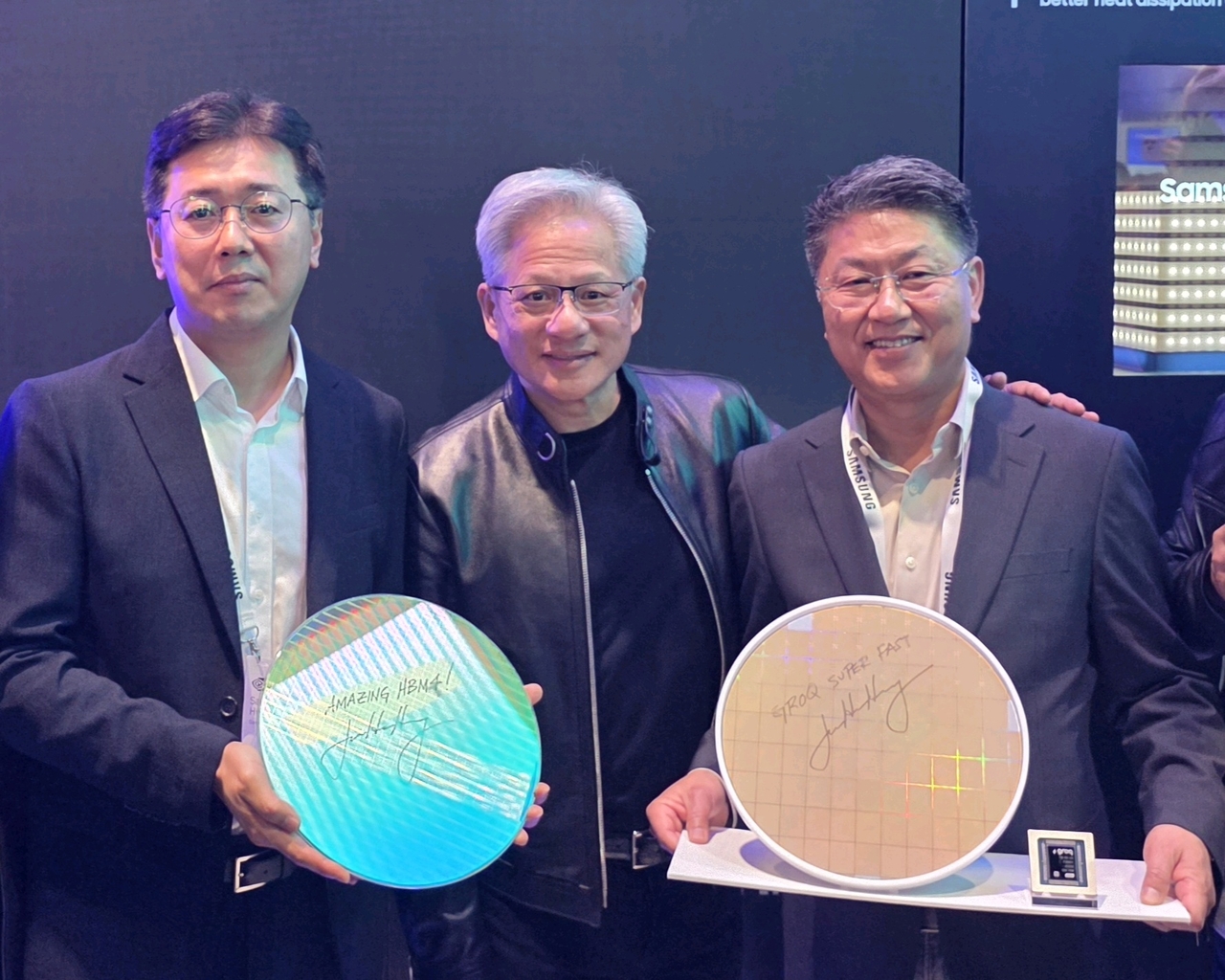
Once saddled with a reputation for chronic losses, Samsung Electronics' foundry business is now raising prices on its mature 4-nanometer process by a wider margin than Taiwan's TSMC, and profitability is improving at an accelerating pace. Han Jin-man, head of Samsung Electronics' foundry division, has said the business has a strong chance of turning profitable by 2028.
According to Reuters, Samsung Electronics last month raised prices on its 4-nanometer process by 10 to 15 percent for Chinese and American customers, and by 5 to 10 percent for Taiwanese customers. Wafer prices for the 5-nanometer process rose 10 to 15 percent, while those for the older 8-nanometer process climbed nearly 10 percent.
The 4-nanometer process produces the base die for Samsung Electronics' own HBM4 sixth-generation HBM, as well as Nvidia's Groq 3 LPU and some Qualcomm products. Reuters, citing sources, said Samsung Electronics' 4-nanometer production lines have been running at full capacity since late last year, and that Google is in negotiations with Samsung Electronics to produce chips on the 4-nanometer process.
Samsung Electronics has also identified the expansion of 4-nanometer LPU mass production in the second half of this year as a key driver of foundry growth. At the second-quarter earnings conference call on July 30, Kang Seok-chae, executive vice president of Samsung Electronics' foundry division, said the company expects double-digit or higher year-on-year sales growth, driven by the start of mass production of next-generation mobile products on its second-generation 2-nanometer process and the full-scale ramp-up of 4-nanometer LPU production, which together are expected to boost sales to major customers in the United States and China.
Signs of a foundry rebound have been building since last year. Samsung Electronics secured an order for Tesla's next-generation AI chip "AI6" using its leading-edge 2-nanometer process, and has since landed a string of major customers including Apple's image sensor for the iPhone. The possibility of winning a logic chip order from AI company Anthropic has also been raised.
Close ties with Nvidia and Broadcom are expected to yield additional orders. After meeting with Nvidia CEO Jensen Huang in June, Samsung Electronics co-CEO and semiconductor division head Jeon Young-hyun said the company is "cooperating on autonomous driving chips needed in the 4-nanometer and 8-nanometer nodes, as well as Nvidia's accelerator chip, the Groq chip, and we are also discussing cooperation on the next generation."
Following the San Francisco AI Summit in July, Samsung Electronics announced plans to pursue strategic cooperation with Broadcom worth more than $200 billion across memory and foundry.
Samsung Electronics is also strengthening its technological competitiveness at the leading-edge 2-nanometer node. Starting in the second half of this year, the company plans to begin mass production of its next-generation mobile application processor, the Exynos 2700, based on its second-generation 2-nanometer process, SF2P.
The Exynos 2700 has reportedly outperformed Qualcomm's Snapdragon 8 Elite Gen 6 — believed to be manufactured on TSMC's 2-nanometer process — in internal benchmark tests, with some observers saying the results demonstrate Samsung Electronics' foundry capabilities.

go@heraldcorp.com