The average sale price of Seoul apartments has surpassed 1.6 billion won for the first time. Prices rose across both Gangnam and Gangbuk, but gains were most pronounced in outer districts such as Seongbuk-gu, Jungnang-gu and Gangbuk-gu, where mid- to lower-priced apartments drove Seoul's overall average up 1.14 percent. Experts say the surge reflects a shift in demand: as jeonse listings have dwindled, anxious renters have turned to buying, pushing prices higher.
Seoul apartment average breaks 1.6 billion won mark — Gangbuk outpaces Gangnam
According to the August national housing price trend report released by KB Real Estate on Monday, the average sale price of Seoul apartments stood at 1.61 billion won as of Aug. 10 — up 12.49 million won, or 0.07 percent, from the previous month's 1.59 billion won — marking the first time the figure has entered the 1.6 billion won range.
Seoul's average apartment price first crossed the 1.5 billion won threshold in December last year, when it reached 1.51 billion won, and has now broken through 1.6 billion won in roughly eight months. The figure has risen for 30 consecutive months since March 2024, when it slipped about 940,000 won from the prior month's 1.2 billion won to 1.196 billion won.
The gains were led by Gangbuk. The 14 districts north of the Han River posted a larger increase than the 11 districts to the south. The average sale price in Gangbuk rose 12.49 million won in August to 1.18 billion won from 1.17 billion won the previous month, while Gangnam prices climbed 12.25 million won to 1.99 billion won from 1.98 billion won — making Gangbuk's advance the more notable of the two.
The median apartment price — the midpoint when all transactions are ranked by value — also rose. Seoul's citywide median came in at 1.29 billion won, while the median for the 14 Gangbuk districts reached 1 billion won, crossing that threshold for the first time. The median for the 11 districts south of the Han River stood at 1.63 billion won.
By district, Seoul's overall apartment sale prices rose 1.14 percent, with the sharpest gains in outer areas: Jungnang-gu (2.25 percent), Seongbuk-gu (2.08 percent), Nowon-gu (1.95 percent), Jongno-gu (1.94 percent) and Gangseo-gu (1.86 percent). Jungnang-gu widened its gain by 0.17 percentage points from the previous month's 2.08 percent, topping Seoul's district rankings for the second consecutive month.
Gangnam-area districts posted more modest gains — Gangnam-gu at 0.11 percent, Seocho-gu at 0.22 percent and Songpa-gu at 0.96 percent. Analysts say the government's announced plans to raise the comprehensive real estate tax and capital gains tax on high-priced properties have left both buyers and sellers in a wait-and-see mode.
As prices in previously subdued Gangbuk districts have risen, the gap between the city's top and bottom tiers has narrowed slightly. Dividing Seoul apartment prices into five quintiles, the top 20 percent averaged 3.46 billion won this month — 6.4 times the bottom 20 percent average of 541.38 million won. That ratio is down from a peak of 6.9 times recorded in February 2026.
Price gains were also notable in southern Gyeonggi Province. Suwon's Yeongtong District posted the highest increase of any district nationwide at 2.85 percent, followed by Yongin's Suji District (2.76 percent), Hwaseong's Dongtan District (2.61 percent) and Suwon's Jangan District (2.54 percent). Gwangmyeong (2.26 percent), Hwaseong's Byeongjeom District (2.14 percent) and Seongnam's Sujeong District (1.91 percent) also recorded gains.
Buyers in their 30s emerge as driving force behind Seoul panic buying
Experts say panic buying by buyers in their 20s and 30s is helping push Seoul's average apartment price steadily higher, even as asking prices for ultra-high-end properties have softened somewhat in the wake of the 2026 tax reform proposals. They argue that a sharp drop in jeonse listings has pushed rental demand toward purchases, and anxiety among younger buyers has accelerated sales of mid- to lower-priced apartments — sometimes described as "less prime but still a single unit."
Park Won-gap, a senior real estate specialist at KB Kookmin Bank, said buyers in their 30s, who have emerged as the most active purchasers recently, are largely unaffected by the tax reform measures. "A combination of supply shortages and vigorous home buying by younger generations has pushed the average price up," he said.
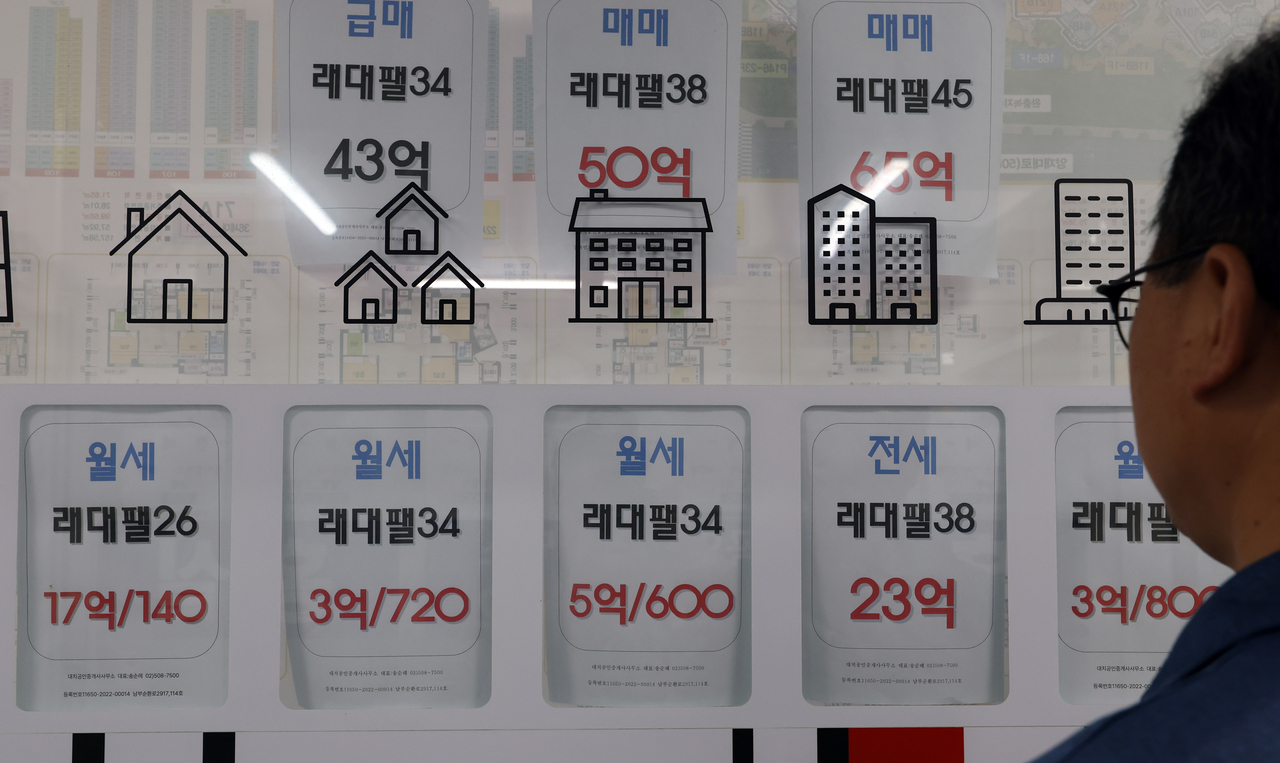
Prices for apartments in the 1 billion won range in Seoul's outer districts are rising quickly. Sagarjeong Central I'Park in Jungnang-gu, the district's flagship complex, set a record high when an 84-square-meter unit sold for 1.54 billion won on Aug. 7 — a complex that was still trading in the 1.3 billion won range as recently as June. In Seongbuk-gu, a pre-occupancy rights contract for a unit at Changgyeonggung Lotte Castle Signature changed hands on Aug. 14 for 1.68 billion won, more than 300 million won above the previous transaction price of 1.33 billion won recorded in March.
Seo Gwang-chae, a real estate professor at Hanyang Cyber University, said the tax reform proposals are pushing ultra-high-end properties lower, but demand for the tier just below — the so-called "less prime but still a single unit" — is strengthening as a result. "In a market like Seoul's, there is also the anxiety that if you don't get in now, you won't be able to at all," he said.
Meanwhile, the national average jeonse price for apartments rose 0.45 percent. Seoul's apartment jeonse prices climbed 1.10 percent from the previous month, though the pace of increase narrowed by 0.24 percentage points.
By district in Seoul, Seongbuk-gu (2.21 percent), Jungnang-gu (2.05 percent), Gangbuk-gu (1.91 percent), Dongdaemun-gu (1.82 percent), Gwangjin-gu (1.62 percent), Nowon-gu (1.62 percent) and Geumcheon-gu (1.58 percent) led jeonse price gains. In Gyeonggi Province, which rose 0.70 percent overall, Guri (1.77 percent), Hwaseong's Dongtan District (1.74 percent), Suwon's Gwonseon District (1.58 percent), Yongin's Suji District (1.55 percent) and Gwangmyeong (1.44 percent) posted the highest jeonse increases. Incheon rose 0.29 percent.
hss@heraldcorp.com
shy@heraldcorp.com