
![Dealers work at the trading room of Hana Bank's headquarters in Seoul. [Yonhap]](https://wimg.heraldcorp.com/news/cms/2026/08/19/rcv.YNA.20260813.PYH2026081319030001300_P1.jpg)
Retail investors are souring on the domestic stock market once again. After a brief lull driven by a rally in Korean equities, investment in US stocks has rebounded sharply this month, pushing the total custody balance back above $190 billion. In the ETF market, products tracking major US indexes have also begun reclaiming the top spots in individual net purchases.
The shift reflects growing unease with the domestic market's wild swings, prompting investors to rotate back into US benchmarks seen as relatively stable. Some are even buying products that bet directly on a decline in Korean share prices, signaling that the "exit Korea" trend among retail investors — which had quieted for a time — may be spreading again.
According to the Korea Securities Depository, the custody balance of US stocks held by domestic investors stood at $190.2 billion as of Monday, up from around $170 billion at the end of last month — a gain of more than $18 billion in just weeks.
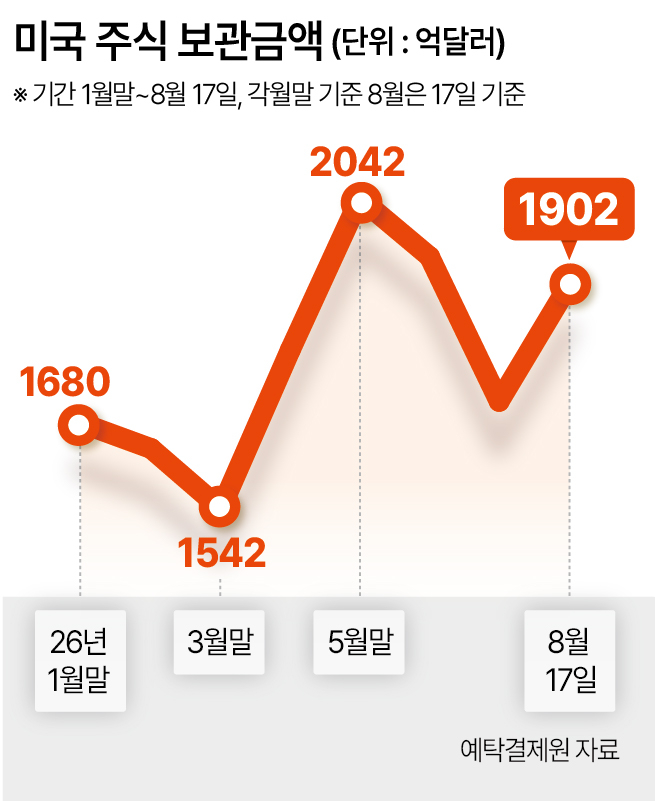
The US stock custody balance hit an all-time high of $204.2 billion at the end of May, surpassing $200 billion for the first time. It then retreated to around $194.8 billion in June as a strong domestic market rally drew some funds back home. In July, broad weakness across global equity markets pushed the figure down sharply to around $171.5 billion — a drop of more than $30 billion in just over two months.
August, however, brought a reversal. Much of last month's decline was recovered in barely two weeks, suggesting that domestic investors' appetite for US equities is reigniting.
Market observers say the heightened volatility in the domestic market has been a key driver of the capital shift. Investors who had trimmed their US stock exposure and returned to the Korean market during its sharp rally are now rebuilding those positions as domestic swings intensify.
Analysts note that US equities continue to serve as a kind of safe haven — particularly among investors who prioritize market stability and long-term growth potential over short-term returns. Even as domestic indexes climbed to elevated levels, demand persisted to diversify into the US market rather than keep funds tied up at home.
The divergence between retail and foreign investors has also become apparent in recent domestic market flows. Foreign investors posted net purchases on the Kospi for five consecutive trading sessions from Aug. 11 through Tuesday, with cumulative net buying totaling 8.16 trillion won ($5.78 billion) — an average of 1.63 trillion won per session.
Retail investors, by contrast, had been selling domestic shares until recently, recording net selling for four consecutive trading sessions from Aug. 11 through Monday. They did snap that streak on Tuesday, however, swinging to net purchases of 731.6 billion won.
The preference for US markets is also showing up in the ETF space. According to ETF Check, three of the top five ETFs by individual net purchases over the past week tracked major US indexes. Tiger US S&P500 ranked second with 119.8 billion won in net individual buying, followed by Kodex US NASDAQ (68.4 billion won, fourth) and Kodex US S&P500 (66.9 billion won, fifth).
Active bets on a domestic market decline were also evident. The top ETF by individual net purchases over the same period was Kodex 200 Futures Inverse 2X, which attracted 142.2 billion won. The product delivers twice the inverse of the daily return on the KOSPI 200 futures index, generating gains when the index falls.
"The market has been rebounding recently, but the mood among retail investors is markedly different from before," a securities industry official said. "Retail investors had been the main force driving growth in trading volume and value, but lately many appear to be waiting for share prices to recover to their purchase levels rather than adding to their positions."
The official added that investors sitting on losses tend to wait for a breakeven recovery rather than re-entering aggressively, and that those who were stopped out during the sharp selloff have been left behind in the rebound. "Their appetite to invest seems to have significantly weakened," the official said.

th5@heraldcorp.com




