With the government unveiling its Aug. 13 housing rapid-supply plan — centered on accelerating ground-breaking at public housing sites and designating new land — observers say the plan's success will hinge on policy execution: streamlining administrative procedures and resolving factors that delay projects. The newly designated public housing districts, including Gangseo's Yeomchang Park and downtown Namyangju, covering 27,000 units, are only just getting off the ground, and land compensation disputes and community conflicts are expected to be the critical variables shaping the pace of development.
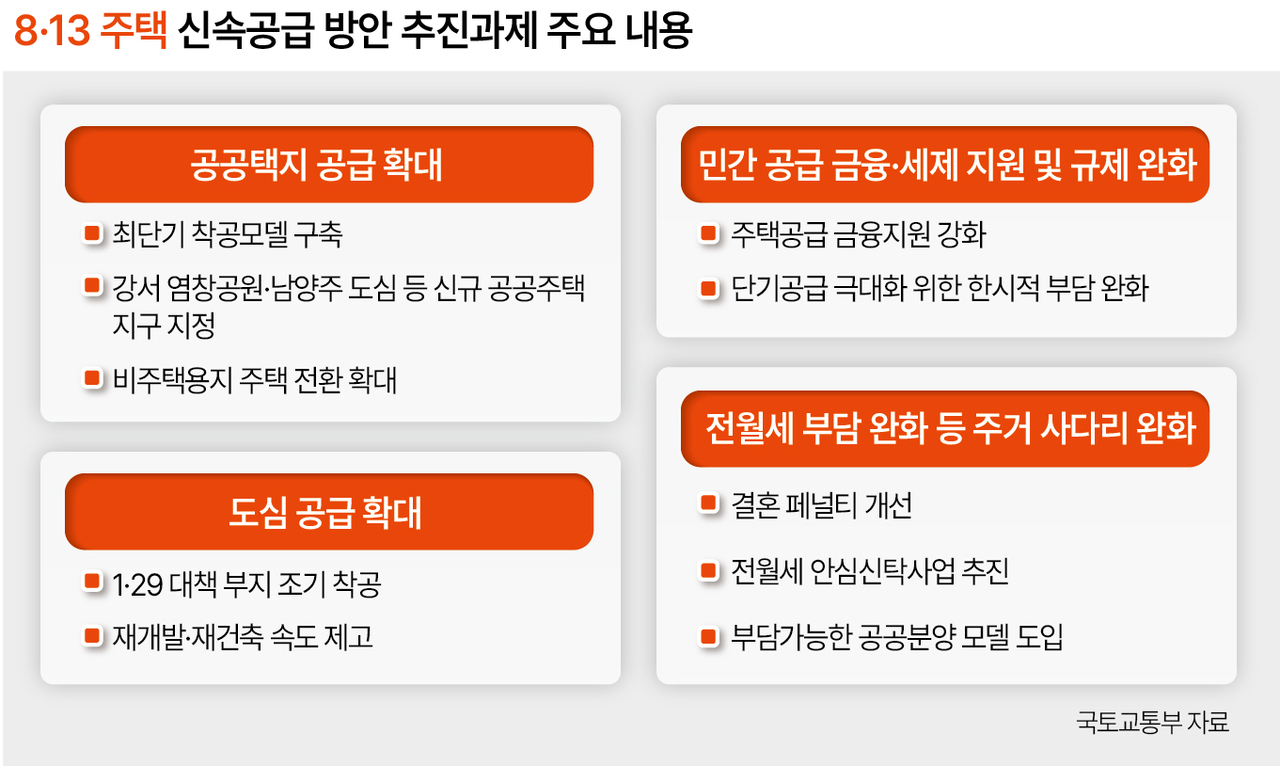
According to the Ministry of Land, Infrastructure and Transport, the government on Thursday announced a housing supply acceleration package that includes: establishing a fast-track ground-breaking model for public housing sites (cutting the timeline from 68 months to 37 months after announcement); designating new public housing districts with a combined 100,000 units this year — including 27,000 units at Gangseo Yeomchang Park, downtown Namyangju and the Gyeonggi Gwangju Station transit-oriented area 2; accelerating ground-breaking at sites from the Jan. 29 supply package, including Taereung Country Club, the Gwacheon racetrack, the Defense Counterintelligence Command site and the Yongsan International Business District; and pursuing mixed-use development of school sites and aging public buildings.
New housing sites face long lead times — speed of compensation-to-ground-breaking conversion is decisive
Experts gave the plan credit for pulling the housing supply timeline forward, but cautioned that without real execution on the ground — given the risk of community opposition and administrative delays — the government's push for speed would be difficult to feel in practice.
Yang Ji-young, a senior adviser at Shinhan Premier Pathfinder, said "accelerating ground-breaking at third-generation new towns and other sites by one to two years would have a more tangible market impact than designating additional candidate sites." She added that "this plan goes beyond simply announcing new supply figures — it also attempts to address the bottlenecks that have been delaying actual construction, including project financing support, relocation loans for redevelopment projects, improved project viability and land-use deregulation, which makes it stronger on execution than previous supply measures."
While there was broad support for the fast-track ground-breaking model — which aims to cut the time to construction start by roughly half — some experts urged caution. Lee Eun-hyung, a research fellow at the Korea Construction Policy Research Institute, said "the proposed reduction in timelines is substantial," adding that "it would be more appropriate to view this as something that will be applied selectively to sites where it is feasible, rather than being generalized across all projects." He also noted that "for existing sites such as the Gwacheon racetrack, relocation of existing facilities is a complicating factor, so whether the fast-track model can be applied as-is will need to be watched going forward."
Among the measures drawing the most market attention — the Gangseo Yeomchang Park and downtown Namyangju sites — analysts say a significant gap remains before actual move-ins, with land compensation, community persuasion and other hurdles still to clear. The government has set a target of breaking ground on the Gangseo Yeomchang Park site (1,000 units) by 2029, 33 months after the announcement, and on the downtown Namyangju (21,700 units) and Gyeonggi Gwangju Station transit-oriented area 2 (4,500 units) sites by the first half of 2030.
But analysts say the real test will be how quickly the government can resolve a host of thorny issues — land acquisition and compensation, conflicts among residents, local governments and other stakeholders, and infrastructure development. Experts say the speed of the compensation-to-ground-breaking conversion, more than the headline figure of 100,000 net new units, will determine whether the policy delivers.
Yang said "the announcement of 100,000 units on new sites is meaningful in that it secures a medium- to long-term supply base for the Greater Seoul area," but stressed that "the biggest variable is not location — it is how quickly land acquisition, compensation and community conflicts can be resolved." She went on to say that "as seen in cases like Seoripul and Gwangmyeong-Siheung, compensation and community consultations can take years even after a district is designated," and that "while the government is pursuing institutional reforms to bring forward preliminary compensation surveys, it remains to be seen whether that will actually translate into shorter project timelines."
Ham Young-jin, head of the real estate research lab at Woori Bank, also said "concentrating supply at locations with good access to Seoul in order to absorb metropolitan housing demand is a strength," but noted that "even with the fast-track ground-breaking model applied, a considerable amount of time will be needed before new candidate sites are converted into actual move-in units."
'PF support and faster redevelopment are positives — but detailed criteria need to be spelled out'
While the public housing acceleration measures and new district designations are largely medium- to long-term in nature — drawing criticism that they will do little to stabilize the Greater Seoul property market in the near term amid rising home prices — the plan's moves to address on-the-ground obstacles, including faster private redevelopment projects and project financing support, have drawn positive assessments.

The government plans to support the normal ground-breaking of approximately 234,000 redevelopment and reconstruction units by 2030, offering tax and financial incentives for fast-tracked projects and easing the consent-rate threshold for redevelopment. To boost private-sector supply, the plan also includes a range of practical incentives — anchor real estate investment trusts, expanded main project financing loan support, relaxed infrastructure contribution requirements, improved relocation loan terms and reduced development charges.
Yang said "a significant portion of this plan's supply targets are measured by ground-breaking, not move-in, so the effect on filling the shortage of move-in units in 2026 and 2027 or stabilizing jeonse and monthly rent prices may be limited." She added, however, that "ultimately this plan is less a short-term price stabilization measure and more a policy aimed at driving a recovery in private-sector and redevelopment ground-breaking after 2027 and normalizing the supply base, including non-apartment housing."
She also said "project financing guarantees and interest rate support should help to some extent in restarting projects that had received permits but could not break ground due to financing problems," and that "relocation loans, project financing support, funding for small-scale redevelopment projects, and public contribution and levy burdens all need to have their detailed criteria spelled out so they can actually function in the field."

hwshin@heraldcorp.com