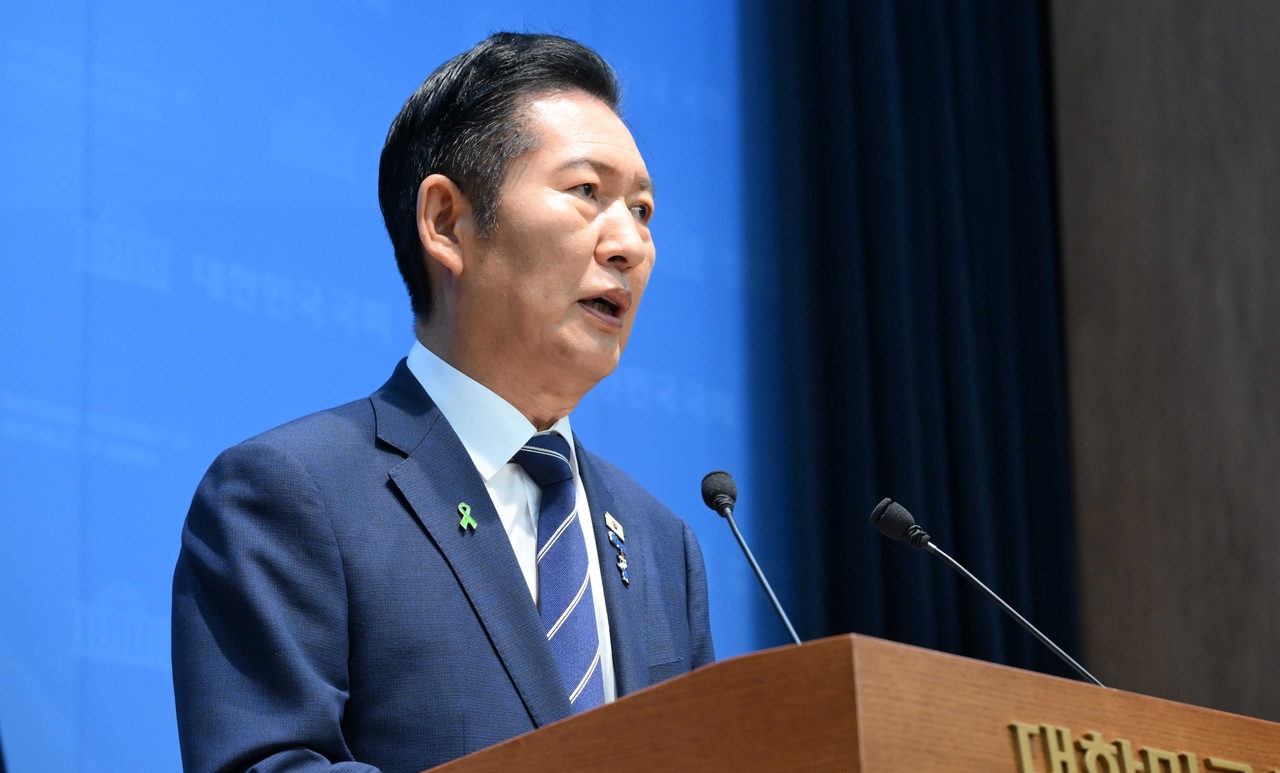
Jung Chung-rae, a candidate in the Democratic Party of Korea's Aug. 17 national convention leadership race, has criticized the party's election management committee for filing an expulsion complaint against Jung Dal-seong, head of the "Cheongcheong Yurangdan" group, over proxy-voting allegations that surfaced in Suncheon, South Jeolla Province.
Speaking on BBS Radio's "Morning Journal" on Friday, Jung said he had looked into the matter and concluded that "the party's election management committee was in the wrong," calling the decision "deeply regrettable" and warning it would become "a serious problem."
Jung said the party's election body had given National Assembly members a chance to respond to the proxy-voting allegations but denied the same opportunity to Jung Dal-seong. "Assembly members were given a chance to explain themselves — for example, lawmakers like Hwang Myeong-seon and Jeon Jin-suk," he said. "But the party member was not."
He also argued that Jung Dal-seong's actions amounted to guiding someone through the voting process rather than casting a ballot on their behalf. "If he had gone into the voting booth and marked the ballot for someone else, that would be proxy voting," Jung said. "But he says he cast his own vote, and his mother is also testifying, saying, 'I cast my own vote — how is this proxy voting?'" He went on to say, "If they had given him a chance to explain, they would not have made such a reckless decision to file for expulsion. What kind of irresponsible decision sends someone straight to the ethics tribunal without even hearing them out?"
Jung said it would be a serious problem if the party's election body had applied different procedures to lawmakers and ordinary members. "If it is true that Assembly members were given a chance to explain themselves while party members were not, that needs to be verified again," he said. "Based on what I have confirmed so far, that is what happened. This is something that will outrage every party member."
Jung also raised broader concerns about how the party has been managing its internal primary process, criticizing the election body for adopting a preferential voting system. "They are just deciding things that are not in the party constitution or rules," he said. "Why is the Democratic Party doing this?"
Returning to the expulsion filing against Jung Dal-seong, he said, "Being expelled as a party member is a political death sentence. How can such a decision be made without even giving the person a chance to explain? Regardless of the national convention, I intend to make this a major issue."
Jung shrugged off the framing of a so-called conflict between himself and Lee Jae-myung, saying "the very notion of such a conflict does not exist — it is fiction." On the recent dip in President Lee's approval rating, he attributed it to a loosening of the party's traditional support base and said, "The moment I become party leader, it will go up about 5 percentage points."
Jung also said that if he becomes party leader, he would order an ethics investigation into allegations raised by fellow candidate Kim Min-seok about Shincheonji's involvement in the party. "For Kim Min-seok's own sake, an ethics probe needs to be conducted," he said, adding that it must be verified whether there is any basis for the claim that the Democratic Party is connected to Shincheonji.
thanks@heraldcorp.com