![An aerial view of the Taereung Country Club site. [Yonhap]](https://wimg.heraldcorp.com/news/cms/2026/08/13/news-p.v1.20260129.b0243614135d44e6becc4805b1e20679_P1.jpg)
The government, which has staked its housing policy on an aggressive supply push, unveiled its Aug. 13 rapid housing supply plan Thursday, targeting more than 230,000 additional units in the greater Seoul area by 2030. But analysts say the package focuses more on accelerating previously announced projects than on identifying new supply sources — and that it falls short of any near-term fix for market instability. Sites such as Taereung Country Club, the Gwacheon racecourse and the Defense Counterintelligence Command compound had already appeared in the Jan. 29 supply package, while urban public housing mixed-use development, school site redevelopment and aging government building redevelopment largely rehash earlier policy announcements.
The "rapid housing supply plan for stabilizing jeonse, monthly rent and sales markets," announced Thursday by the Ministry of Land, Infrastructure and Transport and related ministries, includes six measures: establishing the fastest possible ground-breaking model for public housing sites such as the third-generation new towns and the Seoripul district; expanding the conversion of non-residential land to housing; accelerating ground-breaking on already-sold apartment sites; bringing forward ground-breaking on sites from the Jan. 29 supply plan; expanding urban public housing mixed-use development; and advancing timelines and modestly increasing unit counts for existing projects such as school site and aging government building redevelopments.
Jan. 29 sites — including Taereung CC and Gwacheon racecourse — to break ground earlier; public land development accelerated
In Seoul, Gyeonggi Province and other urban areas where home purchase prices, jeonse and monthly rents have all surged simultaneously, the government plans to push forward ground-breaking on sites disclosed in the Jan. 29 package — including Taereung CC, the Gwacheon racecourse, the Defense Counterintelligence Command compound, the Yongsan International Business District and the Gangseo military site.
Taereung CC and the Gwacheon racecourse and Defense Counterintelligence Command sites, originally targeting a 2030 ground-breaking, will now aim for September and December 2029, respectively. For Taereung CC, the plan calls for completing a World Heritage impact assessment by the second half of this year, obtaining district plan approval in the second half of 2028, breaking ground on the site in the first half of 2029 and beginning housing construction in September of that year. For the Gwacheon site, relocation of non-core facilities will begin in the first half of next year, with permitting procedures running in parallel during the relocation period.
The Yongsan International Business District — where the government and the Seoul Metropolitan Government have been at odds over the number of units — is also being pushed toward a housing ground-breaking by late 2028. The government said it will also move up the facility relocation and construction timelines for other Jan. 29 sites, including areas in Eunpyeong-gu and Dongdaemun-gu, the Gangseo military site, the Hanam tennis center and the Gwangmyeong police station.
The government also disclosed the first-round pilot sites for school site mixed-use redevelopment, a measure included in last year's Sept. 7 package, and identified new sites for aging government building redevelopment. The pilot school sites are Gonghang High School in Gangseo-gu, Seoul (270 units); Suo High School (497 units) and Gwonseon 2 Middle School (276 units) in Suwon, Gyeonggi Province; and Hongi Middle School in Yongin, Gyeonggi Province (395 units). For aging government building redevelopment, the government added new sites on top of those in the Jan. 29 package — the Korea Land and Housing Corporation's Seoul regional headquarters in Gangnam-gu, Seoul (250 units) and the Korea Land and Geospatial Informatix Corporation's Incheon-Gyeonggi South regional headquarters in Suwon, Gyeonggi Province (200 units).
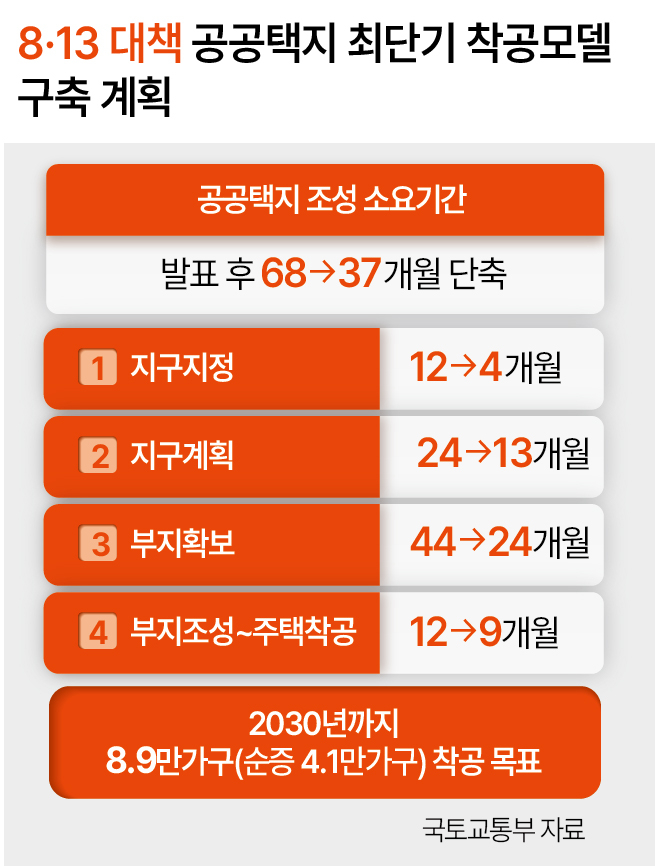
The government also aims to cut the average development timeline for public housing sites — including the third-generation new towns and the Seoripul district — from 68 months to within 37 months by streamlining each stage: district designation, district planning, land acquisition, site preparation and housing construction. Through this effort, it plans to break ground on 89,000 units at public housing sites by 2030, accelerating the pace on the existing 48,000-unit plan while also pulling forward 41,000 units that had been scheduled for ground-breaking in 2031 or later.
Sites overlap with Moon-era Aug. 4 package; experts warn of limited near-term supply impact
Despite the government's focus on accelerating timelines and front-loading unit counts, market observers say a significant portion of the supply figures are recycled from previously announced sites and are unlikely to ease near-term supply-demand anxiety. They also note that key sites are frequently delayed by disagreements between local governments and relevant agencies, and that even with streamlined administrative procedures, the gap between ground-breaking and actual move-in will remain substantial for public housing sites.
Taereung CC, Yongsan Camp Kim and the Korea Land and Housing Corporation's Seoul regional headquarters were all included in the Aug. 4, 2020 package under the Moon Jae-in administration. Aging government building redevelopment was also a measure proposed at that time. Both have resurfaced in the current government's Sept. 7 and Jan. 29 packages, yet have made little progress due to resident opposition and difficulties in reaching agreement with local governments.
Even within this package, the 30,000-unit supply from converting non-residential land to housing includes 15,000 units already counted in the Sept. 7 package. As a result, the net new units among the 230,000-plus figure amount to roughly 120,000-plus — about half the headline number the government presented.
Yun Ji-hae, head of the research lab at Real Estate 114, said the Jan. 29 package — which put forward a target of 1.4 million ground-breakings in the greater Seoul area — "was already an all-in plan," adding, "No matter how hard you look for something new, you can't surpass 1.4 million units." He said the measure of how much the market actually benefits "is exactly how much genuinely new supply has been found."
Among experts, the prevailing view is that the plan is unlikely to deliver a supply impact the market will meaningfully feel.
Kim In-man, director of the Kim In-man Economic Real Estate Research Institute, said measures that keep recycling announcements from the Moon administration era "are not enough to reassure anxious buyers and renters." He added that with jeonse and rental markets already in acute distress, "even if ground-breaking starts now, construction takes at least four years at the fastest."
Song Seung-hyeon, chief executive of Urban and Economy, said that while the government is showing commitment on sites such as Taereung CC and the Gwacheon racecourse, "local residents still oppose them, and housing policy has lost its momentum, so pushing them through will inevitably be difficult." He said Seoul alone needs around 50,000 to 60,000 units of supply per year, and "this plan has its limits in meeting that demand."

hwshin@heraldcorp.com