
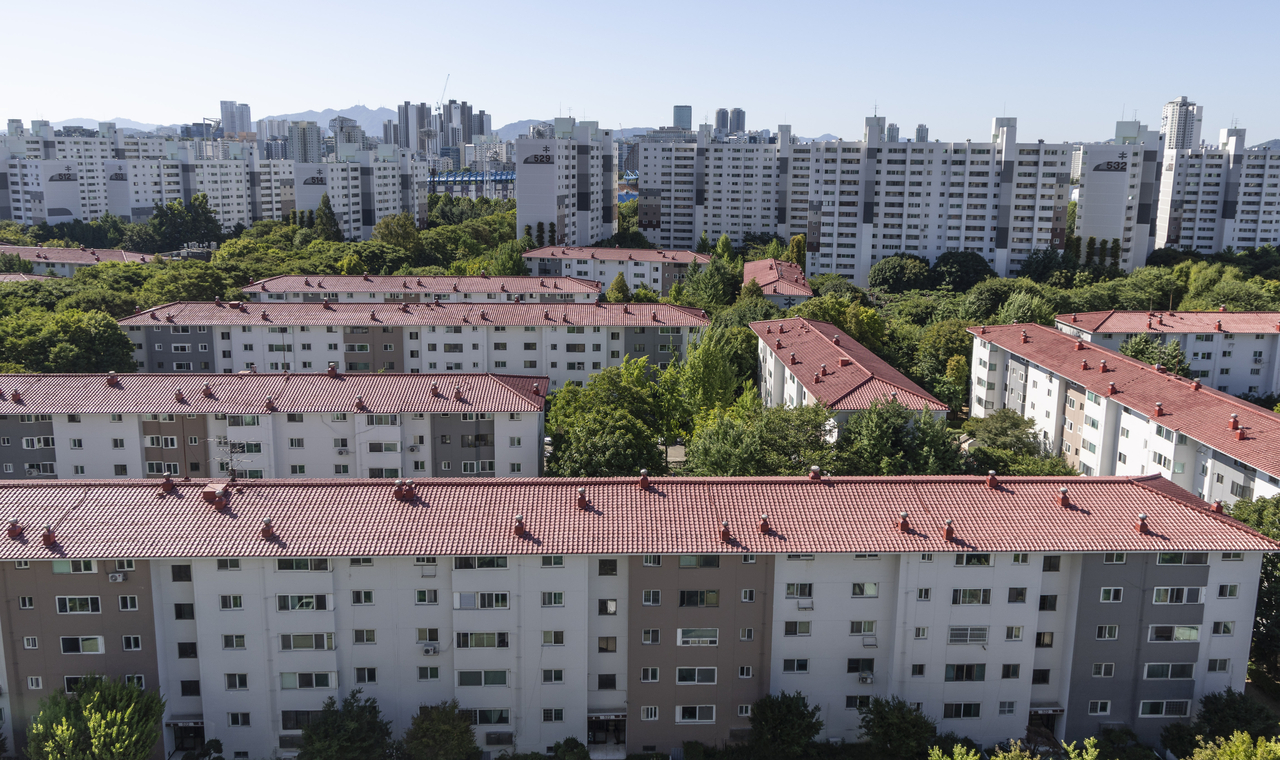
With a housing supply package expected to be announced soon, the jeonse shortage in Seoul and Gyeonggi Province's most popular school districts is deepening. A survey of apartment complexes in Daechi-dong, Mok-dong, Junggye-dong and Pyeongchon found more than 82,000 units across the four areas, yet only 659 jeonse listings were available — less than 1 percent of the total housing stock.
Analysts attribute the squeeze to a combination of tightened owner-occupancy requirements, a chronic supply shortage and a newly announced tax reform package that raises the holding-tax burden on non-resident single-home owners — prompting more landlords to move back into their own properties. While the government has pledged an all-out push to boost housing supply across the greater Seoul area, critics say such measures do little to ease the jeonse crunch in school districts where rental demand is driven primarily by families seeking access to top schools.
A comprehensive survey conducted Thursday of apartment complexes in Daechi-dong (Gangnam-gu), Mok-dong (Yangcheon-gu), Junggye-dong (Nowon-gu) and Pyeongchon-dong (Dongan-gu, Anyang, Gyeonggi Province) found 659 registered jeonse listings as of that day. The four neighborhoods together contain 190 complexes and 82,151 units in total, yet available listings numbered only in the hundreds.
In many complexes, the jeonse listing count stands at zero. In Mok-dong, which has 25,335 units spread across 88 complexes, 55 — or 62.5 percent — had no jeonse listings at all. Smaller complexes of 200 to 300 units, including Mok-dong Woosung (332 units), Mok-dong e-Pyeonhansesang (276 units) and Mok-dong Samik (277 units), have seen jeonse supply dry up entirely. Even large complexes of more than 1,000 units are barely represented: Mok-dong Shinsigaji complexes 1 and 2 (1,640 and 1,882 units, respectively) each had just four listings, while Hansin Cheonggu (1,512 units) had three.
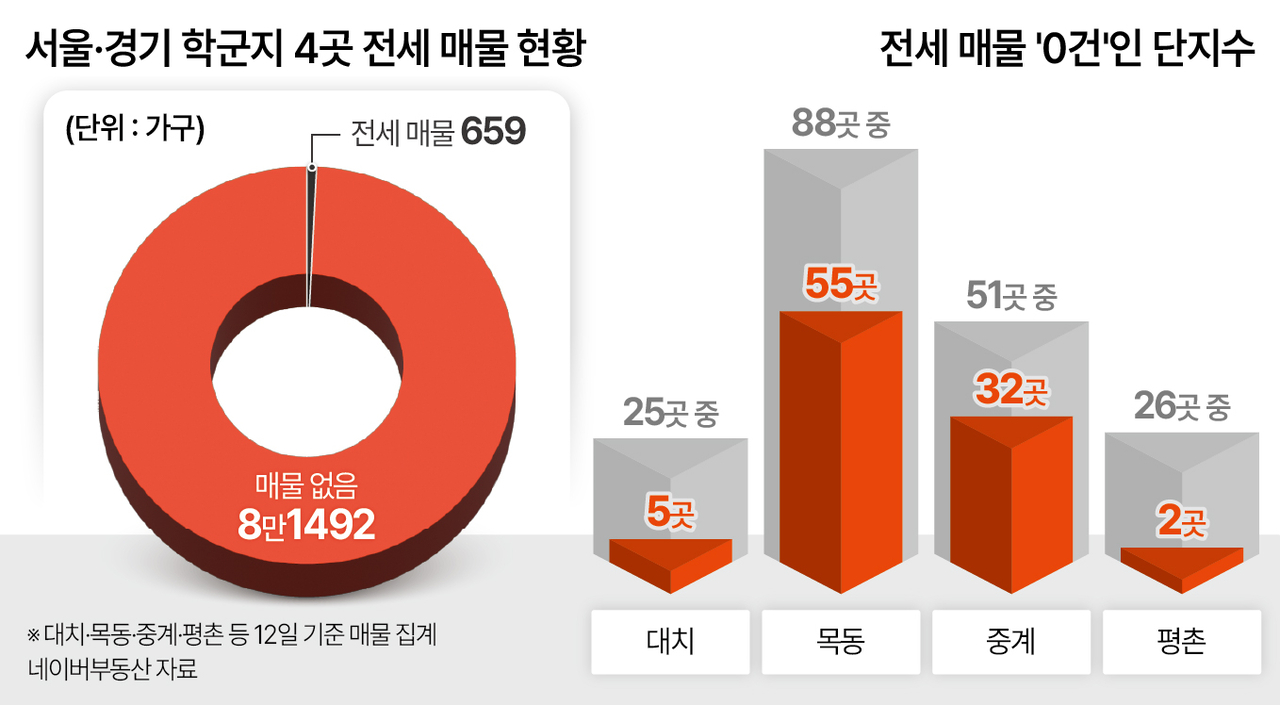
Junggye-dong, northern Seoul's premier school district, tells a similar story. Of its 51 complexes totaling 28,186 units, 32 — or 62.7 percent — had no jeonse listings. Because jeonse prices there are relatively affordable compared with other school districts, rental demand is even more concentrated, and even large complexes have run dry. Junggye Jugong Complex 2, with 1,800 units, had no jeonse listings, nor did Geonyeong 3rd (948 units) or Geonyeong 2nd (742 units). Gyeongnam Lotte Sangah (1,890 units) and Junggye Mujigae Complex 2 (2,433 units) — both near the 2,000-unit mark — had only one or two listings each.
Pyeongchon-dong (15,606 units) and Daechi-dong (13,024 units) fared no better, with just 43 and 51 jeonse listings available respectively — a supply ratio of roughly 0.2 to 0.3 percent of total units.
The listing drought reflects a convergence of pressures: the expansion of land transaction permit zones imposing owner-occupancy obligations, tighter jeonse loan regulations, a persistent supply shortage, and a wave of landlords choosing to move back in following the tax reform announcement. School districts already faced heavy rental demand from education-driven families, and the owner-occupancy rules have further reduced the pool of circulating jeonse supply. Stricter lending conditions have also accelerated a shift toward monthly rent arrangements, while rising jeonse prices have led more existing tenants to renew their contracts rather than vacate — sharply cutting the flow of new listings onto the market.
Adding to the pressure, the government's 2026 tax reform package, announced Aug. 3, includes measures that would significantly increase the tax burden on non-resident single-home owners — lowering the comprehensive real estate tax basic deduction to 900 million won ($636,000) and reducing long-term holding deductions on capital gains tax. The changes have prompted more owners to consider evicting tenants and moving in themselves.
"There is a strong sense in the real estate market that owners feel they need to keep their homes vacant because they don't know what might happen," said Yun Su-min, a real estate specialist at NH NongHyup Bank. "Given the policy uncertainty and the growing tax penalties for non-residents, more and more owners are taking the attitude of 'let's just move in for now.'" She added that in school districts, owners who do not currently need to live there themselves are increasingly choosing to move back in as soon as a lease expires rather than renew with a tenant.

hwshin@heraldcorp.com




