About this series: The business world is full of companies — but what do they all actually do? Firms split, merge and rebrand constantly. Some launch new ventures; others quietly wind down operations they ran for years. This series uses on-the-ground reporting and data analysis to tell those stories in plain language.
"In the age of horse-drawn carriages, there were three kinds of companies: those that believed the horse was what mattered, those that insisted the coachman was the key, and those that focused on developing the carriage itself. In the end, none of them won — because the automobile arrived."
With the era of humanoid robots now at hand, Robotis CEO Kim Byung-soo used that analogy to urge businesses to prepare swiftly for the transformation that physical AI will bring — just as the automobile rendered the carriage age obsolete.
Kim made the remarks Wednesday at the Physical AI Frontier National Strategy Forum held at the National Assembly Members' Hall in Yeouido, Seoul. "Physical AI must not be viewed through the lens of past regulations or technologies," he said. "It needs to be approached as an entirely new concept."
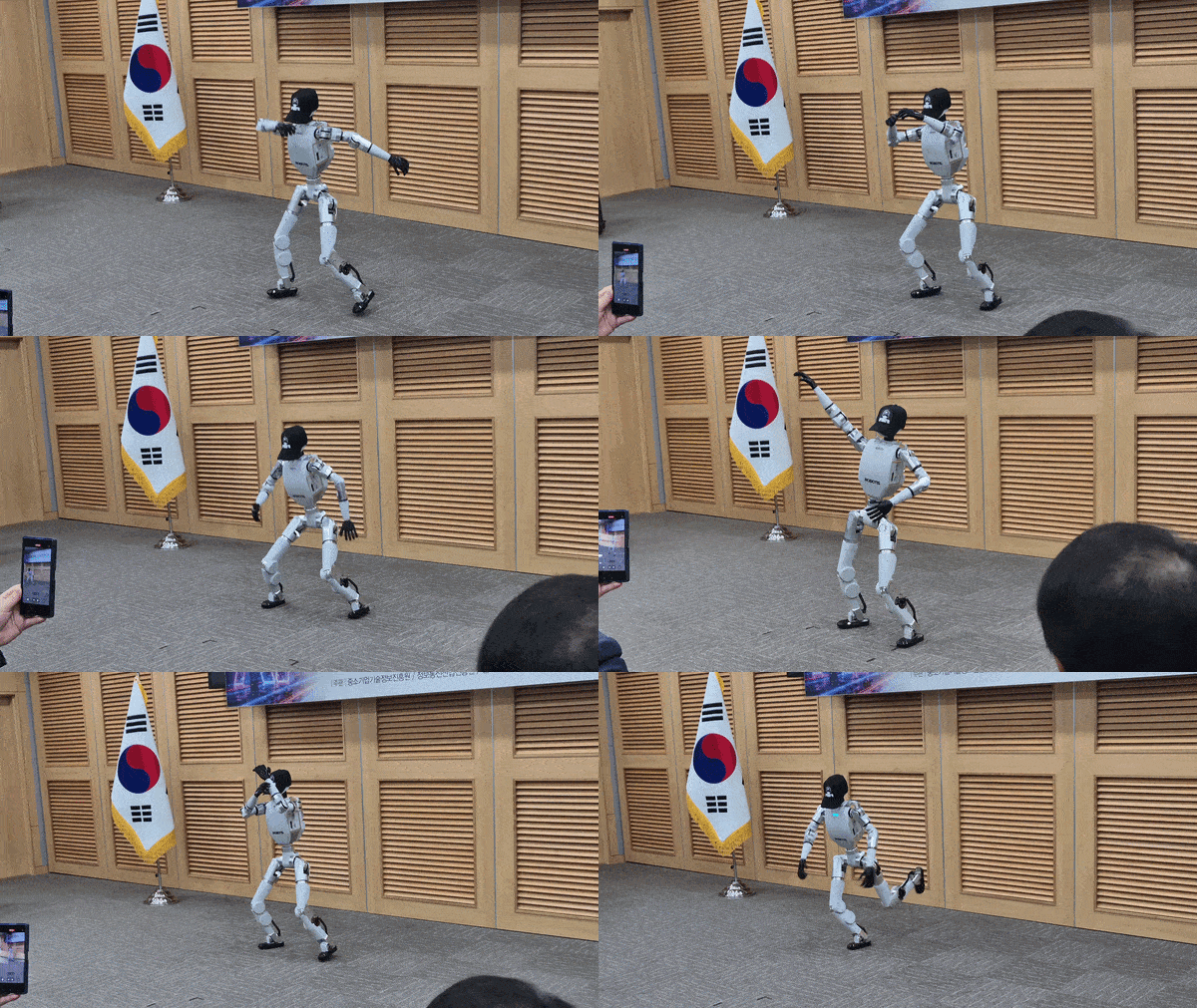
Also on display at the forum was AI Sapiens, a humanoid robot Robotis unveiled in April. The robot performed choreography from "REDRED," a song by idol group Cortis, swinging both arms freely and hopping on one leg to replicate the moves — drawing applause from the audience.
Kim founded Robotis in 1999 and has spent more than two decades building expertise in actuators — the components that function as a robot's joints. Drawing on that accumulated technology, the company is now pursuing the robot hand, humanoid robot, autonomous driving robot and industrial robot markets on all fronts.
First humanoid in 2013, now AI Sapiens — a second attempt 13 years later
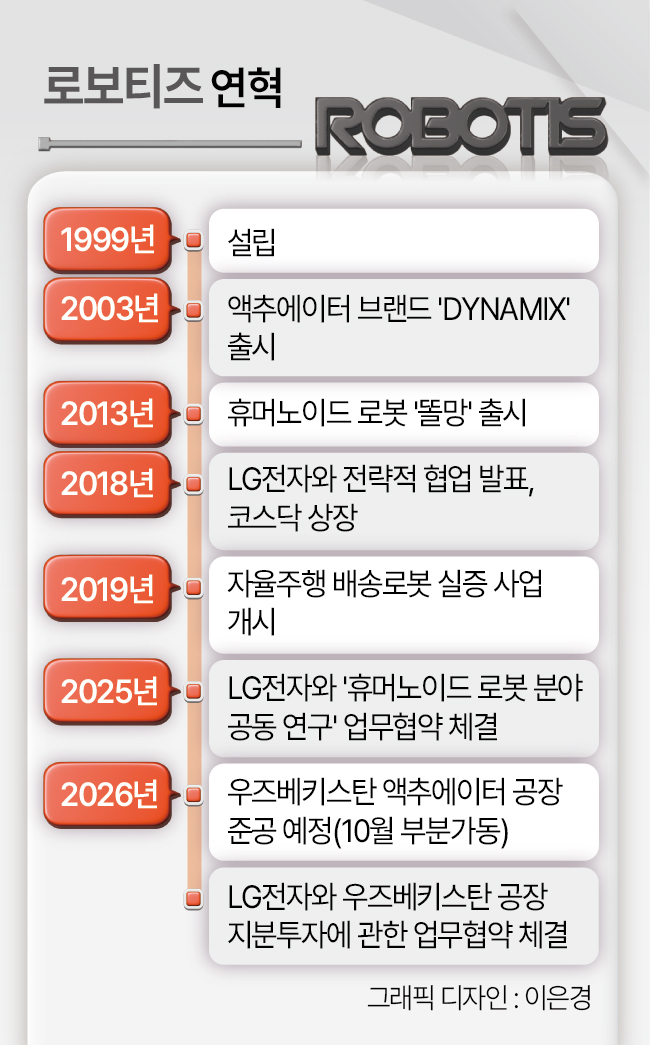
Robotis first introduced a bipedal humanoid robot 13 years ago. It launched "Ttolmang" in 2013, but the product attracted little attention because the humanoid market was slow to take off.
Now, with the arrival of the physical AI era stoking enthusiasm for humanoid robots, Robotis has re-entered the field with AI Sapiens. The company plans to begin full commercial sales next year.
"Watching the recent surge in actuator demand, I felt that the humanoid era is truly coming," Kim said. "AI Sapiens was built as a validation exercise ahead of our actuator launch."
Robotis said AI Sapiens is fully competitive with the G1, a humanoid robot made by Chinese firm Unitree.
"Unitree's G1 stands 130 centimeters tall; AI Sapiens is 135 centimeters. The knee joint structure is not significantly different," Kim said. "Test results show we have reached a level slightly superior to the Chinese product."
He also expressed confidence that South Korea, though a latecomer in humanoid robotics, can hold its own against China, the current leader in the field.
"Many companies are using Chinese robots right now, but deep down they want to use their own," Kim said. "They don't want 'action data' — the most important asset in the physical AI era — accumulating inside Chinese robots."
"The strong resistance to Chinese robots can become a real obstacle for Chinese companies," he added. "Korean companies have every chance of winning out against China and Europe."
Surging actuator orders drive overseas expansion — LG Electronics moves to lock in supply
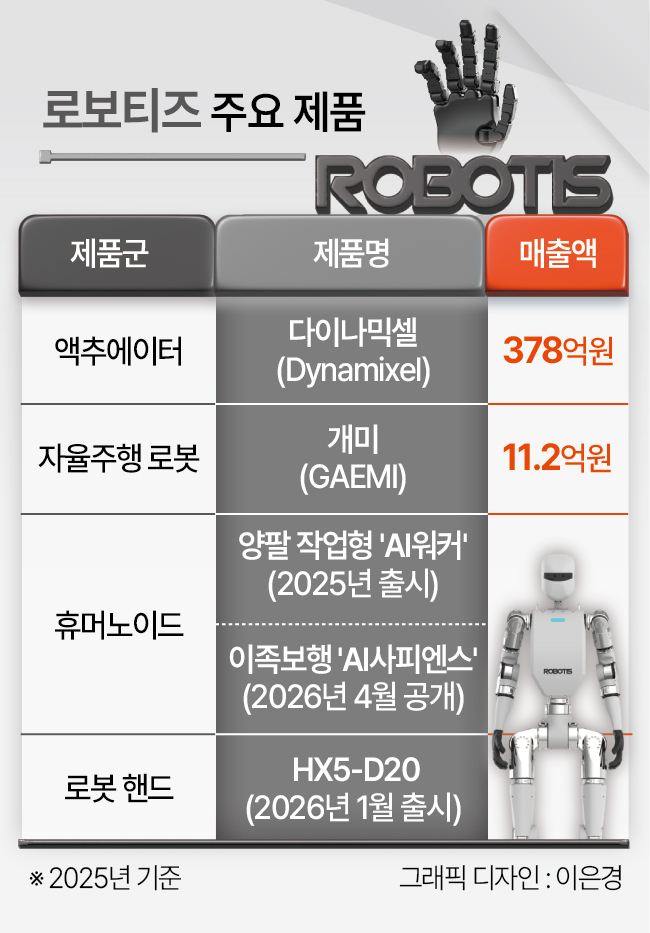
Robotis' core business is actuators — the components that serve as a robot's joints and muscles. The company has built up its capabilities in the field since launching its actuator brand Dynamixel in 2003.
After more than two decades of singular focus, Robotis has entered a full growth phase as the humanoid market begins to bloom. Last year it posted record sales of 38.9 billion won ($27.5 million) since its founding, with actuator sales accounting for 37.8 billion won, or 97.1 percent of the total.
Overall operating profit came in at 3.3 billion won, snapping a loss streak that had persisted for four years since 2022. Growing actuator orders from humanoid robot manufacturers drove the improvement in profitability.
Robotis plans to expand actuator output from about 220,000 units last year to more than 500,000 units this year. "Demand for actuators is rising sharply — most of it going into humanoid robots," Kim said. "We expect actuator output to more than double every year."
AI Sapiens is equipped with Dynamixel-Q, a humanoid-dedicated actuator developed by Robotis. The company began capital investment this year to scale up mass production of the humanoid-specific actuator.
Robotis is currently building a factory in Uzbekistan targeting completion in 2031, with a total production capacity of about 5 million actuators. Once the facility enters partial operation at year's end, combined capacity with the domestic Magok factory is expected to reach about 1.3 million units, according to industry estimates.
LG Electronics, Robotis' second-largest shareholder with a 6.6 percent stake, signed an MOU with Robotis in June to invest in the Uzbekistan factory.
LG Electronics has been building its own actuator production line at its Changwon factory, but its partnership with Robotis is widely seen as a move to also secure a stable supply of actuators for its own humanoid robots ahead of anticipated demand.
'Open the Kospi door to domestic robot firms — the bar is too high'

Kim said listing requirements on both Kosdaq and Kospi need to be relaxed to allow domestic robot companies to grow faster.
In October 2018, Robotis became the first domestic robot company to list on Kosdaq through the technology-exception listing regime, with its actuator technology recognized as the key qualifying factor.
"Our sales weren't large, but we were able to list because the evaluation placed heavy weight on technology," Kim said. "After that, as sentiment around robots warmed up, investors poured in, the share price rose and we were able to raise capital."
He said Kospi, by contrast, remains conservative toward robot companies. "Kospi still evaluates companies primarily on sales. It's time for Kospi to adopt a policy that more actively welcomes robot companies," he said.
His argument is that domestic robot companies need a path beyond Kosdaq — one that lets them raise large-scale funding through a Kospi listing.
"Unitree, which is listing on the Shanghai exchange this month, is expected to be valued at around 21 trillion won. US firm Figure AI, still pre-IPO, is valued at around 54 trillion won," Kim said. "The Korean government also needs to take note of the value of robotics and actively encourage it."
Cho Kyu-jin, a mechanical engineering professor at Seoul National University who was elected president of the IEEE Robotics and Automation Society — the world's largest robotics academic society — last November, praised Robotis at the forum. "Robotis' products are already world-renowned, widely used in universities and research institutes," he said. "For Korea to expand its reach globally, we need a second and third Robotis — companies that make excellent hardware."
"In the physical AI era, hardware is what travels well as an export. Hardware is hard to replicate," he added. "Robotis was able to do it because it spent 20 years accumulating know-how."
joze@heraldcorp.com