
South Korea's two dominant memory chipmakers, Samsung Electronics and SK Hynix, tumbled by double digits last week, falling far more steeply than their overseas peers. The combined weighting of the two companies in the Kospi's total market cap, which once approached 60 percent, has slipped below 50 percent.
Analysts at local brokerages say the scale of the correction is unprecedented, but caution that a genuine recovery will require upward earnings revisions and concrete shareholder return policies to come first.
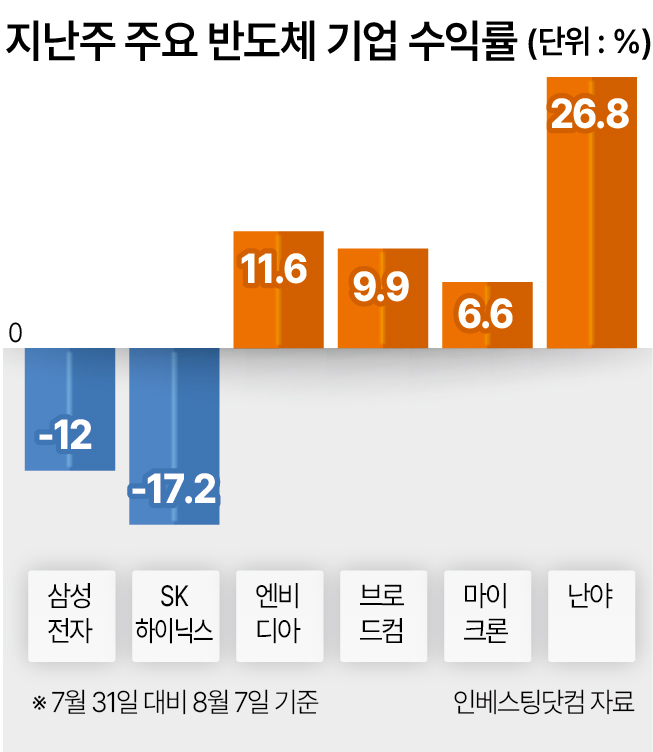
Korea Exchange data show Samsung Electronics' share price tumbled 12 percent from its July 31 close to its Aug. 7 close. SK Hynix fell even harder over the same period, dropping 17.2 percent.
Global chipmakers, by contrast, posted gains. Most stocks in the Philadelphia Semiconductor Index surged — Nvidia rose 11.6 percent, Broadcom 9.9 percent, Micron 6.6 percent and Intel 12.7 percent.
Major Taiwanese chipmakers also advanced. Nanya Technology, a Taiwanese DRAM maker, surged 26.8 percent, while chip designer MediaTek rose 9.7 percent.
As Samsung Electronics and SK Hynix tumbled, their combined weighting in the Kospi's market cap fell below 50 percent. As of Aug. 7, the two companies — including Samsung's preferred shares — accounted for 48.95 percent of the Kospi's total market cap, down more than 10 percentage points from a peak of 59.69 percent on June 25.
Foreign investors were particularly heavy sellers of domestic chip stocks last week. Korea Exchange data show foreigners net sold 1.3 trillion won ($915 million) worth of Samsung Electronics and 3.51 trillion won worth of SK Hynix during the first week of August. Institutional investors net sold 2.93 trillion won and 843 billion won of the respective stocks over the same period.
Some analysts now believe both share prices have reached a floor. Kim Rok-ho, a researcher at Hana Securities, said domestic memory chipmakers are suffering "serious reverse discrimination" compared with their global peers. "The unprecedented scale of the share price decline leads us to conclude that the bottom has been reached," he said, "but a recovery will require upward revisions to earnings forecasts and shareholder return announcements to come first."
He added that memory chip prices in the third quarter appear to be holding up as expected, and that investors should position themselves for the possibility of upward earnings revisions for memory chipmakers during the quarter.
Shareholder returns are also seen as a key catalyst for any share price recovery. Kim Dong-won, head of research at KB Securities, said he expects Samsung Electronics' forthcoming shareholder return policy to set annual returns at a minimum of 100 trillion won and a maximum of 200 trillion won — more than 10 times the existing 9.8 trillion won. "A large-scale shareholder return policy will serve as the starting gun for a share price rerating," he said.
Kim added that it is "abnormal" for Samsung Electronics, the world's No. 1 DRAM maker, to trade at a 4 percent discount to third-ranked Micron, even accounting for the dollar premium. "This is a zone where we have conviction to buy," he said.
Samsung Electronics is expected to announce a shareholder return policy that includes a special dividend in the near term, while SK Hynix also plans to unveil additional shareholder return measures within the third quarter.
Global investment banks have similarly flagged current share price levels as an attractive re-entry point. In a recent Asia technology report titled "Memory — A Small Bump," Morgan Stanley said "the steepest correction seen so far in the memory industry appears to be over." The bank singled out share buybacks and other shareholder return measures as key catalysts for future share price gains. It cautioned, however, that from the fourth quarter onward, the pace of memory price increases could slow as inventory and supply rise, leaving less room for further upward earnings revisions.
The report was written by Morgan Stanley analyst Sean Kim, who in 2021 issued an early warning about a sector downturn in a report titled "Memory — Winter Is Coming." Earlier in July, Morgan Stanley had also flagged the risk of a short-term correction, warning that the pace of DRAM price gains was approaching a peak and that investor positioning and leverage in memory stocks had become excessive.

jiyun@heraldcorp.com



