
![A notice about the government's tax reform plan is posted at a real estate agency in Seoul on Thursday. [Yonhap]](https://wimg.heraldcorp.com/news/cms/2026/08/07/rcv.YNA.20260806.PYH2026080611280001300_P1.jpg)
My tenant has already signaled they will exercise their lease renewal right, so I cannot sell until December 2028. Even if I wanted to sell, the property is in a land transaction permit zone, making it extremely difficult to offload a tenanted home. I followed all the cooperative lease conditions, yet there is no way to escape what amounts to punitive taxation.
— Lee, a registered rental housing provider
As the government moves to scrap the cooperative lease special tax exemption — set to expire at year's end under its 2026 tax reform plan — capital gains tax bills for single-homeowner landlords who met the cooperative lease conditions could more than double depending on when they sell.
The government once encouraged landlords to keep rent increases to 5 percent or below just once over the entire lease period, in exchange for capital gains tax exemptions or the long-term holding special deduction. Now, with the government announcing it will grant a grace period only to those whose current lease contract qualifies as a cooperative lease, frustration and confusion are spilling over among landlords.
Tax bill can double even for landlords who met cooperative lease terms — if current contract raised rent above 5%
A simulation commissioned from Yang Dong-hyeon, a team leader at Woori Bank's WM Sales Strategy division, shows that if landlord A — a non-resident single homeowner — bought an 84-square-meter unit at the Ricenz apartment complex in Jamsil-dong, Songpa-gu, Seoul for 1 billion won ($705,000) and sold it for 3.6 billion won, the capital gains tax liability could surge by as much as 161 percent depending on the timing of the sale.
If A sells the apartment for 3.6 billion won in 2027 after completing the mandatory eight-year rental period, the bill comes to 359.71 million won including local tax, thanks to the single-household capital gains tax exemption and a 50 percent long-term holding special deduction. The government has said it will preserve existing benefits for landlords whose cooperative lease contracts end by year's end, provided they sell by the end of December 2027.
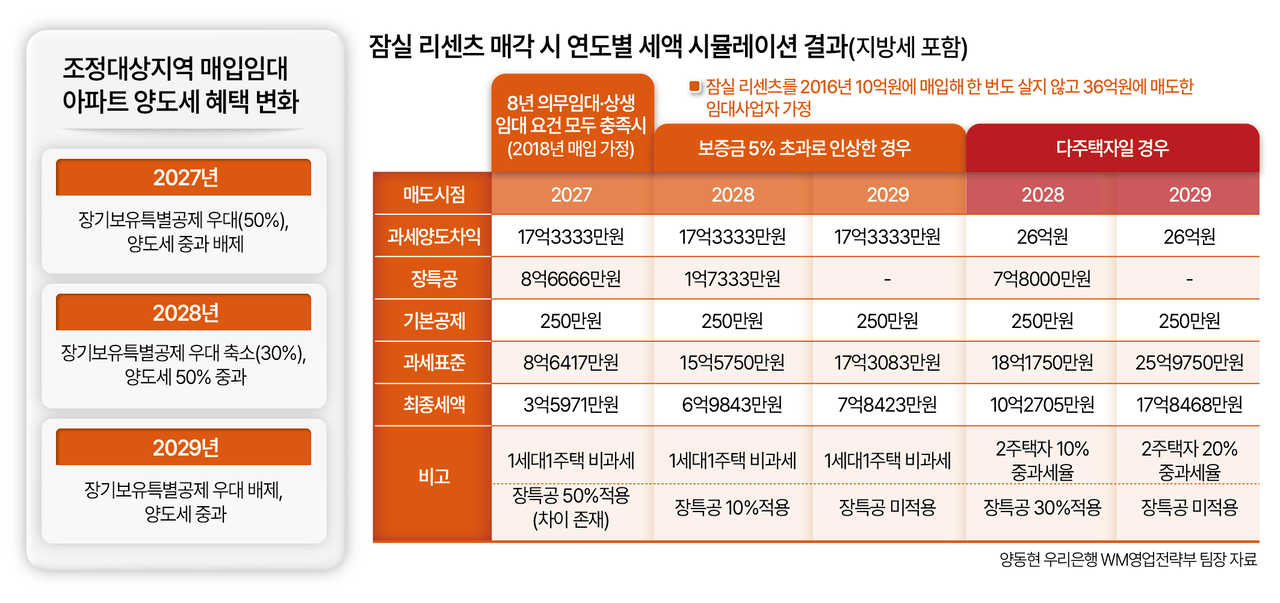
But if the tenant exercises the lease renewal right and the sale is pushed to 2028 — and the current contract raised rent by more than 5 percent — the tax bill balloons sharply. Should A, who bought the Ricenz unit for 1 billion won a decade ago, sell it for 3.6 billion won in 2028, only a 10 percent long-term holding deduction would apply, pushing the capital gains tax to 698.43 million won, a 94 percent increase.
If circumstances delay the sale further to 2029, the bill jumps to 784.23 million won — more than double the 2027 figure.
For a multi-homeowner rather than a cooperative lease landlord, the burden is even heavier. If A owns one additional property and sells under the same conditions in 2028 after holding for ten years, even with a 30 percent long-term holding deduction under the government's grace period, a 10 percent surcharge for two-home owners would apply, resulting in a capital gains tax bill of 1.03 billion won. In 2029, when the long-term holding deduction no longer applies, the tax on a capital gain of 2.6 billion won would reach 1.78 billion won — equivalent to 68 percent of the total gain.
President called rental landlord tax breaks 'strange' — now they're gone, and the market is pushing back
With tax liabilities varying so sharply by sale timing, landlords whose lease periods extend beyond 2028 say they have no choice but to delay selling, and resentment is growing.
One landlord said he registered as a rental housing provider at the government's urging during the Moon Jae-in administration, kept to the 5 percent rule throughout eight years of renting, and renewed the contract in March — only to find himself unable to sell by next year. He added that when he asked the tenant to vacate once the four-year lease expires, the tenant demanded 30 million won for moving costs, agency fees and compensation for damages.
The cooperative landlord system was introduced in 2017 under the Moon administration to promote rental housing registration. Under the system, single homeowners who agreed to raise rent by no more than 5 percent compared with the previous contract were exempted from the two-year residency requirement for the long-term holding special deduction.
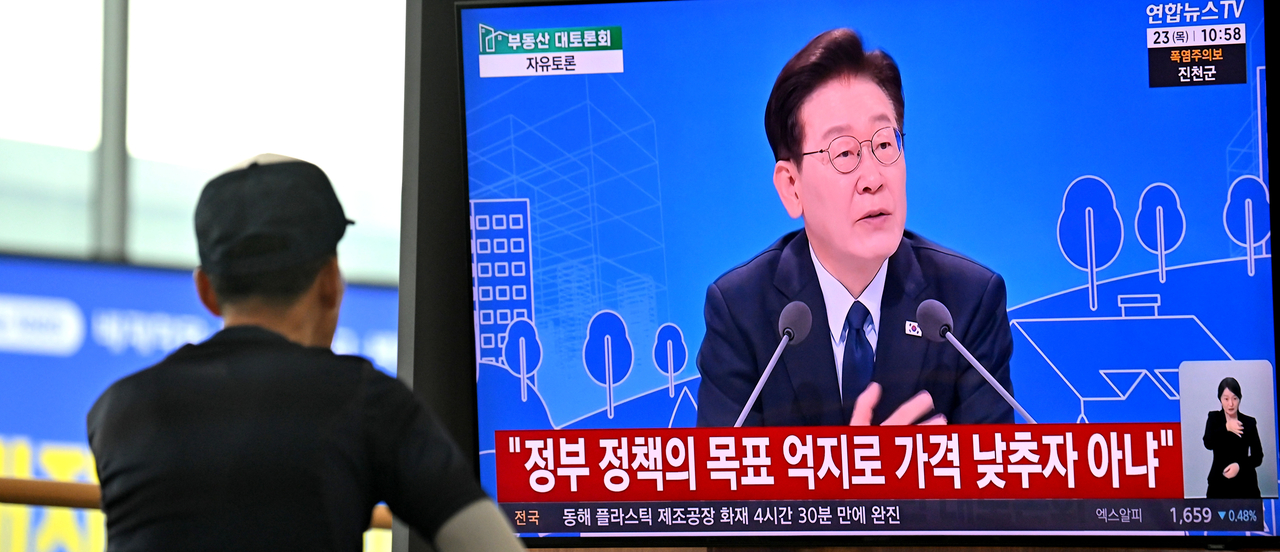
President Lee Jae Myung sharply criticized the purchase rental system and the various tax benefits granted to registered rental housing providers in February, writing on social media that it was "strange" that simply registering as a rental housing provider allowed people to accumulate hundreds of properties. The 2026 tax reform plan ultimately followed through by scrapping the cooperative lease special exemption.
Under the new rules, landlords must sell by the end of next year to have the two-year residency requirement waived. For cooperative lease contracts ending after January 2027, the government said the residency condition will be deemed met if the property is sold before whichever comes first: one year after the lease ends, or Dec. 31, 2029 — a form of grace period.
The catch is that these conditions apply only when the current lease contract qualifies as a cooperative lease. If a cooperative lease has already ended and the landlord raised rent by more than 5 percent upon renewal, the contract no longer qualifies — meaning the landlord must sell by the end of next year to receive the residency waiver. Before this reform, the capital gains tax exemption and long-term holding deduction were available regardless of sale timing, as long as rent had been raised by no more than 5 percent just once over the entire rental period, and the change stirs controversy.
In a case like A's, a landlord who trusted the previous government's assurances and met the cooperative lease conditions could face a tax bill more than double the original if the current contract raised rent above 5 percent.
'The government made a promise — changing it is a problem,' some say
The backlash has been swift. As of Friday, more than 1,140 public comments had been posted on the legislative opinion page of the National Participation Legislative Center, operated by the Ministry of Government Legislation, in response to the proposed partial amendment to the income tax act. One middle-aged landlord surnamed Lee said she registered as an eight-year long-term rental housing provider for an approximately 60-square-meter apartment, with the lease set to expire in September, but that her tenant has already signaled an intent to exercise the lease renewal right, making a sale before December 2028 impossible.
Some have gone further, questioning whether retroactively limiting the cooperative lease benefit to a fixed deadline raises legal issues — given that the current government is effectively reversing a commitment made by a previous administration.
A representative of one law firm said the amendment falls under the category of "impure retroactivity," making it difficult to declare it outright illegal, but added that it remains fair to ask whether the government could have found a less property-rights-infringing approach in reaching its policy judgment.
hss@heraldcorp.com



