![The Kospi is displayed on a screen at the Hana Bank dealing room in Jung-gu, Seoul, on Friday as the index opened higher. [Yonhap]](https://wimg.heraldcorp.com/news/cms/2026/08/07/rcv.YNA.20260807.PYH2026080701040001300_P1.jpg)
Share prices of the world's leading chipmakers have shed more than half their value from recent peaks, yet retail investors are treating the selloff as a buying opportunity and snapping up semiconductor stocks. Analysts at brokerages are also lining up behind the view that the current decline is a correction within a broader bull market — not the end of the cycle — citing continued capital expenditure expansion by hyperscalers and long-term supply agreements.
Data released Friday from Korea Securities Depository's SEIBro portal show that semiconductor companies dominated the top net-purchase rankings among Korean retail investors trading overseas markets from Monday through Thursday this week.
In the United States, Micron Technology (215.1 billion won, $152 million), SanDisk (210.3 billion won) and SK Hynix's American depositary receipts (137.7 billion won) all ranked within the top five most net-purchased stocks.
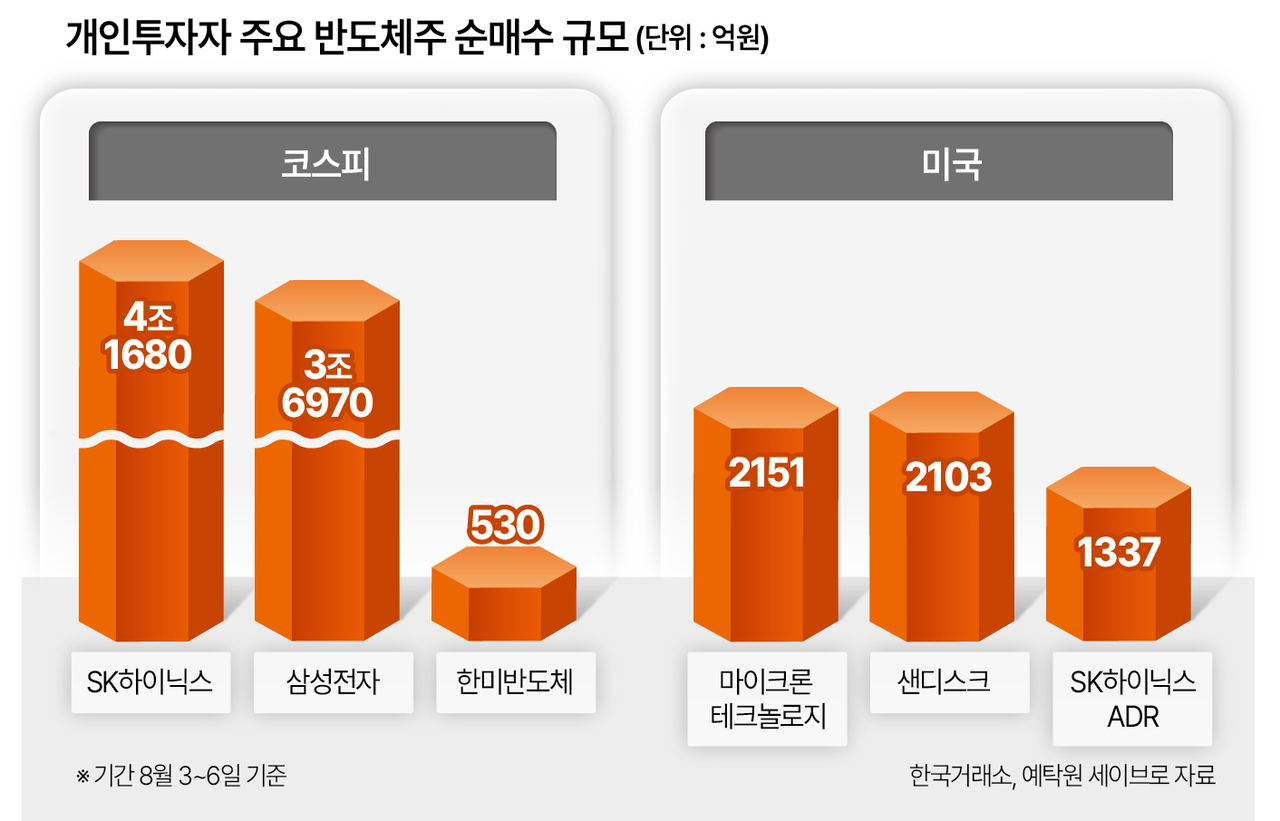
In Hong Kong, a two-times leveraged product on SK Hynix (XL2CSOPHYNIX) ranked third in net purchases at 2.7 billion won. In Japan, investors added meaningfully to positions in Tokyo Electron, a semiconductor front-end equipment maker (1.5 billion won), and RS Technologies, which operates in silicon wafers and semiconductor equipment (800 million won). In Chinese markets, AMEC, a leading semiconductor equipment company, ranked third in net purchases at 1 billion won.
The domestic market told a similar story. SK Hynix (4.17 trillion won) and Samsung Electronics (3.7 trillion won) were the top two most net-purchased stocks on the Korean market over the same period, with Hanmi Semiconductor ranking sixth at 53 billion won.
The buying spree reflects how far chipmaker share prices have fallen from their highs. Samsung Electronics closed Thursday at 230,500 won, down 38.45 percent from its intraday peak of 374,500 won recorded on June 19. SK Hynix fell nearly in half — dropping 49.95 percent from its intraday high of 2,987,000 won on June 25 to 1,495,000 won on Thursday.
Japan's top memory chipmaker Kioxia suffered the steepest decline, falling 56.75 percent from 112,700 yen on June 25 to 48,740 yen. Tokyo Electron also fell 31.91 percent from its previous high.
In the United States, Micron Technology dropped 29.76 percent from its peak, while SanDisk fell 46.54 percent. Nvidia, the top US chipmaker, held up relatively well, declining just 7.42 percent, buoyed in part by news of an exclusive partnership with Elon Musk.
The turbulence in global chipmaker stocks reflects a confluence of concerns: fears of an AI bubble, worries that the memory supercycle may be ending, and the threat posed by low-cost Chinese memory chips.
Still, the prevailing view in the brokerage community is that the memory supercycle will continue. Three of the four major hyperscalers — Microsoft, Alphabet (Google), Amazon and Meta — raised their annual capital expenditure guidance in their most recent second-quarter earnings releases. Amazon and Google lifted their guidance by 10 percent and 8 percent, respectively, while Meta also nudged its figure higher. Microsoft held its guidance steady.
"Management commentary on capital expenditure has turned more positive than before," said Han Sang-won, an analyst at Toss Securities. "In the previous quarter, the main reason for raising guidance was rising memory chip prices, but this time the core investment rationale cited was that computing demand is outpacing supply."
Some analysts now argue that memory chips have transitioned from a cyclical industry into a structurally growing one, underpinned by the vast demand generated by AI. Others suggest that as companies use long-term supply agreements to improve supply management, cycle volatility could be lower than in the past.
"Samsung Electronics has signed five-year long-term supply agreements with five global hyperscalers, and the contracted volumes will account for 60 to 70 percent of the DRAM and NAND capacity to be added going forward — structurally reducing the risk of the oversupply and sharp price declines that have recurred with every past cycle," said Han Yong-hee, an analyst at Growth Research. "The current level looks like an attractive entry point from a risk-reward perspective, with more upside from earnings growth than downside risk."
Roh Geun-chang, an analyst at Hyundai Motor Securities, said capital expenditure by North American cloud service providers "appears set to keep expanding through 2028, despite deteriorating free cash flow and rising borrowing costs."
On CXMT, the Chinese chipmaker seen as a low-cost threat to the market, Roh said: "There are concerns about CXMT's rising profile, but given the massive capital investment by TSMC and the three major memory chipmakers — Samsung Electronics, SK Hynix and Micron — CXMT is expected to face significant difficulty securing foreign equipment, and US sanctions on its equipment access are likely to tighten further."
Goldman Sachs also maintained an optimistic view on the memory chip sector, saying this memory cycle will prove stronger and longer-lasting than previous ones, given accelerating computing demand and a severe supply shortage that could persist through 2030.
"The strong pricing power and profitability of the memory sector are not yet fully reflected in current share prices," Goldman Sachs strategist Timothy Mo said. He added that concerns about the memory cycle, hyperscaler capital expenditure, capital market financing and intensifying competition were not enough to undermine the long-term growth scenario.
The key variable, however, is interest rates. "As capital expenditure keeps growing, big tech companies are burning through cash rapidly, and external fundraising — through share issuances, corporate bond offerings and joint ventures — has already begun," one analyst said. "The interest rate sensitivity of capital expenditure is rising."

jiyun@heraldcorp.com