![Seoul Mayor Oh Se-hoon speaks at a public forum on real estate normalization held at Seoul City Hall on Thursday. [Provided by Seoul Metropolitan Government]](https://wimg.heraldcorp.com/news/cms/2026/08/06/news-p.v1.20260806.fdd3b58a824b4f608007bee8ed3bb60c_P1.jpg)
Seoul Mayor Oh Se-hoon said Thursday that the government's tax reform plan would "fail to rein in home prices while driving up jeonse and monthly rents," and called for expanding housing supply to stabilize the market. At a public forum convened by the Seoul Metropolitan Government as a counterpart to a government-led real estate forum held last month, residents voiced demands for easing financial regulations and maintaining the current long-term holding special deduction.
Speaking at the "Public Forum for Real Estate Normalization" held at Seoul City Hall that morning, Oh warned that "elderly homeowners with poor cash flow due to tax burdens will be forced — against their will — to sell their homes." He argued that a tax regime targeting ultra-high-priced properties, with no visible plan to increase supply, could end up squeezing middle-class homeowners and tenants.
The government held five real estate forums from July 14 to July 27 and announced its tax reform plan on Monday. The plan tightens the tax burden on multi-home owners, holders of ultra-high-priced properties and non-resident single-home owners, raising concerns that housing demand could shift toward less premium single-unit homes as buyers seek to avoid the higher levies.
Seoul residents warn of worsening jeonse shortage
Residents and experts attending the forum — including non-resident single-home owners, young people without homes and private rental business operators — spoke on tax reform, real estate transactions, the jeonse and monthly rent market, and housing supply.
Concerns about the jeonse and rental shortage dominated the discussion. Speakers said tenants are being pushed out as transaction regulations, owner-occupancy requirements for landlords and a tax overhaul shifting the focus from ownership to residency pile up simultaneously.
One attendee who has run a licensed real estate agency in Jamsil-dong, Songpa-gu for 21 years said that owner-occupancy requirements imposed on landlords in parts of Seoul and Gyeonggi Province, compounded by the latest tax reform plan, are prompting landlords to move back into their own units. "As a butterfly effect, jeonse and monthly-rent listings that used to number at least 50 to 80 have now fallen to fewer than 10, and prices have gone up as well," the attendee said.
The attendee added that "tenants have had a very hard time meeting the various conditions landlords demand," and warned that the jeonse crisis would deepen once relocations begin in earnest at complexes such as Eunma Apartments and Jamsil Jugong 5 complex, which are approaching redevelopment.
Choi Wang-gyu, a tax accountant active in Mapo-gu, said the government had undermined the stability and predictability of its own policies by scaling back tax benefits for registered rental business operators. "Registered rental operators have been unable to raise rents all this time and could not freely terminate lease contracts due to the lease renewal right," he said, calling for a grace period.
The tax reform plan includes a phased elimination of the capital gains tax surcharge exemption and preferential long-term holding special deduction for rental apartments purchased in designated adjustment areas. Homes sold through 2027 will continue to receive the current exemption from the surcharge and a 50 percent preferential deduction rate. In 2028, the surcharge rate will be applied at half the full level — an additional 10 percentage points above the basic rate for two-home owners and 15 percentage points for those with three or more homes. The preferential deduction rate will also be lowered to 30 percent. After that, both the surcharge exemption and the preferential deduction will be eliminated entirely.
There are also concerns that expanding regulations on rental business operators — a key pillar of rental supply — will accelerate the shrinkage of jeonse and monthly-rent listings.
Eyes on whether forum demands will shape government supply plan
With the government expected to announce a housing supply plan as early as next week, attention is focused on whether the issues raised at Thursday's forum will be reflected in it. President Lee Jae Myung is set to chair a closed-door "Second Real Estate Supply Review Meeting" on Friday.
The meeting comes four days after Lee wrapped up a tour of the United States and three South American countries on Monday and held a marathon session of more than seven hours. The day before the forum, Kim Yong-beom, the presidential chief policy secretary at Cheong Wa Dae, and Mayor Oh held a working lunch, signaling that both sides are pressing ahead on supply.
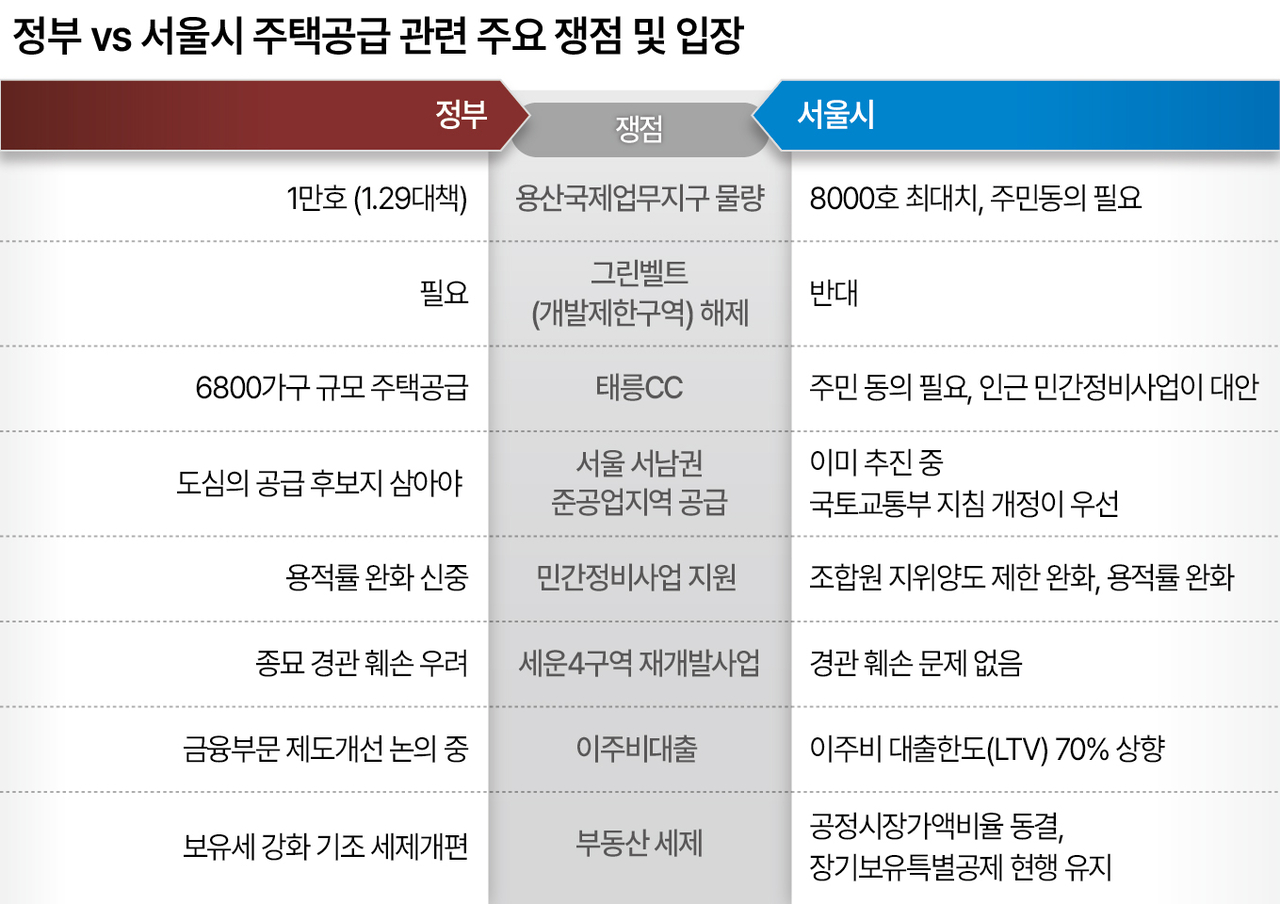
The government and the Seoul Metropolitan Government agree on the need to expand housing supply in central urban areas but have differed on the approach, particularly over the Yongsan International Business District and the use of semi-industrial zones. Even if the government announces a plan, its real-world impact is expected to be limited without cooperation from local governments.
For example, the government intends to secure large volumes of housing on public sites — including 10,000 units at the Yongsan International Business District and 6,800 units at the Taereung Country Club site in Nowon-gu — but Seoul City Hall is holding firm that private redevelopment projects should be supported instead, citing the need to preserve Yongsan's existing functions and opposition from local residents.
The two sides also diverge on additional supply through greenbelt release. Land Minister Kim Yun-deok earlier expressed willingness to partially lift greenbelt restrictions to boost housing supply. Candidate sites include areas around Segok-dong and Jagok-dong in Gangnam-gu and the Suseo vehicle depot, which could absorb demand in the Gangnam area, as well as a reserve forces training ground in Naegok-dong, Seocho-gu, and land near the Olympic Athletes' Village in Bangi-dong, Songpa-gu.
Oh, however, expressed opposition to greenbelt release even in his meeting with Chief Policy Secretary Kim, according to people familiar with the talks. The city argues that releasing greenbelt land not only faces resident opposition but also conflicts with Seoul's policy of preserving green space by channeling housing supply through redevelopment of aging residential areas.
The use of semi-industrial zones, by contrast, is an area where the government and Seoul City Hall are relatively aligned. Seoul already moved to ease floor-area-ratio limits in those zones — raising the ceiling from 250 percent to 400 percent — through its 2024 "Southwest Seoul Transformation" announcement, suggesting a compromise is within reach.
Also at issue is whether the government's supply plan will include three measures Seoul has been pushing for: raising the loan-to-value ratio cap on relocation loans to 70 percent, easing restrictions on the transfer of association membership rights, and allowing floor-area ratios up to 1.2 times the legal ceiling for redevelopment projects. Financial authorities are currently reviewing whether to exempt collective loans — covering relocation loans, interim payments and balance loans for end-users — from the overall household lending cap.
The outcome of next week's supply meeting is expected to hinge on how far the government and Seoul City Hall can close the gap on these contested measures.
lucky@heraldcorp.com
hope@heraldcorp.com
quq@heraldcorp.com