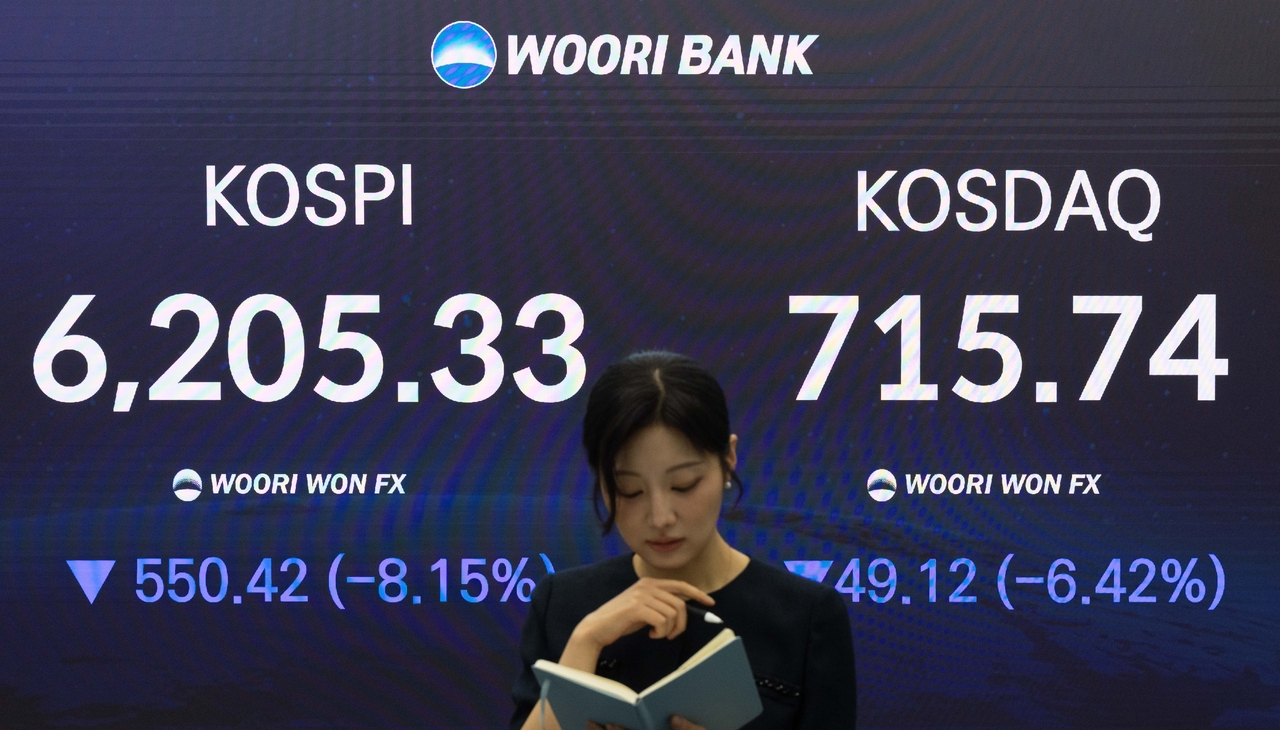
Forced liquidations of margin-financed stock positions at South Korea's 10 largest brokerages jumped nearly sevenfold in the first half of this year, as growing market volatility caught leveraged retail investors off guard even as the broader market rallied on an AI semiconductor boom. Investors in their 50s accounted for the largest share of forced liquidations by value, while those aged 70 and older posted the steepest rate of increase among all age groups.
Data submitted to the office of People Power Party lawmaker Kim Sang-hoon by 10 major domestic brokerages — Mirae Asset Securities, Korea Investment & Securities, Samsung Securities, KB Securities, NH Investment & Securities, Shinhan Investment, Meritz Securities, Kiwoom Securities, Hana Securities and Daishin Securities — showed that the total value of margin loan forced-liquidation trades settled in the first half of this year reached about 1 trillion won ($682 million).
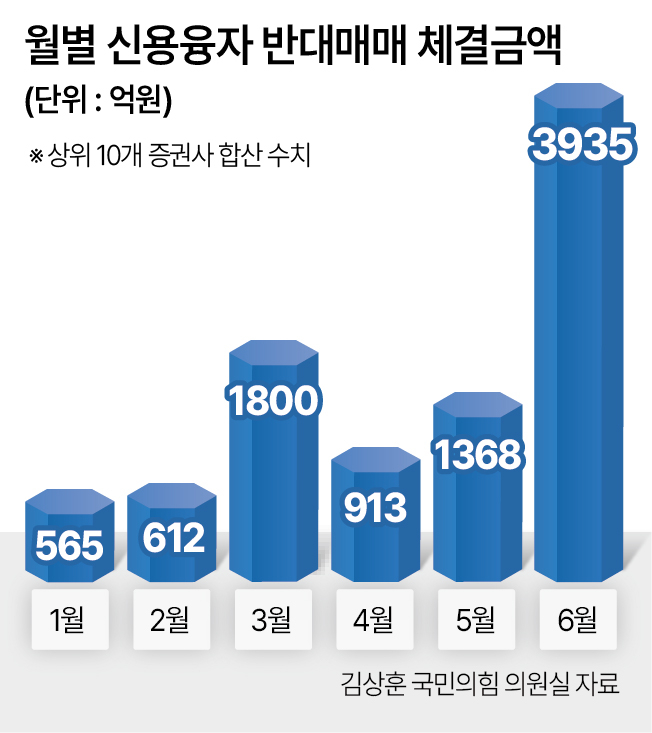
Forced liquidations settled in June alone totaled 393.51 billion won, up 337 billion won from 56.51 billion won in January — a surge of 596.39 percent. A forced liquidation occurs when a brokerage forcibly sells shares purchased with borrowed funds after the collateral value falls below a required threshold.
Monthly figures show the scale of forced liquidations held relatively steady from January's 56.5 billion won to February's 61.2 billion won before jumping sharply to 180 billion won in March. The figure pulled back to 91.3 billion won in April, then climbed again to 136.8 billion won in May, before surging to 393.5 billion won in June — the highest monthly total of the year.
The number of accounts hit by forced liquidations also climbed sharply. In June, the number of margin loan accounts subject to forced liquidation reached 21,615 — surpassing 20,000 for the first time this year — up 6,945, or 47.34 percent, from 14,670 in May. Over the same period, the total settlement value nearly tripled, rising 256.7 billion won, or 187.61 percent, from 136.82 billion won to 393.51 billion won within a single month.
The value of forced liquidations grew far faster than the number of affected accounts, indicating that the average size of each forced sale also expanded. The average forced-liquidation amount per account nearly doubled, rising from about 9.32 million won in May to about 18.2 million won in June. Not only were more investors caught in forced liquidations — the scale of each individual liquidation also grew larger.
The June spike in forced liquidations was closely tied to conditions in the market at the time. The Kospi ended the month virtually flat, moving from 8,476.15 at the start of June to 8,476.48 at month's end. Beneath that calm surface, however, the market was sharply polarized around AI semiconductor stocks. Single-stock leveraged and inverse ETFs and exchange-traded notes based on Samsung Electronics and SK Hynix — the first such products in South Korea — listed on May 27 and saw trading activity accelerate from June onward. The KRX SK Hynix index rose 13.59 percent in June, the highest gain among all KRX indexes, while the KRX Samsung Electronics index climbed 5.36 percent. In contrast, the KRX Steel index fell 26.07 percent, and a broad range of other sectors posted double-digit losses — automobiles down 25.90 percent, KRX300 Consumer Discretionary down 23.48 percent and KRX300 Materials down 21.23 percent — widening the performance gap between individual stocks.
While the headline index suggested a stable market, the reality for most investors was far harsher. As demand concentrated in a handful of AI semiconductor names such as Samsung Electronics and SK Hynix, the majority of sectors and small- and mid-cap stocks fell sharply. In June, declining stocks on the Kospi numbered 787 — more than six times the 130 that advanced — while on the Kosdaq, 1,521 stocks fell against only 224 that rose. Investors who had used margin financing on individual stocks were pushed into forced liquidations as collateral values eroded, and this stark divergence in stock-level returns drove the June surge.
By age group, investors in their 50s bore the heaviest burden. Their forced-liquidation settlement amount in June reached 142.05 billion won, the highest of any age group, followed by those in their 40s at 102.87 billion won, those in their 60s at 67.87 billion won and those in their 30s at 52.34 billion won. Combined, investors aged 40 to 60 accounted for 312.9 billion won — roughly 80 percent of the June total of 393.5 billion won — underscoring how heavily forced liquidations fell on middle-aged investors.
The fastest rate of increase, however, was recorded among investors aged 70 and older. Their forced-liquidation settlement amount rose 791 percent, from 1.83 billion won in January to 16.32 billion won in June. The monthly figures for that age group fluctuated — 1.8 billion won in January, 3.1 billion won in February, 7.2 billion won in March, 4.3 billion won in April and 6.2 billion won in May — before jumping to 16.3 billion won in June. By comparison, investors in their 50s saw a 693 percent increase, from 17.91 billion won in January to 142.05 billion won in June, while those in their 40s rose 504 percent, from 17.02 billion won to 102.87 billion won — both below the rate posted by the 70-and-older group. The number of forced-liquidation accounts for investors aged 70 and older also more than tripled, from 357 in January to 1,174 in June.
Forced liquidations also surged in unsettled-trade transactions, a form of ultra-short-term credit trading in which a forced sale is triggered immediately if an investor fails to deposit funds by the settlement date. Data submitted to Kim's office show that the settlement value of forced liquidations from unsettled trades jumped 348.1 percent, from 188.79 billion won in January to 845.93 billion won in June. The number of accounts subject to such forced liquidations rose 165.2 percent over the same period, from 14,611 to 38,755. Because unsettled trades carry an immediate forced-sale trigger, they are particularly sensitive to market volatility.
Middle-aged investors also dominated unsettled-trade forced liquidations by age group. In June, investors in their 50s recorded the highest settlement value at 288.57 billion won, followed by those in their 40s at 220.9 billion won and those in their 60s at 187.54 billion won. The steepest rate of increase again belonged to investors aged 70 and older, whose settlement value surged 656.7 percent — from 9.07 billion won in January to 68.63 billion won in June — the largest percentage gain of any age group.
Analysts say the trend is closely linked to the AI- and semiconductor-driven stock market environment. "Margin trading has a procyclical nature — it amplifies buying demand during upswings but intensifies selling pressure through forced liquidations during downturns," said Hong Ji-yeon, a senior researcher at the Korea Capital Market Institute. "Given that South Korea's stock market is characterized by a high proportion of retail investors and heavy use of leverage, the need to strengthen risk management around margin trading grows alongside market volatility."
hajun825@heraldcorp.com
jiyun@heraldcorp.com