
The equity risk premium for the South Korean stock market — a measure of the extra return investors demand for taking on equity risk — has reached its highest level since January 2007, when the Bank of Korea began tracking the indicator. The current reading is roughly 1.7 times higher than the peak recorded during the 2008 global financial crisis.
The Bank of Korea believes that a sharp rise in expected corporate earnings — particularly in the semiconductor sector — has had a greater influence on the equity risk premium's rise than any strengthening of risk-averse sentiment among investors.
An analysis of data from the Bank of Korea, Bloomberg and Refinitiv found that the equity risk premium stood at 13.7 percentage points as of Monday — the highest since Jan. 1, 2007, the earliest date for which the central bank officially tracks the figure. The Bank of Korea has published equity risk premium trends in its Financial Stability Report since 2021. The most recent figure disclosed in the June report covered data through June 9, when the premium stood at 8.7 percentage points.
The equity risk premium is the additional expected return investors require as compensation for the risks of holding equities. It is calculated by subtracting the yield on 10-year government bonds from the earnings-to-price ratio — the inverse of the 12-month forward price-to-earnings ratio based on MSCI data. The earnings-to-price ratio indicates how undervalued or overvalued the current share price is relative to the expected earnings per share of major domestic companies over the next 12 months.
A higher earnings-to-price ratio means share prices are undervalued relative to expected earnings one year out. A widening gap between the earnings-to-price ratio and the government bond yield has traditionally been interpreted as a sign that investors are becoming more risk-averse, pushing share prices lower. The equity risk premium typically rises when economic uncertainty increases, when corporate earnings deteriorate, or when risk-averse sentiment intensifies.
The recent reading stands well above levels seen during past global crises. Even at the height of the global financial crisis in late 2008, the premium reached only 8 percentage points. In early 2020, as COVID-19 began spreading rapidly, the peak was 9.9 percentage points — just below the 10-point threshold. During the Russia-Ukraine war and the Federal Reserve's tightening cycle in 2022, it remained below 9 percentage points.
![[Created using Gemini]](https://wimg.heraldcorp.com/news/cms/2026/07/25/news-p.v1.20260725.eb5eaf77601e48659d100696313d3329_P1.png)
The recent surge in the equity risk premium reflects a sharp jump in the earnings-to-price ratio against a backdrop of only modest increases in government bond yields. Compared with June 22, the forward price-to-earnings ratio as of Monday had tumbled roughly 30 percent, falling from 8 times to 5.6 times. Its inverse, the earnings-to-price ratio, moved in the opposite direction — rising from 12.5 percent to 18 percent. Over the same period, the yield on 10-year government bonds edged up just 0.15 percentage points, from 4.192 percent to 4.342 percent. The earnings-to-price ratio's rise far outpaced the increase in bond yields, driving the equity risk premium higher.
For the earnings-to-price ratio to rise, either share prices must fall or expected net profit must increase — since the ratio is calculated by dividing expected earnings per share over the next 12 months by the current share price.
Consider a hypothetical company, Company A, with a share price of 10,000 won ($7) and expected earnings per share of 1,000 won one year out. Its earnings-to-price ratio — expected earnings divided by share price — would be 10 percent. If expected earnings remain unchanged but the share price falls 20 percent to 8,000 won, the ratio rises to 12.5 percent. Conversely, if the share price stays flat but expected earnings rise 20 percent to 1,250 won, the ratio reaches the same 12.5 percent.
The same outcome can occur even when share prices rise, as long as expected earnings grow by a larger margin — or when expected earnings fall but share prices drop by an even greater proportion. For Company A, if the share price climbs 20 percent from 10,000 won to 12,000 won but expected earnings surge 50 percent to 1,500 won, the ratio still comes to 12.5 percent. Likewise, if expected earnings fall 20 percent to 800 won but the share price drops 36 percent to 6,400 won, the ratio is again 12.5 percent.
The equity risk premium rose 1.9 percentage points — from 6.5 percentage points in early January to 8.4 percentage points on June 22 — even as the Kospi more than doubled over the same period, surging from 4,309.6 to 9,114.6. A rising share price would normally push the earnings-to-price ratio and the equity risk premium lower. That the premium climbed anyway is interpreted as a sign that expected corporate earnings grew at an even faster pace.
A Bank of Korea official said that while a rising equity risk premium generally signals stronger risk aversion, the recent increase in the earnings-to-price ratio occurred as share prices continued to climb and profit forecasts reached unprecedented levels. "It is more appropriate to interpret this as a significant increase in the expected return on equities," the official said.
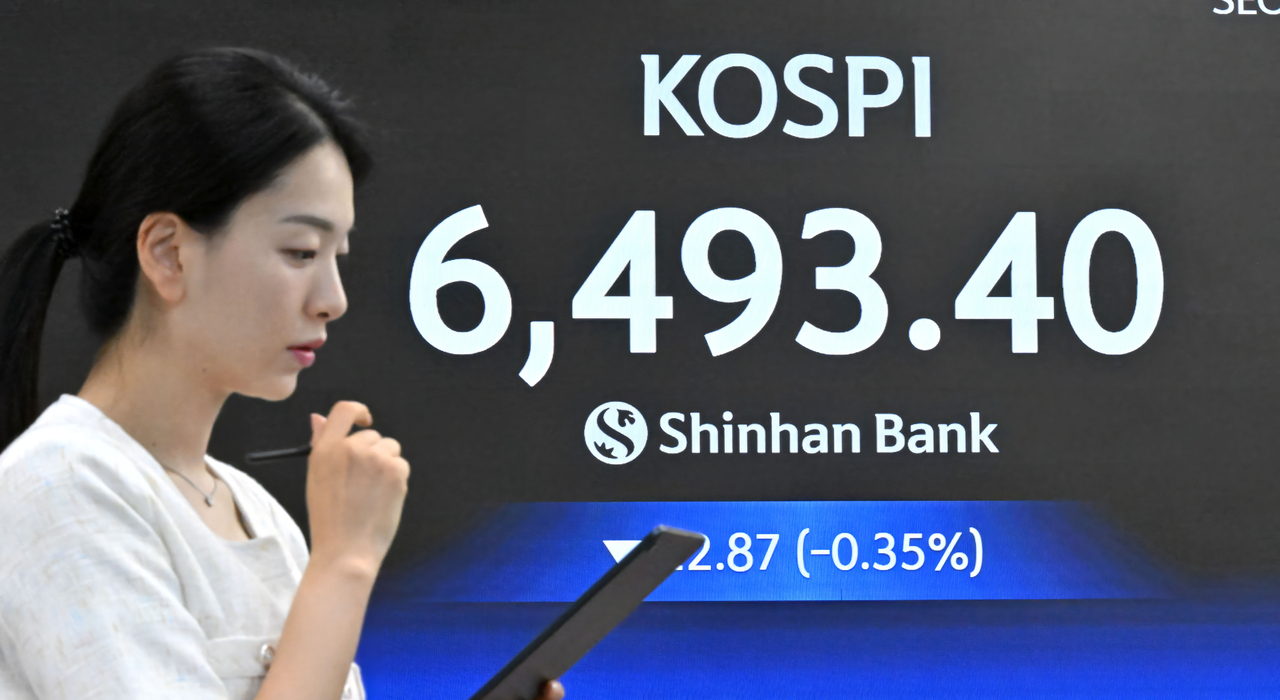
The picture shifted somewhat from mid-June onward, as share prices tumbled sharply — driven largely by single-stock leveraged products tied to large-cap semiconductor names such as Samsung Electronics and SK hynix. The Kospi fell 26.6 percent, from 9,114.6 on June 22 to 6,690.6 on Friday.
Whereas the equity risk premium had previously been rising because expected earnings were growing faster than share prices, the recent sharp decline in share prices is now pushing the premium even higher.
Even so, the Bank of Korea maintains that the rise in the equity risk premium reflects higher expected returns rather than a broad shift toward risk aversion — because corporate profit forecasts remain elevated.
"Share prices have fallen sharply recently, but the earnings companies are expected to generate over the next 12 months have either held steady or been revised slightly upward," the Bank of Korea official said. "While share prices are lower than their peak, they are not particularly low compared with the start of this year, so it is still difficult to say that risk aversion has strengthened."
The official added that it is unusual for profit forecasts to remain intact even as share prices fall this sharply, since earnings expectations typically deteriorate alongside declining prices. "The domestic stock market right now appears to be in a situation where share prices are falling even though there is nothing wrong with corporate fundamentals," the official said.
kimstar@heraldcorp.com




