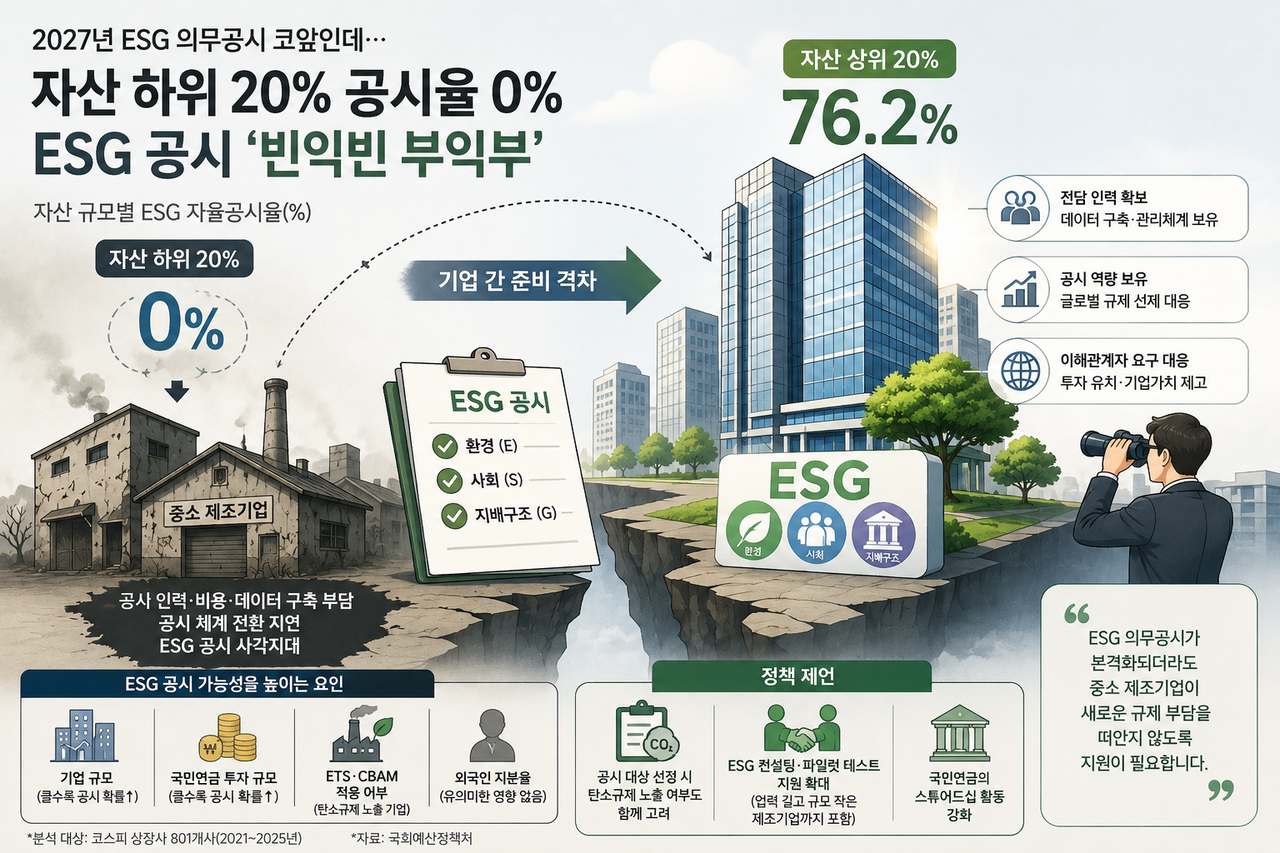
A stark divide in ESG (environmental, social and governance) disclosure readiness has emerged among South Korean companies ahead of mandatory reporting requirements set to take effect in fiscal year 2027. Voluntary ESG disclosure rates among firms in the bottom 20% by assets stood at 0%, while the top 20% reached 76.2%. Analysts warn that smaller manufacturing firms lacking disclosure infrastructure could face a significant new burden once mandatory reporting begins, and that tailored support will be needed.
According to a report published Saturday by the National Assembly Budget Office — titled "ESG Disclosure: Who Does It and Why? An Analysis of the Determinants of Voluntary Disclosure" — voluntary ESG disclosure among Kospi-listed companies grew from 78 firms in 2021 to 225 last year.
Even so, the overall disclosure rate among all listed companies was limited to 27.5%. Of the 801 Kospi-listed firms covered in the analysis, only 222, or 27.7%, voluntarily disclosed ESG information. Growth in voluntary disclosure has also shown signs of slowing recently.
The gap between companies was starkest when measured by asset size. The ESG disclosure rate among firms in the bottom 20% by assets was 0%, rising to 4.4% in the second quintile, 15.6% in the third and 42.5% in the fourth — a clear pattern of higher disclosure rates as asset size increases.
Firms in the top 20% by assets reached a disclosure rate of 76.2%. By sector, the financial industry posted the highest rate at 59.6%, followed by other industries at 31.6%, while manufacturing was limited to 22.5%, below the overall average of 27.7%.
The findings suggest that ESG disclosure is not simply a matter of willingness.
Preparing ESG disclosures requires substantial cost and capacity — dedicated personnel, data infrastructure and internal management systems — giving large companies with established disclosure frameworks a structural advantage.
A company's age also proved to be a factor. Older firms tended to have more entrenched financial reporting systems, making the transition to ESG disclosure frameworks comparatively slower.
Firms with fewer than 23 years of operating history posted an ESG disclosure rate of 41.5%, while those with 64 or more years of history were limited to 22.6%. Older and smaller manufacturing firms were identified as the most underserved segment in ESG disclosure.
The report also examined which types of companies are most active in ESG disclosure.
A logistic regression analysis of 801 Kospi-listed companies found that firm size, the scale of national pension investment, and exposure to the emissions trading system (ETS) and the carbon border adjustment mechanism (CBAM) all increased the likelihood of ESG disclosure. Foreign ownership, by contrast, had no statistically significant effect.
The influence of the national pension fund was particularly notable. Companies with larger national pension investment showed a higher probability of ESG disclosure — a finding attributed not merely to shareholding but to the fund's active exercise of shareholder rights under the stewardship code, which appears to have encouraged firms to disclose ESG information.
Companies subject to the ETS and CBAM were also more proactive in voluntary disclosure, as they already have greenhouse gas emissions management systems in place — reducing the relative burden of disclosure — and face greater pressure to meet global regulatory requirements.
"In operating the mandatory ESG disclosure regime, it will be necessary to consider not only asset size but also whether companies are exposed to carbon regulations such as the ETS and CBAM," said Kim Yun-hee, an analyst at the National Assembly Budget Office's industry and resources analysis division. She added that ESG consulting and pilot testing currently targeting firms with 2 trillion to 5 trillion won in assets should be expanded to include older, smaller manufacturing firms to ensure they have sufficient preparation time. "The national pension fund's stewardship activities should also be actively leveraged as a policy tool to encourage corporate ESG disclosure," she said.
fact0514@heraldcorp.com