
Narasallim Research Institute analyzes 2027 greenhouse gas reduction budget
Five-year total of 57.3 trillion won falls short of carbon neutrality investment plan of 89.9 trillion won
Number of participating ministries stagnates at 16; execution records and emissions impact assessments need improvement
![Workers install a median barrier at a road construction site in Seongsan-gu, Changwon, South Gyeongsang Province, on a morning when an extreme heat alert was in effect for the city. [Yonhap]](https://wimg.heraldcorp.com/news/cms/2026/10/14/news-p.v1.20260801.1a9b6ac74e084ace9d91ad2b8b7ff6eb_P1.jpg)
The government's greenhouse gas reduction budget will grow 25.9 percent next year, but its share of total government spending will still fall short of 2 percent, according to a new analysis. Although the greenhouse gas reduction-conscious budgeting system is entering its fifth year, the number of participating ministries has remained at 16. Analysts said the budget expansion must be accompanied by reforms — including public disclosure of project-level execution records and impact assessments for emissions-generating projects.
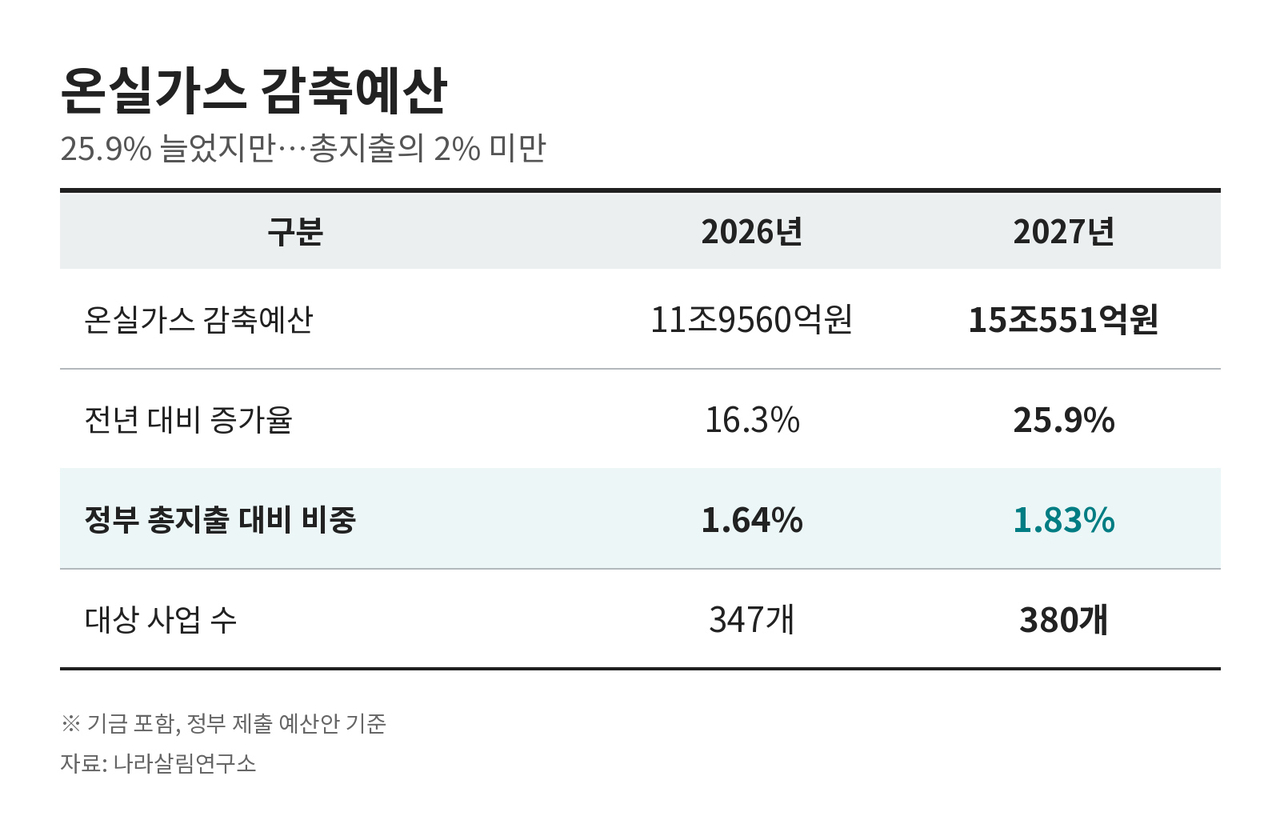
According to the "Analysis Report on the 2027 Greenhouse Gas Reduction-Conscious Budget" released Wednesday by the Narasallim Research Institute, next year's greenhouse gas reduction budget, including funds, stands at 15.06 trillion won ($11.2 billion). That is an increase of 3.1 trillion won, or 25.9 percent, from this year's 11.96 trillion won. The number of covered projects rose by 33, from 347 to 380.
The greenhouse gas reduction-conscious budgeting system is designed to analyze in advance how government spending affects climate change, encouraging national fiscal management to contribute to emissions reductions. The government has submitted the relevant budget documents to the National Assembly starting with the 2023 budget proposal.
Next year's increase in the reduction budget is the highest since the system was introduced, surpassing the overall government spending growth rate of 12.7 percent. The institute said the Lee Jae Myung administration is actively identifying and investing in greenhouse gas reduction projects.
However, the reduction budget accounts for just 1.83 percent of next year's total government expenditure proposal of 820.83 trillion won. The share has risen from 1.55 percent in 2023, 1.54 percent in 2024 and 1.52 percent in 2025 to 1.64 percent this year and 1.83 percent next year — a gain of only 0.28 percentage points since the system's first year. These figures are based on the government's submitted budget proposal, not the final budget approved by the National Assembly.
Five-year reduction budget falls short of carbon neutrality investment plan
The gap between the national carbon neutrality plan and the reduction budget was also flagged as a concern. The total reduction budget reflected in the greenhouse gas reduction-conscious budget proposals from 2023 to 2027 amounts to 57.3 trillion won — 32.6 trillion won less than the 89.9 trillion won fiscal investment plan set out for the same period under the First Carbon Neutrality and Green Growth Basic Plan.
The basic plan also includes 19.4 trillion won earmarked for climate change adaptation measures, which differ in nature from greenhouse gas reduction. Even excluding that amount, the reduction budget still falls 13.2 trillion won short of the remaining 70.5 trillion won, the institute found.
The picture changes depending on the scope of comparison. Adding up the full budgets of all detailed projects that include reduction components yields 71.7 trillion won over five years — exceeding the investment plan when adaptation measures are excluded. However, the institute said it is more appropriate to evaluate based solely on the portion of those budgets directly tied to reduction activities, since the detailed project budgets also contain spending unrelated to emissions cuts. For next year, the total budget for all relevant detailed projects is 20.06 trillion won, of which non-reduction spending accounts for 24.9 percent.
The number of ministries submitting budget documents has also barely grown. The count stood at 13 central government agencies in 2023, rose to 16 in both 2024 and 2025, reached 17 this year, and is back to 16 for next year. According to the institute, the Ministry of Interior and Safety and the Ministry of Employment and Labor have each operated sizable budget projects without submitting a single greenhouse gas reduction-conscious budget document since the system took effect. The Ministry of Health and Welfare and the Ministry of Culture, Sports and Tourism have each submitted one.
The institute said that while the unique characteristics of each ministry's programs should be taken into account, there is a need to actively develop reduction project categories and manage each ministry's submission performance.
Beyond budget size: execution rates and emissions impact must be tracked
Settlement and execution data needed to assess the adequacy of the reduction budget are also lacking. Next year's budget documents added policy management numbers to verify alignment with national carbon neutrality policy, as well as medium-term fiscal input plans by project — but prior-year settlement records were not included.
The institute cited the zero-emission vehicle distribution project as an example.
Next year's budget for the project is 3.01 trillion won, up 724.5 billion won, or 31.7 percent, from this year's original budget. Yet the project's execution rate in 2024 was just 65.6 percent, and in 2025, even after a 362.3 billion won budget cut, the execution rate against the revised budget reached only 83.9 percent. The institute said that while demand has been rising this year due to expanded subsidies, any budget increase should be accompanied by a clear justification that accounts for past execution performance.
The institute also proposed that the government analyze not only projects that reduce greenhouse gas emissions but also the emissions impact of fiscal projects that increase them. Although the government said at the time of the system's introduction that it would gradually expand coverage to include high-emission projects and steer them toward reductions, it has yet to present information on emissions-generating projects or an implementation plan for emissions impact assessments, even in the system's fifth year.
Some positive developments were also noted. The budget share of quantitative projects that directly reduce greenhouse gas emissions rose from 60.3 percent this year to 62.9 percent next year, and the number of such projects increased from 95 to 112.
The institute also called for legal and institutional reforms to support local governments in implementing the system.
Lee Seong-hyeon, a senior researcher at the Narasallim Research Institute, said the government issued operational guidelines for local governments in June but that implementation remains at each locality's discretion because the relevant laws have not been revised. "The Local Finance Act and the Local Accounting Act should be amended to clearly define the scope, coverage and content of the documents, and a foundation for full implementation should be established," he said.
fact0514@heraldcorp.com




