![Nvidia CEO Jensen Huang poses for a photo after a meeting with Samsung Electronics Chairman Lee Jae-yong and Hyundai Motor Group Chairman Euisun Chung at a fried chicken restaurant in Seoul's Samseong-dong in November 2025. From left: Lee Jae-yong, Jensen Huang, Chung. [Yonhap]](https://wimg.heraldcorp.com/news/cms/2026/07/22/news-p.v1.20251101.b00b6bdb966c4244984f419fa2e1dccc_P1.jpg)
Hyundai Motor Group Chairman Euisun Chung will join South Korea's economic delegation to the United States and Brazil. With US tariff pressures mounting and Chinese automakers intensifying their push into Brazil, the trip is seen as a move to personally oversee production and sales strategy in both key markets and accelerate the group's localization of manufacturing.
Cheong Wa Dae and business circles said Wednesday that Chung and other senior Hyundai Motor Group executives will join President Lee Jae Myung's US and Brazil tour, running from Friday through Aug. 3, as members of the economic delegation. It will be the third time this year Chung has joined a presidential trade mission, following trips to China in January and India and Vietnam in April.
The first stop is San Francisco. President Lee will hold a series of meetings Friday and Saturday with global AI company leaders, including Nvidia CEO Jensen Huang, OpenAI CEO Sam Altman and Anthropic CEO Dario Amodei. Chung is also expected to attend the "San Francisco AI Summit" alongside Samsung Electronics Chairman Lee Jae-yong, SK Group Chairman Chey Tae-won and Naver board chairman Lee Hae-jin, where participants will discuss AI cooperation between Korean and international companies.
Business circles are describing the gathering — with Huang and the heads of South Korea's major conglomerates in the same room — as a US version of the "Kkanbu" meeting, a term for a close-knit gathering of allies. Hyundai Motor Group already works with Nvidia on software-defined vehicles, autonomous driving, robotics and smart factory technology, and Chung is expected to explore ways to expand those partnerships. President Lee plans to announce a "San Francisco AI Declaration" at the summit, outlining South Korea's vision for AI investment and global cooperation.
After wrapping up the US leg, Chung is expected to accompany the president on a state visit to Brazil from Sunday through Tuesday, to review local investment and production expansion plans. He is not expected to join the subsequent legs of the tour covering Chile, Argentina and Germany.

US, the group's biggest market, races to localize amid tariff pressure
The United States is Hyundai Motor Group's largest market and the region where localization is advancing most rapidly. Hyundai Motor marks its 40th year in the US market this year. Since first exporting the Excel in 1986, the company has built production bases in Alabama and Georgia and steadily expanded into parts, logistics and financial services.
Hyundai Motor's North America sales last year reached 83.44 trillion won ($56.5 billion), up 8.3 percent from 77.03 trillion won the year before. North America's share of total sales of 186.25 trillion won rose from 44.0 percent to 44.8 percent. North America sales alone were 1.8 times the combined 47.51 trillion won generated across Asia, Europe and all other overseas markets.
Sales momentum has remained solid this year. Hyundai Motor and Kia sold a combined 920,383 vehicles in the United States in the first half of this year, including Genesis models — a 3.0 percent increase from the same period last year and a record for any first half.
To keep pace with rising sales, Hyundai Motor Group is investing a total of $21 billion in the United States from 2025 through 2028. Of that, $9 billion will go toward expanding the combined annual production capacity of Hyundai Motor, Kia and Genesis in the US to 1.2 million vehicles, with production facilities at Hyundai Motor Group Metaplant America in Georgia, Hyundai Motor's Alabama plant and Kia's Georgia plant all set to be upgraded.

Another $6 billion will be directed toward localizing parts, logistics and steel. Hyundai Steel plans to build an electric arc furnace steel mill in Louisiana with an annual capacity of 3 million tons to supply automotive steel sheet to Hyundai Motor Group's US plants. The remaining $6 billion will go into future businesses and energy infrastructure, covering autonomous driving, robotics, AI, advanced air mobility and electric vehicle charging. The group estimates the investment will create more than 100,000 direct and indirect jobs by 2028.
Despite record sales, tariff risk remains a significant burden. Vehicles produced in South Korea and exported to the United States currently face a 15 percent auto tariff. With the zero-tariff benefits previously enjoyed under the Korea-US Free Trade Agreement now gone, the tariff burden grows in step with every additional vehicle sold in the US market.
With the possibility of additional tariffs being raised once the global tariff pause ends, keeping auto tariffs from rising above the current 15 percent level is a central agenda item for the US visit and the broader Korea-US trade negotiations.
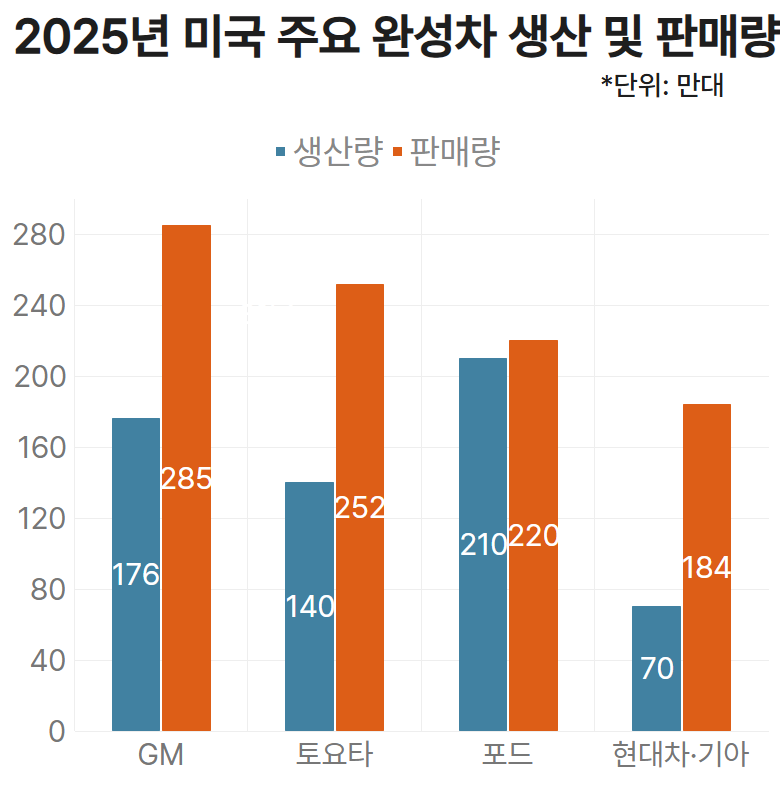
Market analysts estimate that Hyundai Motor and Kia together absorbed 3.42 trillion won in US tariff costs in the first half of this year alone — 1.82 trillion won for Hyundai Motor and 1.59 trillion won for Kia. The two companies themselves disclosed a combined tariff burden of approximately 1.6 trillion won for the first quarter of this year.
![The HB20, Hyundai Motor's strategic model for the Brazilian market. [Hyundai Motor]](https://wimg.heraldcorp.com/news/cms/2026/07/22/news-p.v1.20260722.89eb9b28fc6047b3ba4765eafa5cc1ef_P1.jpg)
Brazil first-half sales up 14.5%, but BYD pushes Hyundai to fifth place
Brazil is considered a key market for gauging Hyundai Motor Group's South America strategy. Chung met Brazilian President Luiz Inácio Lula da Silva during the latter's state visit to South Korea in February, where they discussed expanding local business operations and cooperation in advanced industries.
Chung also met President Lula in 2024 and pledged to invest $1.1 billion in Brazil through 2032. The investment targets include hybrid vehicles, electric vehicles and green hydrogen technology.
During this visit, Chung is expected to share an update on the $1.1 billion investment plan and hold focused discussions on expanding local production of eco-friendly vehicles and strengthening the parts supply chain.
Brazil's auto market has been growing rapidly. Anfavea, the national association of motor vehicle manufacturers, raised its sales forecast for this year to more than 3 million vehicles earlier this month — an 11.7 percent increase from last year. If the projection holds, it would mark the first time Brazil's annual auto sales have surpassed 3 million units since 2014.

Hyundai Motor's growth in Brazil has also been sharp. The company sold 96,643 passenger cars in the first half of this year, up 14.5 percent from the same period last year. However, with the overall Brazilian passenger car market expanding 23.7 percent, Hyundai Motor's market share slipped 0.7 percentage points to 8.9 percent from 9.6 percent, and its ranking fell one spot from fourth to fifth.
Sales were concentrated in three locally focused models. The HB20 subcompact hatchback led with 38,930 units, followed by the Creta subcompact SUV at 35,925 units and the HB20S subcompact sedan at 20,588 units.
![Hyundai Motor's Piracicaba plant in Brazil. [Hyundai Motor]](https://wimg.heraldcorp.com/news/cms/2026/07/22/news-p.v1.20260722.8ac721661f7c4bd4a0132b872079a0bc_P1.jpg)
Local production gives Hyundai Motor an edge in Brazil
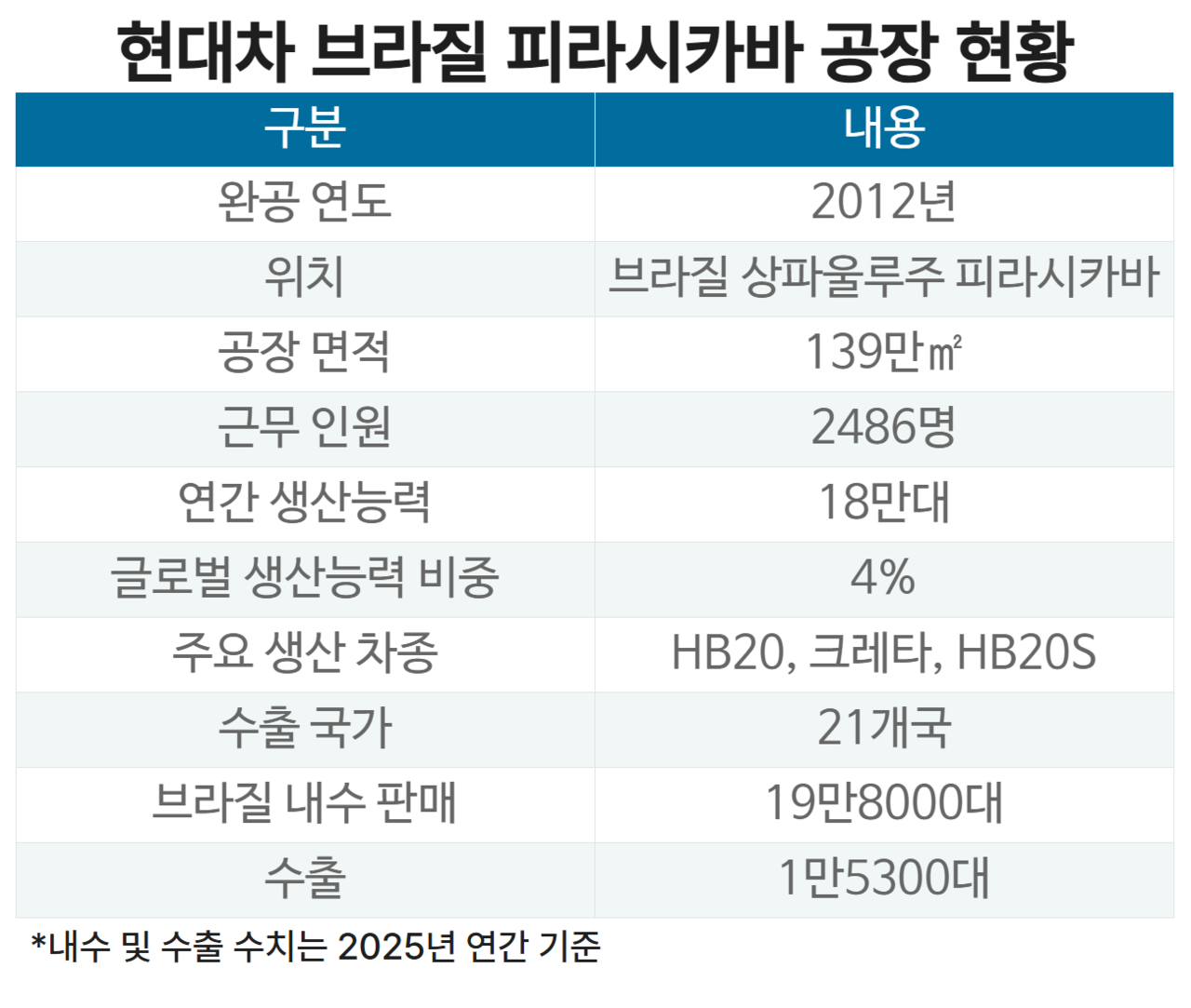
Hyundai Motor's ability to hold its ground against imported brands rests on its local production setup. The company entered the Brazilian market in 1992 and completed its Piracicaba plant in São Paulo state in 2012. With an annual capacity of about 180,000 vehicles, the facility produces locally focused models including the HB20 and Creta.
Vehicles produced at the Brazilian plant recorded first-half sales of 104,228 units, up 8.0 percent from the same period last year. Exports fell 21.9 percent to 6,869 units, but domestic sales in Brazil rose 11.0 percent to 97,359 units, driving overall growth.
Kia weighs local production ahead of Tasman launch
Kia, by contrast, has yet to establish a meaningful production base in Brazil. First-half sales in the country totaled only about 2,200 units, combining the K2500 light commercial vehicle, the Carnival and other models — a stark contrast to Hyundai Motor's nearly 100,000 passenger car sales in the same period.
Kia is looking to turn things around with the launch of its Tasman midsize pickup truck in Brazil on Aug. 17. Brazil is a key market for midsize pickups, where the Toyota Hilux, Ford Ranger and Chevrolet S10 compete fiercely.
Locally, there is speculation that Kia may restructure the import-and-sales model it has operated for more than 30 years and move toward direct business operations, with the possibility of building a local production facility also being discussed.
kwater@heraldcorp.com