
![Gayang 6 Complex, considered the flagship apartment complex in Gayang-dong, Gangseo-gu, Seoul. [Herald DB]](https://wimg.heraldcorp.com/news/cms/2026/07/22/news-p.v1.20260225.2b57d3f5c4c84a008dd6c1bc87ac6e66_P1.jpg)
Jeonse is disappearing from Seoul. Only the homes where people without property can live are vanishing. Each day feels like my blood is running dry. Do you know how helpless this situation makes us feel? Please fix the jeonse crisis.
— Posted by a user identified as K on the official website of the National Public Forum on Real Estate Policy
With jeonse ("전세," a lump-sum deposit rental system) and the broader rental crisis expected to be among the central topics at a real estate policy forum President Lee Jae Myung is set to chair on Thursday, average apartment jeonse prices across nine outer Seoul districts have all surpassed the peaks recorded during the Moon Jae-in administration. The figures exceed even the 2020–2021 highs that accompanied the so-called "jeonse crisis" triggered by the two tenant-protection laws enacted under Moon, underscoring how housing instability is deepening in the more affordable outer districts that have long served as a foothold for lower-income residents without property.
Tighter jeonse loan regulations and stricter owner-occupancy requirements have sharply reduced the supply of rental listings, and the government has been sending repeated signals of expanded housing supply to stabilize both the rental and sales markets. But analysts say there will inevitably be a significant lag before any supply-side measures are felt on the ground, particularly as demand that has shifted toward jeonse amid soaring purchase prices is now flooding into outer districts. Ongoing disputes between government agencies over key inner-city development sites — including the Yongsan International Business District and the Taereung Country Club redevelopment — are adding to upward pressure on jeonse prices in Seoul, a trend analysts expect to persist for now.
An analysis of monthly apartment jeonse price data by district from Seoul's Real Estate Information Plaza, covering a 10-year span from May 2017 to June 2026, found that last month's average jeonse prices in nine outer districts — Gangbuk-gu, Gangseo-gu, Gwanak-gu, Guro-gu, Geumcheon-gu, Nowon-gu, Dobong-gu, Eunpyeong-gu and Jungnang-gu — all exceeded the highest levels recorded during the Moon administration.
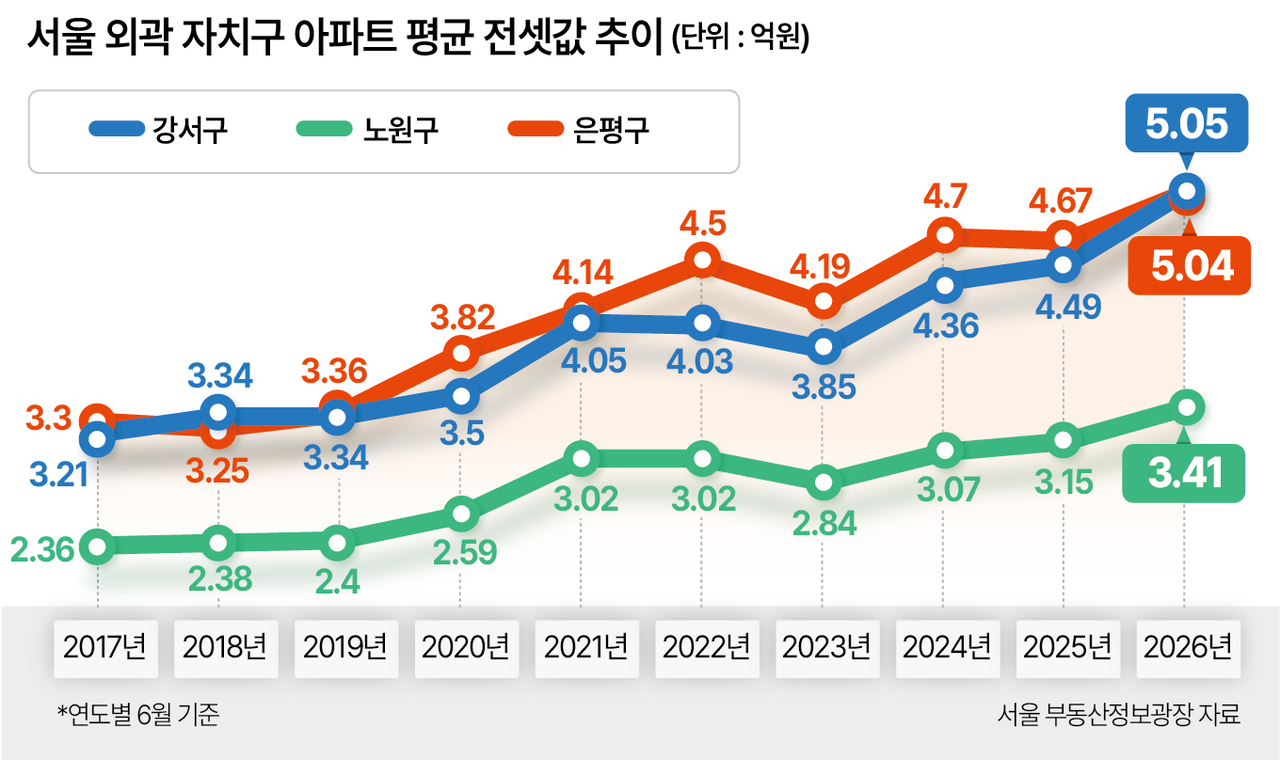
Gangseo-gu posted an average jeonse price of 504.75 million won ($342,000) last month, breaking the 500 million won threshold for the first time since the Seoul Metropolitan Government began compiling the data in January 2011. That figure is 16.8 percent above the district's Moon-era peak of 432.17 million won, set in January 2022 during the height of the "jeonse upheaval" that followed the introduction of the lease renewal right and other tenant-protection measures.
Gwanak-gu's June jeonse price came in at 511.38 million won, about 50 million won above its Moon-era high of 465.52 million won recorded in June 2021. Eunpyeong-gu also crossed the 500 million won mark last month at 504.22 million won, while Gangbuk-gu (434.12 million won), Guro-gu (420.26 million won) and Jungnang-gu (440.31 million won) all registered figures in the 400 million won range. Geumcheon-gu, Nowon-gu and Dobong-gu came in at 382.09 million won, 340.62 million won and 324.31 million won, respectively — all surpassing their 2020–2021 levels.
Analysts attribute the surge to a tightening of jeonse listing supply following two government measures: the June 27 policy last year, which lowered the guarantee coverage ratio for jeonse loans, and the Oct. 15 policy, which designated all of Seoul and 12 Gyeonggi Province areas as land transaction permit zones subject to owner-occupancy requirements, effectively locking up jeonse listings. According to real estate big data platform Asil, as of Tuesday, the number of apartment jeonse listings in outer districts stood at only around 100 per district. Geumcheon-gu had just 72 listings, roughly half the 152 available at the end of January, while Jungnang-gu's count fell 42.3 percent over the same period, from 135 to 78. Guro-gu dropped 56.8 percent from 324 listings at the start of the year to 140, and Gwanak-gu fell 36.2 percent from 235 to 150.
The shrinking supply of jeonse is also eroding its share of the rental market. An analysis of Korea Real Estate Board data by the Seoul Metropolitan Government showed that jeonse transactions for Seoul apartments totaled 7,477 in June, down 12.5 percent from the previous month, while monthly rent transactions rose 3.3 percent over the same period to 8,819. As a result, monthly rent accounted for 54.1 percent of all Seoul apartment lease transactions in June, with jeonse making up the remaining 45.9 percent. In December last year the two were evenly split at 50 percent each, and the market now appears to be cementing a shift toward monthly rent as the dominant rental structure.
The government has pledged to accelerate housing supply in recent Ministry of Land, Infrastructure and Transport briefings and in its second-half economic policy outlook, framing the move as a remedy for housing instability. But analysts say supply-side measures address long-term imbalances and offer little immediate relief for the jeonse shortage. The government has also announced plans to introduce a "safe trust" program under which a public agency would manage jeonse deposits on behalf of landlords, with the aim of converting monthly-rent listings back into jeonse. Concerns remain, however, that landlord participation could be low depending on the program's investment returns.
"Housing supply measures are inherently inelastic in the short term," said Ko Jun-seok, a professor at Yonsei University's Sangnam School of Management. "They are a medium-to-long-term alternative, so the market does not feel their effects right away." He added that while supply measures should be pursued in parallel, easing regulations on land transaction permits or rental business operators would be one immediate option to address the jeonse and monthly rent shortage. "For the safe trust program to be effective, landlords who entrust their deposits to the government must be offered clear tax incentives," he said.
hwshin@heraldcorp.com




