![A view of apartment buildings in Seoul. [Newsis]](https://wimg.heraldcorp.com/news/cms/2026/07/22/news-p.v1.20260703.eef3ae981ea245adb415307646175065_P1.png)
I won an apartment subscription lottery in 2023. The apartment I'm moving into isn't even in a regulated zone. So why should I be affected by loan volume caps? I didn't choose my own move-in date either…
— K, a lottery winner in Suwon, Gyeonggi Province
A fear of missing out on balance-payment loans — anxiety over being left behind as financing slots run out — has been spreading among residents preparing to move into newly built apartments in transit-oriented areas of Greater Seoul. Banks affiliated with contractors for interim and balance payments have announced they will accept balance-loan applications on a first-come, first-served basis.
According to the pre-sale industry on Wednesday, financial institutions have begun accepting not only individual mortgage applications but also pre-arranged group loan applications on a first-come, first-served basis, with some closing early. The government has ordered lenders to manage total loan volumes to curb a surge in household debt, raising thresholds across all loan types. Borrowers scheduled to move into new apartments in the second half of the year are growing increasingly anxious.
A newly built apartment complex of about 2,000 units in Gwonseon-gu, Suwon, Gyeonggi Province, is processing balance-payment applications ahead of a planned move-in next month. On Tuesday, one commercial bank closed its balance-loan window within half a day, citing exhausted limits. Another bank also announced a first-come, first-served cutoff, sending prospective residents into a panic over whether they would be able to secure financing at all.
Gwonseon-gu is the only district in Suwon not designated as a regulated zone — either an adjustment target area or a speculative overheating district. The area falls under non-regulated status, where the loan-to-value ratio can reach 70% with a cap of 600 million won ($407,000) in the metropolitan area, but the government's directive to lenders to manage total loan volumes has made conditions effectively indistinguishable from those in regulated zones. Residents of the complex plan to request the floor to speak on normalizing balance-payment loans at a real estate forum that President Lee Jae Myung is set to chair on Thursday.
The situation is the same at a newly built apartment complex in Dongtan new town in Hwaseong, Gyeonggi Province. Both commercial banks and mutual finance institutions have declared they will accept balance-loan applications on a first-come, first-served basis, making a daily scramble for financing a routine reality among prospective residents.
Group loans in the pre-sale market are structured so that terms are agreed upon in advance at the project level, with funds disbursed according to construction progress or move-in schedules. But as financial institutions work to meet their household-debt management targets for the second half of this year, they have begun capping not only standard mortgage loans but also these pre-committed group loans — prompting warnings that the pre-sale market, which plays a central role in housing supply, could take a serious hit.
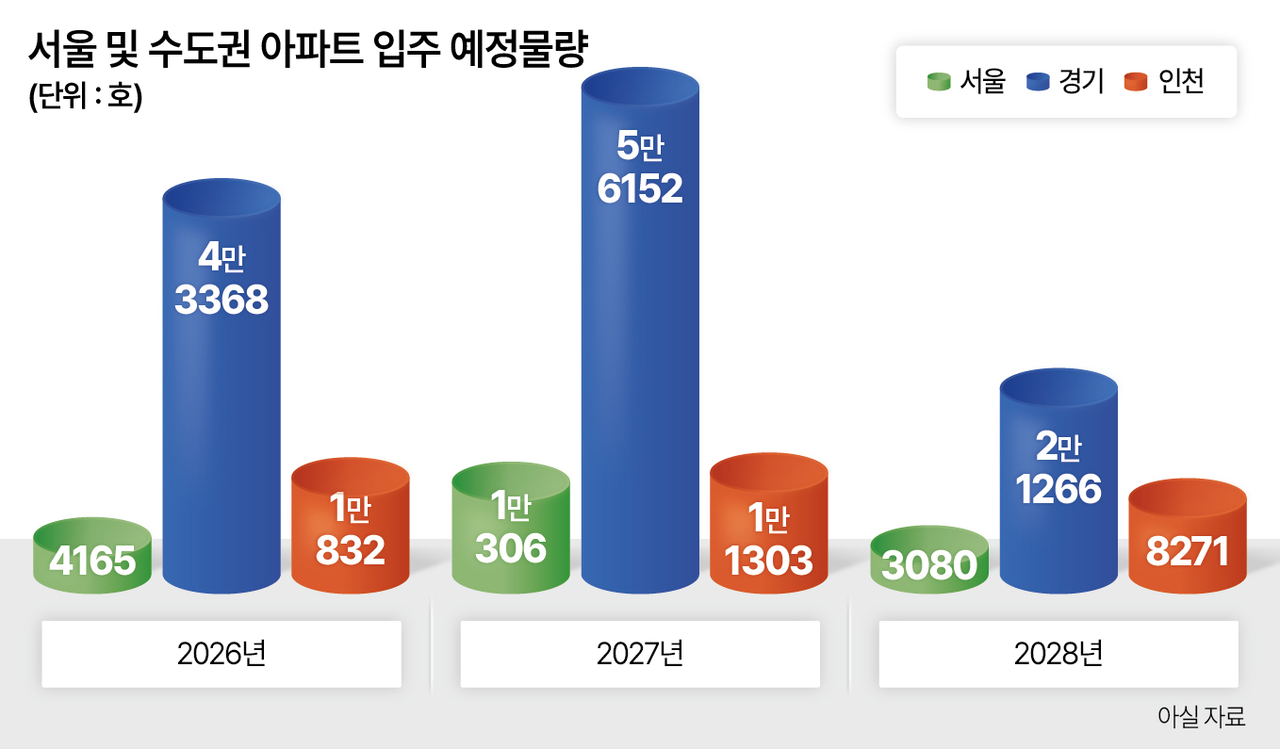
Nearly 60,000 units are scheduled for supply in Greater Seoul this year alone. According to apartment transaction price data, a total of 58,365 new apartment units in Seoul, Gyeonggi Province and Incheon are either already being occupied or scheduled for move-in this year. Next year, the figure is expected to reach 77,761 units, and another 32,617 new homes are slated for supply in 2028.
If the current loan volume caps persist, there are growing concerns that a vicious cycle could take hold — where residents moving into new apartments in the first half of the year secure balance-payment loans and complete their move-ins without difficulty, while those scheduled for the second half cannot.
An official from one new apartment's residents' representative council said they understood the government's intent to manage household debt and safeguard the soundness of financial markets, but added: "The people suffering the most from lender-by-lender loan volume caps are not speculative investors — they are owner-occupiers without homes who signed pre-sale contracts years ago and have been waiting only to move in."
Contractors also face significant risk if balance-payment collection is delayed. They rely on balance payments from buyers who signed pre-sale contracts years earlier to repay construction costs and interim loans, and a failure to move in on schedule could sharply worsen their liquidity.
"For large construction companies the impact may be limited, but for small and mid-sized contractors, balance payments from buyers are a critical source of funding," an official in the construction industry said.

hss@heraldcorp.com