![Canned tuna and other tinned goods are displayed at a hypermarket in Seoul. [Yonhap]](https://wimg.heraldcorp.com/news/cms/2026/07/21/rcv.YNA.20260716.PYH2026071613780001300_P1.jpg)
Import prices for pollock, tuna, mackerel and other fish have been climbing sharply, driven by a weak won and high fuel costs. Major food companies have responded by raising product prices, putting fresh pressure on household food budgets.
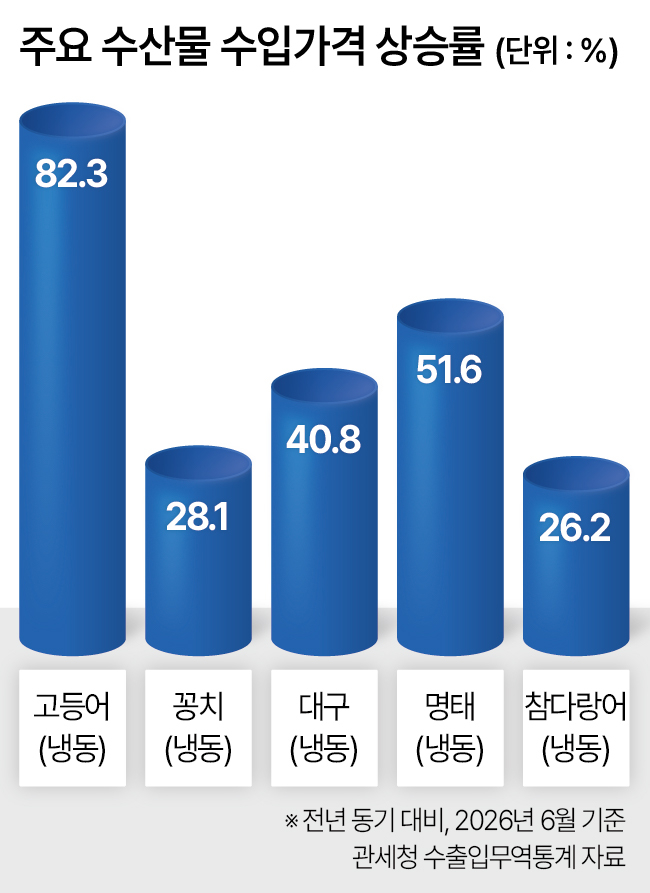
According to Korea Customs Service trade statistics released Tuesday, the import price of frozen pollock stood at 3,674 won per kilogram last month, up 51.6 percent from a year earlier. The price was 1,748 won per kilogram in January, meaning it more than doubled in five months. The pace of increase accelerated from May, when the won-dollar exchange rate climbed above 1,500 won.
The weak won pushed up customs clearance prices for pollock imported from Russia and the United States, while elevated fuel costs raised logistics expenses for long-distance maritime shipping and frozen storage. Pollock, one of South Korea's most widely consumed fish, relies heavily on imports. The government designated it a special price-monitoring item in March in connection with Middle East war-related cost pressures on household living expenses.
Other seafood prices have risen as well. Frozen mackerel cost 7,419 won per kilogram last month, up 82.3 percent year on year. Reduced fishing quotas in Norway, a major producing country, were a direct contributing factor, and the government dispatched a special envoy to key mackerel-producing nations in response. Frozen bluefin tuna prices rose 26.2 percent, while frozen cod climbed 40.8 percent to 8,120 won per kilogram. Frozen Pacific saury prices also rose 28.1 percent.
The weak won that has persisted since May is widely cited as the main driver of rising imported food prices. According to the Korean Statistical Information Service (KOSIS) under the Ministry of Statistics, the import price index for frozen seafood rose 13.3 percent year on year in won terms last month. In dollar terms, the increase was just 1.4 percent, but the weak won amplified the impact. Fresh seafood rose 7.8 percent in dollar terms but jumped 20.5 percent in won terms.
Facing higher input costs, food companies have begun raising prices. Sajo plans to increase factory-gate prices on major products — including canned goods, sauces and edible oils — from Aug. 3. Its flagship canned tuna will go up 10 percent, while canned mackerel, saury and other seafood products will rise 20 percent. CJ CheilJedang will raise prices on 27 items — including Hetbahn cooked rice, mandu and grilled fish products — by an average of 8 percent. Dongwon F&B said it is weighing the timing of its own increases. "Cost pressures from high oil prices, a high exchange rate and rising international fish prices are serious, but we are absorbing them for now," a Dongwon F&B official said. "However, no specific decision has been made on price adjustments at this time."
Small business owners who cannot easily pass on costs are feeling the strain more acutely. A fish shop owner in Jongno-gu, Seoul, identified only as A, said fewer customers come in for dinner as people tend to go home earlier these days. "If I raise menu prices on top of that, I'll lose my lunch regulars too," A said. "I'm just gritting my teeth and holding on." A raw fish restaurant owner in Gangnam, identified only as B, said ingredient costs had risen so much that going directly to the auction market crossed their mind. "Seeing nearby shops close down makes it all the more complicated," B said.
A survey conducted last month by the Korea Economic Association, which commissioned polling firm Mono Research to survey 500 self-employed workers nationwide, found that 57.0 percent said their business conditions had worsened this year compared with last year. By sector, the figures were highest in wholesale and retail (66.3 percent) and accommodation and food service (65.8 percent). Some 37.6 percent of respondents said they were currently planning to raise prices.
Business closures driven by deteriorating profitability are also mounting. According to a survey on closed small businesses released last month by the Ministry of SMEs and Startups, the number of businesses that shut down last year was 976,000, down 32,000 from the previous year. The closure rate fell 0.4 percentage points to 8.64 percent. However, closure rates in retail (15.4 percent) and food service (15.1 percent) far exceeded the overall average. Some 70.9 percent of those who closed cited worsening profitability and sluggish sales as the reason.

korean@heraldcorp.com