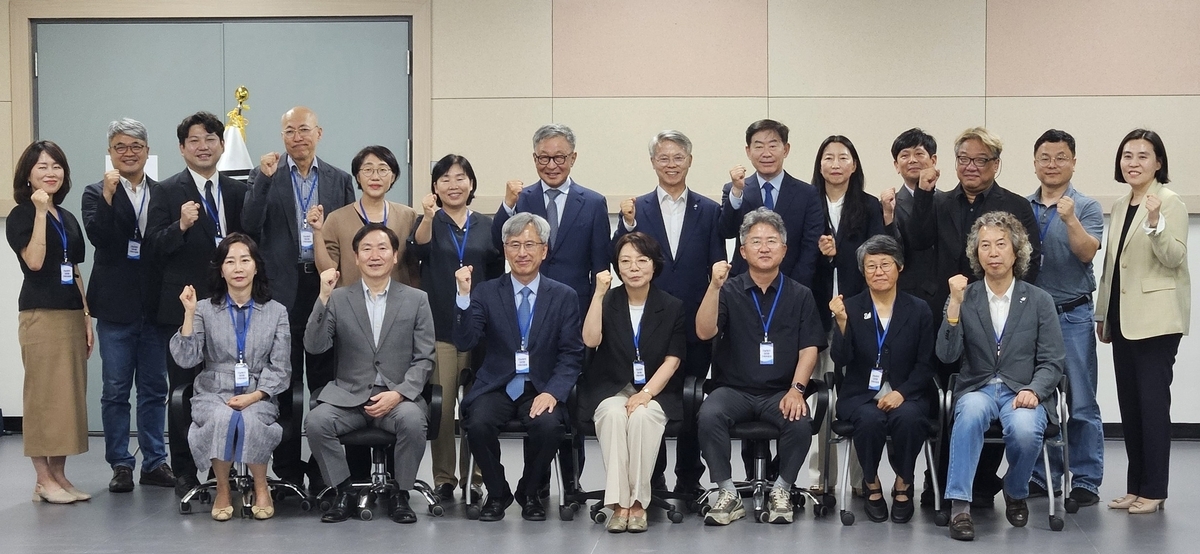
The Jeonnam-Gwangju Great Transformation Committee, the transition committee for South Jeolla-Gwangju Integrated Special City Mayor Min Hyeong-bae, held its dissolution ceremony at the Muan government complex on Monday, concluding 43 days of activity.
The ceremony, held under the theme "One Namdo, a special city opened together with civil servants of the South Jeolla-Gwangju Integrated Special City," drew about 300 people, including Mayor Min, committee chair Jeong Eun-seung, vice chair Baek Seung-ju, other transition committee members and civil servants.
The event opened with a screening of a video titled "From the Blueprint of Integration to the Time of Action," documenting the committee's work.
Vice Chair Baek then presented the city administration plan, centered on key governance priorities.
The administration's vision was set as "a special city of overwhelming growth, shared by all." Under that vision, the plan set targets to be achieved by 2030: attracting 200 trillion won ($135 billion) in investment from global companies, raising per capita income in the integrated special city to $40,000, and growing manufacturing sales to 500 trillion won.
Five governing principles were proposed: leap-forward growth, balanced development, a foundational society, a green city and civic sovereignty.
Seven strategic priorities were also established to put those principles into practice.
The key priorities are: an economic special city that leaps forward through future industries; a balanced-development special city that grows together; an agri-bio project special city that completes urban-rural balance; a foundational-society special city that takes responsibility for residents' lives; a glocal culture and tourism special city that embraces people from around the world; a green special city advancing toward an East Asian eco-city; and a civic-sovereignty special city opened by the voices of all.
The administration plan also includes 40 policy tasks and 104 detailed action items to support those strategic priorities.
The committee also put forward a set of citizen-facing initiatives: operating an "On-Air Special City" platform for real-time administrative communication, issuing digital resident cards, adding new metropolitan bus routes, and building an AI-based disaster risk prediction and monitoring system.
"The white paper captures the issues we wrestled with together, the principles we debated fiercely, and the collective wisdom about the direction the South Jeolla-Gwangju Integrated Special City should take," committee chair Jeong said. "I hope it becomes a living compass that city hall staff reach for again and again."
Mayor Min thanked the committee for charting a course on what the integrated special city should show its 3.16 million residents first. "South Jeolla Province and Gwangju were right to integrate as one," he said. "Let us all push forward together so that residents can say: our daily lives have changed, and our children's future has changed."
sij@heraldcorp.com