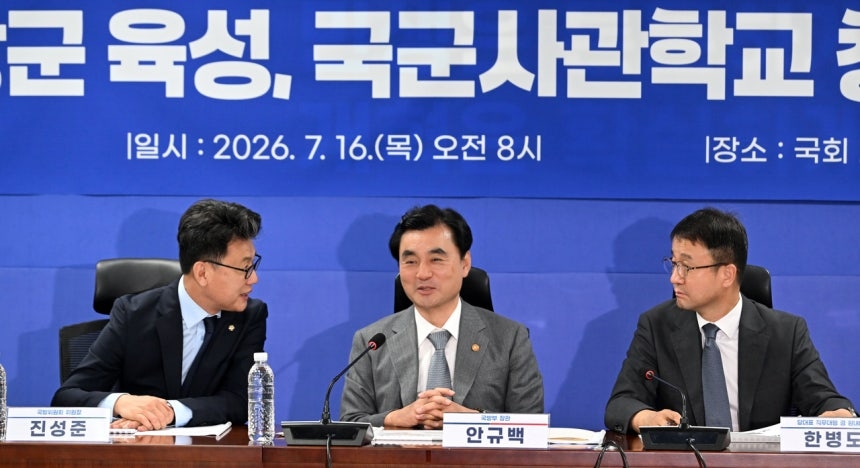
The government has decided to establish a four-year unified Korea Armed Forces Academy at Jaunidae in Daejeon, merging the separate Army, Navy and Air Force academies. Defense Minister Ahn Gyu-back said the move is an unavoidable choice to prepare for rapidly changing future warfare and the eventual transfer of wartime operational control.
The government and the ruling party reached the decision Thursday at a party-government consultative meeting held at the National Assembly.
The plan faces significant headwinds, however, including public criticism that a system responsible for training officers to safeguard the nation's future and security is being pushed through on political grounds. Military experts, senior retired officers, educators and parents of current cadets have all voiced opposition.
Ahn opened by saying the existing academy system "faces serious challenges from within and without," warning that "if we do not change now, there is no future."
He laid out three main reasons for establishing the unified academy. First, he cited the redundancy and inefficiency created by running three separate service academies.
"Each service academy enrolls only around 700 to 1,000 cadets — no larger than a single college within a general university," Ahn said. "To train roughly 2,900 cadets in total, we maintain seven generals, including three three-star generals, and about 3,000 support personnel. The time has come for structural reform."
He also stressed the need to overhaul military education in line with the changing nature of modern warfare. "Modern warfare has expanded beyond the boundaries of land, sea and air into space, cyber and electromagnetic domains," Ahn said. "Military academy education must evolve into a system that can prepare officers for future warfare across all domains."
Ahn placed particular emphasis on developing command talent for the period after the transfer of wartime operational control. "Officers produced by the academy must become the leaders who will drive the Korea-US combined defense system after operational control is restored," he said. He added that "a new educational framework, outstanding faculty and a cutting-edge learning environment are now essential to producing officers suited to the future security environment." The ministry also plans to design a curriculum that cultivates the capabilities needed to lead the combined Korea-US defense system going forward.
The Ministry of National Defense plans to build the integrated academy centered on Daejeon and establish an advanced science and technology-based educational environment. The ministry intends to leverage the region's concentration of major research institutions, including KAIST, the Korea Aerospace Research Institute, the Korea Astronomy and Space Science Institute and the Electronics and Telecommunications Research Institute.
To drive educational innovation, the ministry plans to raise the share of civilian faculty from the current roughly 24 percent to more than 50 percent, guaranteeing compensation on par with national universities to attract top researchers. The curriculum will be restructured around core future-warfare fields, including AI-based all-domain operations and space, cyber and electromagnetic spectrum warfare.
Ahn said the ministry would build a "smart education platform" centered on an integrated campus while also preserving the traditions of the existing academies. He added that the long-term vision is to develop the Korea Armed Forces Academy into a "defense education hub" encompassing the Korea Armed Forces Nursing Academy, an advanced military academy, the Reserve Officers' Training Corps and undergraduate officer programs.
He said reform must be grounded in public trust, and added that "the Ministry of National Defense will actively gather public opinion with an open attitude going forward."
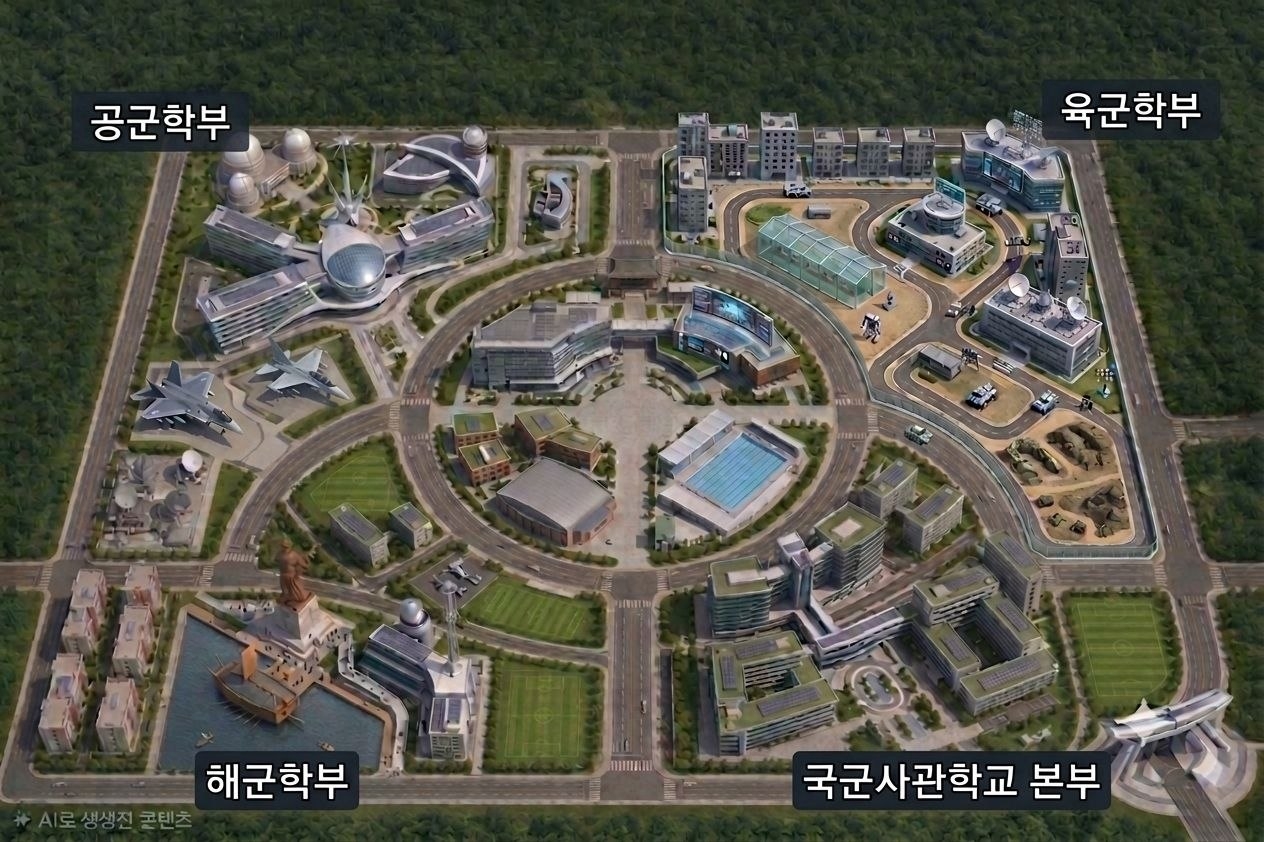
The government also said it will make every effort to ensure that current Army, Navy and Air Force academy cadets face no disruption to their studies. For students preparing for service academy entrance exams, the ministry said it will consult with the Ministry of Education to finalize admissions plans and detailed recruitment guidelines, then provide a sufficient timeline for exam preparation in keeping with the spirit of the university admissions advance-notice system.
Meanwhile, the Reform Party said a poll it commissioned found that more than seven in 10 South Koreans oppose the government's plan to merge the three service academies.
The survey, conducted by the party's think tank, the Reform Research Institute, on Tuesday and Wednesday among 503 men and women aged 18 and older nationwide and released Thursday, found that 75.4 percent of respondents opposed merging the Army, Navy and Air Force academies into a single Korea Armed Forces Academy — with 69.3 percent "strongly opposed" and 6.1 percent "somewhat opposed."
Support for the plan was limited to 22.5 percent, with 15.6 percent "strongly in favor" and 6.9 percent "somewhat in favor." Opposition was highest among those aged 18 to 29 (85.3 percent) and those 70 and older (82.2 percent). The poll used an automated response system with random digit dialing on mobile phones, with a margin of error of plus or minus 4.4 percentage points at the 95 percent confidence level and a response rate of 0.61 percent.
youknow@heraldcorp.com
addressh@heraldcorp.com
rimsclub@heraldcorp.com