Notices missing for Nov. 2 and Oct. 31 launches; 'answer restricted' on Wednesday's
Joint Chiefs cites Earth's curvature as reason cruise missiles go undetected
Expert warns repeated gaps could erode public trust in military's detection capabilities
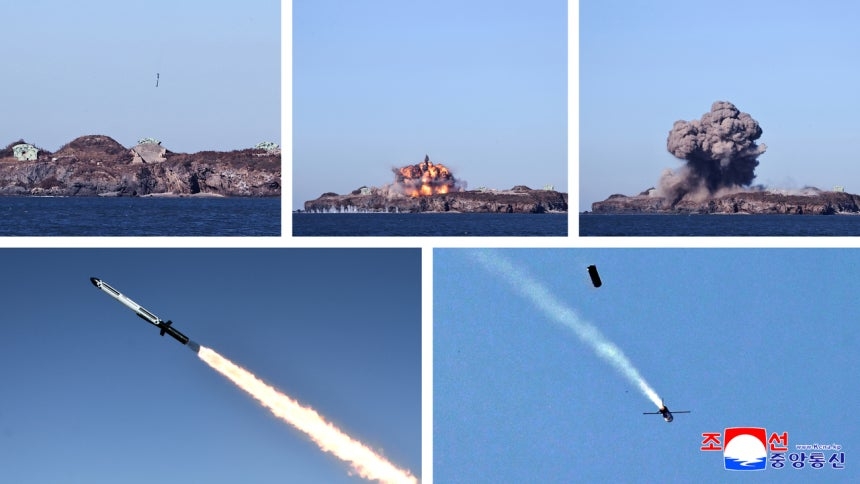
North Korea has conducted four rounds of missile launches and other shows of force since last week, but South Korea's Joint Chiefs of Staff issued public notices for only one of them — raising questions about whether the military failed to detect the launches or simply chose not to disclose them.
North Korea announced it carried out missile test launches toward the East Sea and other areas on four occasions: Oct. 29, Oct. 31, Monday and Wednesday. Of those, the Joint Chiefs issued a same-day media notice only for the Oct. 29 and Wednesday launches.
However, KCNA reported Friday that North Korea had test-fired an anti-aircraft missile the previous day and also conducted a long-range strategic cruise missile demonstration drill. The Joint Chiefs' notice for Wednesday stated only that "several missiles were fired from the Sondok area toward the East Sea," without specifying the types. When asked whether that announcement referred solely to the anti-aircraft missile — or whether the military had initially classified even that as a ballistic missile — the Joint Chiefs said its answer was "restricted."
On the Monday launch, for which no same-day notice was issued, the Joint Chiefs explained: "Unlike ballistic missiles, cruise missiles are slow and fly at low altitudes by following terrain contours using the Earth's curvature. When North Korea fires them from a distant northern location, detection can be limited due to the Earth's curvature and other factors." When asked directly whether the cruise missiles had gone undetected, the Joint Chiefs said only, "Please understand that confirmation is difficult."
For the Oct. 31 launch of a ballistic missile carrying a cluster warhead, the Joint Chiefs' explanation — that it had detected and tracked the trajectory the previous day — came only after North Korea's state media reported the launch the following day.
The Joint Chiefs has maintained that "it is not appropriate to confirm on a case-by-case basis whether our military detected each specific projectile fired by North Korea, as doing so would expose our surveillance capabilities to the enemy." Even so, the military's own admission of difficulty in detecting cruise missiles, combined with the repeated omissions from public notices, has created considerable confusion.
The Joint Chiefs also failed to issue a media notice when North Korea tested a submarine-launched cruise missile on Oct. 14. A Joint Chiefs official said: "If cruise missiles are fired from far in the north, their range would make it difficult to reach South Korea. If they are aimed at the South, we have the capability and readiness to detect them without fail."
Shin Jong-woo, secretary general of the Korea Defense and Security Forum, said the Wednesday incident appeared to be a case of misidentification. "It seems our military mistook the surface-to-air missile for a short-range ballistic missile based solely on the radar track detected by ground radar," he said. "On Oct. 31, the military also misidentified the KN-24 (Hwaseong-11na) ballistic missile as a different type and did not issue a notice. This creates the impression that the Defense Ministry's standard of announcing only ballistic missiles is inconsistent, and ultimately it cannot help but erode public trust in the military's detection and intelligence assessment capabilities."
Shin also raised concerns about cruise missiles, warning that "as North Korea diversifies its arsenal with missiles flying at different altitudes and along different routes, the detection and interception burden on South Korea's air defense network could intensify."
youknow@heraldcorp.com