Maritime patrol aircraft and EOD team to be deployed; 75 additional personnel added
'Will absolutely not engage or intervene in the war'
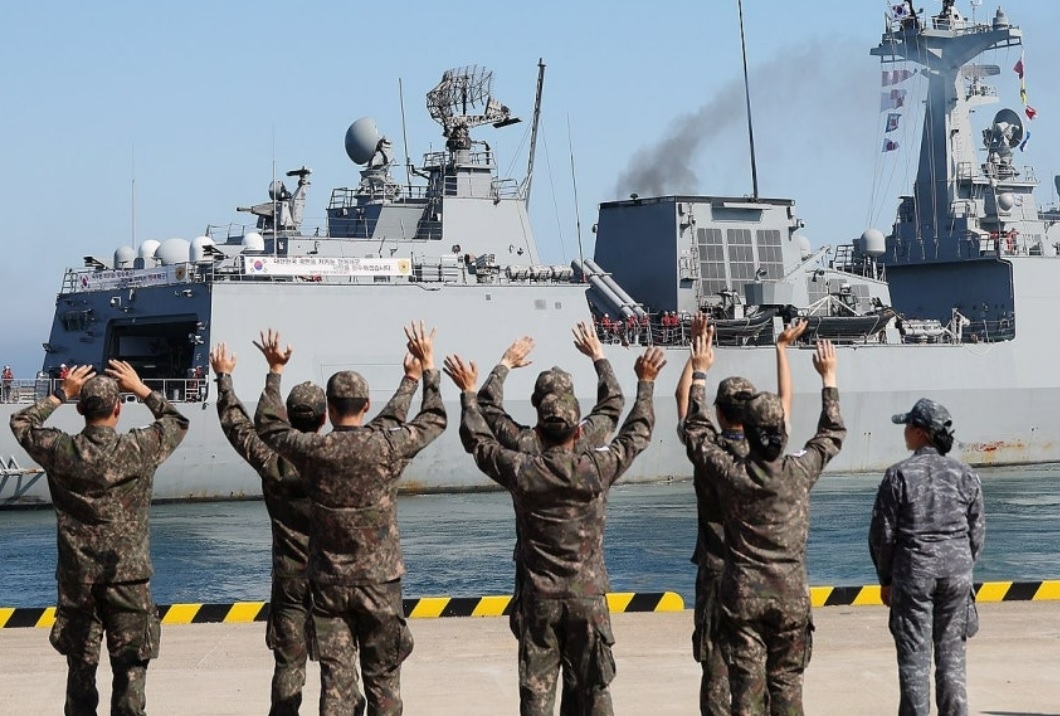
The South Korean government has drawn up a plan to expand and strengthen the Cheonghae Unit's operations and will submit it to the National Assembly. The move is seen as a partial response to US requests for contributions near the Strait of Hormuz, while also seeking to minimize friction with Iran — extending the unit's deployment zone from the current Gulf of Aden waters to the open sea south of Oman.
A Ministry of National Defense official said Thursday that piracy in the Somalia and Gulf of Aden region had surged more than threefold compared with the previous year as the Strait of Hormuz remained blocked and coalition forces concentrated in the Persian Gulf. "The government has been in close communication with the international community to restore freedom of navigation on international sea lanes, and has sought ways to fulfill the necessary role and contribution to protect our citizens and economic interests," the official said, explaining the rationale for expanding the Cheonghae Unit's activities.
The unit's operational zone is expected to roughly double from the current 600 nautical miles (about 1,100 kilometers), extending to the southern tip of Duqm Port in Oman — some 350 nautical miles (about 650 kilometers) from Duqm to the Strait of Hormuz in a straight line. On top of the destroyer already deployed, the Defense Ministry plans to add maritime patrol aircraft, an explosive ordnance disposal (EOD) team, and unmanned minesweeping equipment, while increasing the unit's personnel from 320 to 395.
The ministry also added a new task — "support for restoring freedom of navigation on international sea lanes" — to the missions already specified in the existing Cheonghae Unit dispatch consent.
Operational command will remain with the chairman of South Korea's Joint Chiefs of Staff, and the deployment period will run from the passage of the amended extension consent through Dec. 31 next year.
The Defense Ministry outlined four principles governing the dispatch: the unit will absolutely not engage or intervene in the war; the purpose of the deployment is to protect South Korean citizens, vessels and economic interests; activities will be confined to the open sea south of Oman, with maritime patrol aircraft restricted from conducting surveillance inside Iranian territory, territorial waters or the inner side of the Strait of Hormuz; and the unit will operate under its own independent chain of command.
The principles reflect the government's effort to find an indirect way to contribute near the Strait of Hormuz — as the United States has requested — while minimizing the risk of a clash with Iran.
The Defense Ministry said it was necessary to build experience now, as South Korea may need to deploy relevant forces to the Strait of Hormuz at the request of the international community once a "permissive environment" is established there. A permissive environment refers to a situation in which safety in the Hormuz region is fully secured — through the end of the war or the conclusion of a US-Iran MOU — allowing freedom-of-navigation operations to be conducted.
"This expansion and strengthening of the Cheonghae Unit is aimed at protecting our citizens and economic interests and is limited to non-combat missions," a Defense Ministry official said. "Explanations to the United States and Iran will be handled by the Ministry of Foreign Affairs, and we will provide sufficient clarification regarding any misunderstandings that may arise during the additional deployment process."
The official added that if a permissive environment is established, a new troop dispatch consent would be prepared, and personnel who gained experience in this deployment could potentially be sent again. The ministry is also understood to intend to build capabilities with unmanned surface vessels, unmanned underwater vehicles and remotely operated vehicles — equipment used to neutralize or visually confirm mines — for potential future deployment to the Strait of Hormuz.
The Defense Ministry plans to submit the expansion plan, which cleared a vice ministerial meeting Thursday, to a Cabinet meeting and President Lee Jae Myung for approval next week before forwarding it to the National Assembly. The ministry is understood to have briefed National Assembly Defense Committee Chairman Jin Seong-jun in advance of the vice ministerial meeting agenda.
Meanwhile, the Rebuilding Korea Party pushed back Wednesday, calling the expansion of the Cheonghae Unit's operational zone "a troop deployment — not a clever move, but a sneaky one."
Floor leader Kim Jun-hyung said the government appeared to believe that not participating in direct combat meant it was not intervening in the war. "The president's principle of non-involvement in the war must not be circumvented by expanding the Cheonghae Unit's mission," Kim said.
youknow@heraldcorp.com