![The Kospi and real-time share prices of Samsung Electronics and SK Hynix are displayed on a screen at Hana Bank's dealing room in Jung-gu, Seoul, on Wednesday, as the index reclaimed the 7,000 level. [Yonhap]](https://wimg.heraldcorp.com/news/cms/2026/07/15/rcv.YNA.20260715.PYH2026071502210001300_P1.jpg)
A leveraged-investing craze that took hold in the domestic market has spread to overseas brokerage accounts, with Korean retail investors piling into products offering two- or three-times exposure to US semiconductors, the Korean stock market and individual stocks. The appetite has moved beyond broad index trackers to single-stock leveraged products that offer no diversification benefit, raising concerns that a "one big hit" mentality — chasing outsized short-term gains regardless of market — is intensifying.
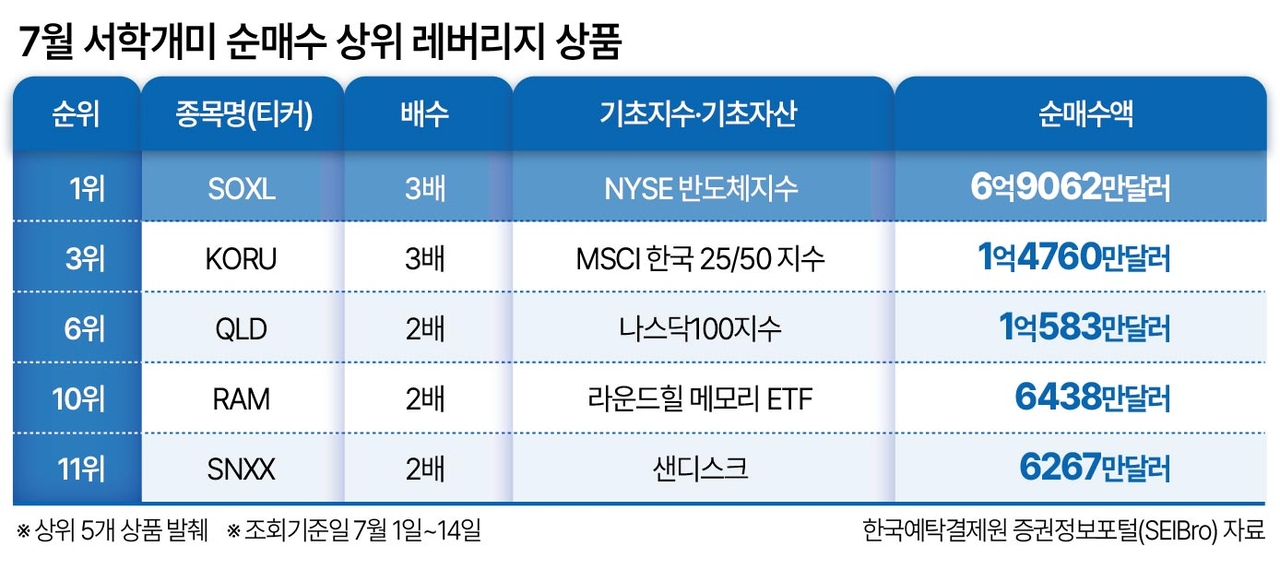
According to data from the Korea Securities Depository's SEIBRO released Wednesday, the top overseas stock net purchase by domestic investors from July 1 to Tuesday was the ETF SOXL, which targets three times the daily return of the NYSE Semiconductor Index, a benchmark of major US chipmakers. Net purchases reached $690.62 million (about 1.04 trillion won), 4.4 times the $156.1 million recorded for second-ranked Applied Materials.
KORU, an ETF providing three-times leveraged exposure to the Korean stock market, ranked third overall with net purchases of $147.6 million — showing that high-multiple bets on the Korean market are being placed not only through domestically listed leveraged ETFs but also through US-listed products.
QLD, which targets twice the daily return of the Nasdaq 100, drew $105.83 million in net purchases, while TQQQ, the three-times version, attracted $30.83 million. RAM, an ETF holding a basket of global memory chip companies and targeting twice the daily return of DRAM stocks, ranked 10th overall with $64.38 million in net purchases. Its underlying index includes Samsung Electronics, SK Hynix, Micron and other companies.
Korean investors' leveraged bets have expanded into single-stock products as well. Of the 11 leveraged ETFs in the top 50 overseas net purchases, six are single-stock products. Their net purchase volumes are smaller than those of index-based triple-leveraged products such as SOXL and KORU, but the spread of leveraged investing into stocks with already-high price swings signals a clear risk appetite among retail investors.
The most popular underlying asset among single-stock products was SanDisk. Investors net-bought $62.67 million worth of SNXX, which tracks twice the daily move of SanDisk's share price, and $20.88 million of SNDU, which follows the same structure. Products tracking twice the share price of IREN, Oracle, Strategy and Bloom Energy also appeared in the rankings.
Index-based products hold multiple stocks, so a single company's earnings miss or unexpected bad news is partially cushioned. Single-stock products, by contrast, amplify one company's price swings directly. Even at the same two-times leverage, a highly volatile underlying stock can cause losses to mount far faster than with an index-based equivalent.
The surge in high-multiple overseas investing mirrors an overheating trend in the domestic single-stock leveraged ETF market. Korean investors have recently been trading Samsung Electronics and SK Hynix single-stock leveraged products in rapid-fire, ultra-short-term bursts.
On Tuesday, when the Kospi came under pressure toward the 6,400 level intraday, combined turnover in 16 Samsung Electronics and SK Hynix single-stock leveraged and inverse ETFs surged 50.5 percent to 18.29 trillion won. That figure represented 39.03 percent of total ETF turnover of 46.86 trillion won for the day — up 5.16 percentage points from the previous session. Even as broader market volatility rose, the concentration in leveraged ETFs grew more pronounced.
Industry insiders say the concern is not leveraged products themselves but the repeated use of them as a vehicle for short-term "one big hit" gains.
"Domestic investors are aggressively buying two-times and three-times index products as well as single-stock leveraged ETFs, not just in the Korean market but in the US market too," a financial investment industry official said. "When stories of big gains spread, people tend to follow the crowd without fully examining the product structure or the potential for losses." The official added that leveraged products require investors to get not only the direction right but also the entry timing and holding period, making it difficult to average down to recover losses.
Foreign investors have also voiced concern about individual investors' heavy use of borrowed money and leverage driving the domestic market.
Alexander Redman, chief equity strategist at CLSA, told Reuters that Korea remains his largest overweight market but that "retail investors are in the driving seat and they use a lot of credit, which is a concern."
Francis Tan, chief strategist for Asia at Indosuez Wealth Management, described the recent sharp selloff in Korean equities as "a wake-up call for both greedy and fearful investors," adding that it "reminds those already heavily weighted in semiconductors that chip investing is a high-volatility game."

kacew@heraldcorp.com