
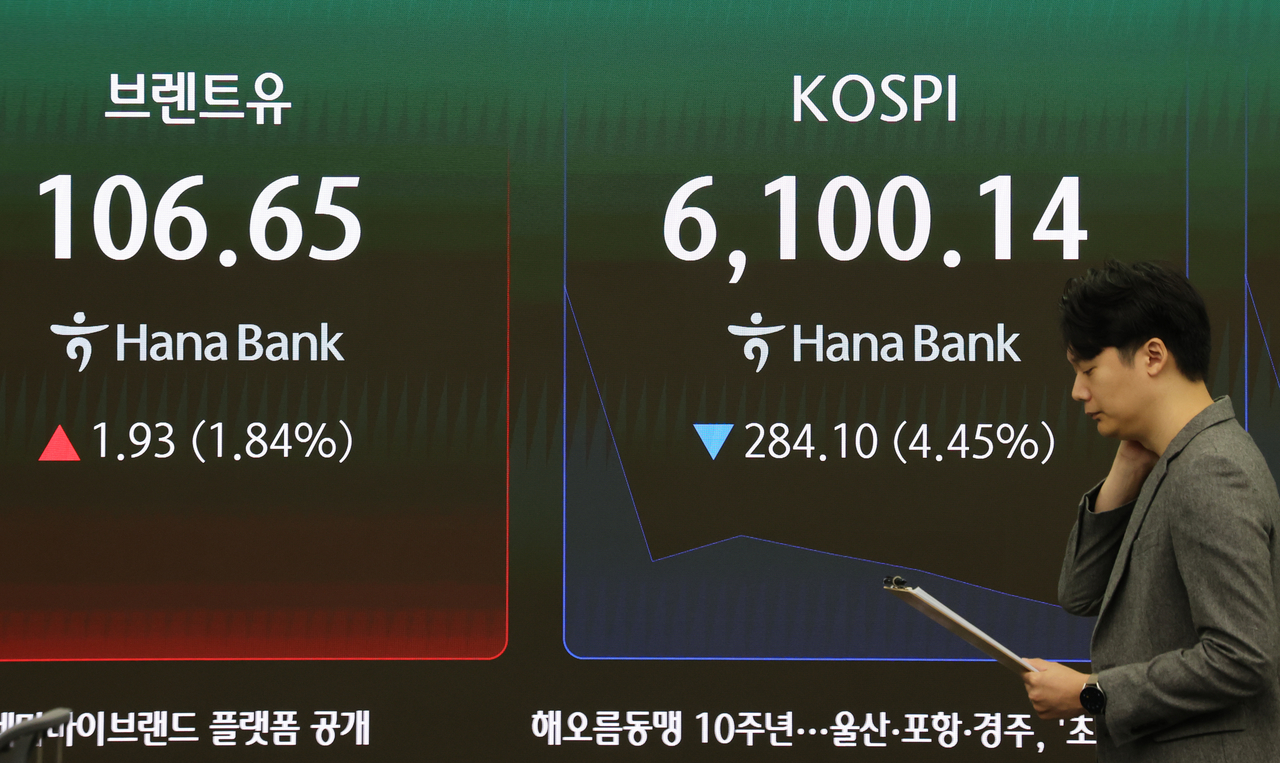
The Kospi has given back all the gains it made after Samsung Electronics and SK hynix launched their share buybacks, yet foreign selling shows no sign of letting up. Even strong earnings from Samsung Electronics have failed to draw foreign capital back in, with global funds increasingly favoring Taiwan's stock market over South Korea's. The need for foreign investors to return has never been more urgent, but their money continues to flow elsewhere.
The Kospi closed Monday at 6,384.24, down 241.69 points, or 3.65 percent, erasing all gains recorded since Samsung Electronics and SK hynix began their buyback programs in late August. Foreign investors, who have been dumping Korean shares relentlessly since the start of the year, again drove the decline, pushing the Kospi's 14-day relative strength index close to oversold territory. The RSI fell to 36.4 — a level not seen since the United States announced reciprocal tariffs last April, setting aside the sharp Kospi drop in late July.
The persistent flight of foreign capital from the Kospi this year can no longer be explained by macroeconomic factors such as high interest rates or elevated oil prices. Foreign investors offloaded more than 40 trillion won in May and June alone, followed by net selling of around 10 trillion won ($7.49 billion) in July and August. Last month, net selling widened again to more than 20 trillion won. Industry watchers warn that South Korean stocks and chipmakers face an increasingly harsh battle to prove their investment appeal globally, as Taiwan's relative outperformance combines with intensifying competition from Chinese memory chip companies.
In practice, foreign capital is gravitating toward Taiwan rather than South Korea. In Bank of America's September fund manager survey, about 40 percent of respondents said they had increased their exposure to Taiwanese equities, compared with 25 percent for South Korea. Over the third quarter, Taiwan's TAIEX outperformed the Kospi by roughly 23 percentage points. Taiwan also led South Korea in upward earnings estimate revisions — the first time that has happened since March 2025.
CXMT, the Chinese memory chip company that has repeatedly rattled investor sentiment toward South Korean chipmakers, added to the pressure. The company announced Monday that it plans to release server memory products this year using a next-generation DRAM architecture that reduces memory cell size. Whether mass production and customer certification will actually follow remains unconfirmed, but concerns that a Chinese manufacturer could push into the high-value memory segment are weighing on domestic and foreign investor sentiment toward both Samsung Electronics and SK hynix.
"We need to examine whether global capital is rotating away from South Korea into other markets, and whether the relative valuation appeal and earnings growth expectations for Korean chipmakers have weakened compared with peers," said Lee Jae-won, an analyst at Yuanta Securities Korea.
Amid the harsh conditions surrounding the domestic market, experts are cautioning against trying to call the bottom on foreign investor returns. Rather than positioning ahead of an anticipated rebound in foreign buying, investors should wait for actual evidence that selling is slowing, they say. Analysts also continue to note that outside of shareholder returns from large companies such as Samsung Electronics, there are few other demand drivers to count on — raising calls for additional buybacks to be brought forward to within this year to support the Kospi.
"The only potential sources of demand right now are shareholder returns and foreign investors," Lee said. "With losses spreading beyond large-cap chipmakers to the broader AI value chain, and with no sector rotation in sight, a core strategy centered on bottom-fishing in semiconductors is essential."
Kim Rok-ho, an analyst at Hana Securities, said Samsung Electronics has indicated it will announce additional shareholder return measures at its board meeting in January 2027, but added that if the company mentions an in-year buyback as part of its third-quarter earnings release, it would help clear a significant overhang.
kacew@heraldcorp.com




