![Examples of fake weather information spreading on social media [Instagram]](https://wimg.heraldcorp.com/news/cms/2026/07/11/news-p.v1.20260710.1c2ef0a20fa14c1586bcc4386508af9b_P1.png)
"Once the monsoon ends, a heat wave of 40 degrees Celsius is coming in August."
Kim Bo-ra, 31, an office worker, came across a card-format social media post with that message while scrolling through Instagram on her morning commute. She did not check the account name or the source of the information. Weather updates are something she encounters every day, she said, so she assumed it was probably true.
Sensationalized weather content — posts claiming "a 40-degree heat wave is coming in August," "record-breaking heat has been forecast" or "the monsoon will last an entire month" — has been circulating widely across Instagram and other social media platforms. Some posts were worded to suggest they reflected official Korea Meteorological Administration announcements, but the KMA said it "has never officially forecast a 40-degree heat wave in August."
Content over source: social media weather posts go mainstream
The KMA has stepped up monitoring and legal action against false weather information spreading on social media, but content of dubious origin or sensationally repackaged forecasts continues to circulate rapidly. The "40-degree August heat wave" posts appear to have gained traction by combining the KMA's mention of a possible "double heat dome" phenomenon after the monsoon season with reports that some regions recorded temperatures of around 40 degrees last year — creating the impression of an official forecast for this summer's temperatures.
The strong public interest in weather content is seen as a key driver behind the spread of unverified information. The operator of an Instagram account with 250,000 followers told The Herald Business that weather content is produced by referencing credible news articles and press releases, with AI used only to create visual materials. "Weather posts tend to get more views and engagement than other content, so I post them often as a way to share useful information with followers," the operator said.
Some accounts create new posts by drawing on weather content already circulating on social media. In such cases, unverified information becomes the source for yet more content, creating a chain reaction in which false information is continuously reproduced, observers say.
An Jeong-sang, a professor at Chung-Ang University's Graduate School of Journalism and Mass Communication, said the problem goes beyond simply repackaging real information in a sensational way. "There are also many cases where existing fake news is re-edited and reposted," he said. "A structure forms in which one fake reproduces another."
He also warned that advances in generative AI technology will make it easier to produce increasingly sophisticated false content. "In the future, deepfakes could be used to create fake weather forecasts that look as though a real meteorologist is delivering the news," he said.
![A post published in May on the official social media account of a well-known fashion platform. After claiming "it will rain for an entire month," the post promoted rain boots sold on the platform. [Instagram]](https://wimg.heraldcorp.com/news/cms/2026/07/11/news-p.v1.20260710.403bc1b7c3ee4443ae30ca327dab806f_P1.png)
Weather information is also being used for commercial marketing. In May, a well-known fashion platform posted a claim on its official social media account that "it will rain for an entire month," then used the post to promote rain boots it sells.
The post included a disclaimer stating that the forecast was "a predicted monsoon period based on KMA climate statistics data and may change depending on weather conditions," but more than 400 comments showed readers treating it as confirmed fact — with responses such as "time to shop for rain boots" and "I should travel before the monsoon starts." Posts promoting group purchases of dehumidifiers, umbrellas and waterproof products after emphasizing heavy rain or monsoon conditions were also easy to find online.
The KMA expressed concern about commercial marketing that exploits false weather information. KMA forecaster Woo Jin-gyu said that "definitively forecasting weather over a long period without scientific basis — such as claiming the monsoon will last an entire month — can be problematic." He added that when specific weather information is linked to commercial purposes such as selling air conditioners or dehumidifiers, the agency weighs a range of factors, including potential social confusion and profit motive, in determining how to respond.
Rain boots and a 'month-long monsoon': weather data as a marketing tool
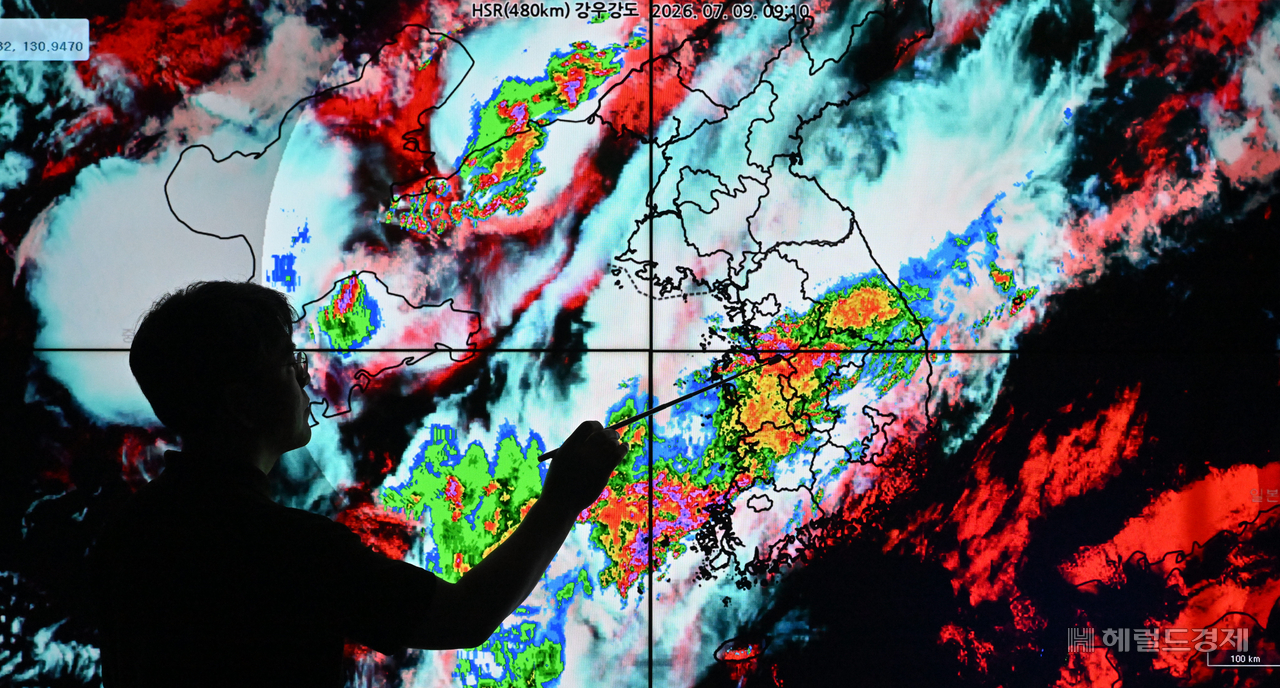
The KMA actively monitors social media platforms to identify false weather information. Whether content qualifies as false is determined not by the KMA alone but through a review committee that includes private-sector experts and journalists. When a post is found to be false, the agency first recommends its removal; if an account repeatedly posts false forecasts, it may face sanctions under relevant laws.
In practice, however, many people accept weather information based on the content of a post rather than the credibility of the account behind it. Lee Bin, 27, a university student, said that frequently seeing posts about "record-breaking heat waves" on social media makes them feel natural to accept. "Even if the source is just a regular account, I assume they got the information from the KMA," she said.
Heo Eun-seo, 27, an office worker, said she tends to look at the content of a card-format post before checking the account or its source. "If there's information about heavy rain or unusual weather, I'll share it with friends," she said.
Lee Do-yeon, 27, another office worker, recalled buying rain boots in advance three years ago after seeing posts claiming it would rain throughout July, only to wear them just three times that entire summer. "I've had sensationalized weather posts turn out to be wrong so many times that I now assume they're exaggerated," she said.
Professor An said false weather information is not simply misinformation — it is disaster-related data that can affect people's lives and property. "People need to develop the habit of cross-checking weather information they encounter on social media against official KMA announcements and other reliable sources," he said.
newday@heraldcorp.com
young2@heraldcorp.com