WMO releases global climate status report
This year's average temperature forecast to rank among four hottest on record
El Niño development compounds extreme weather risks
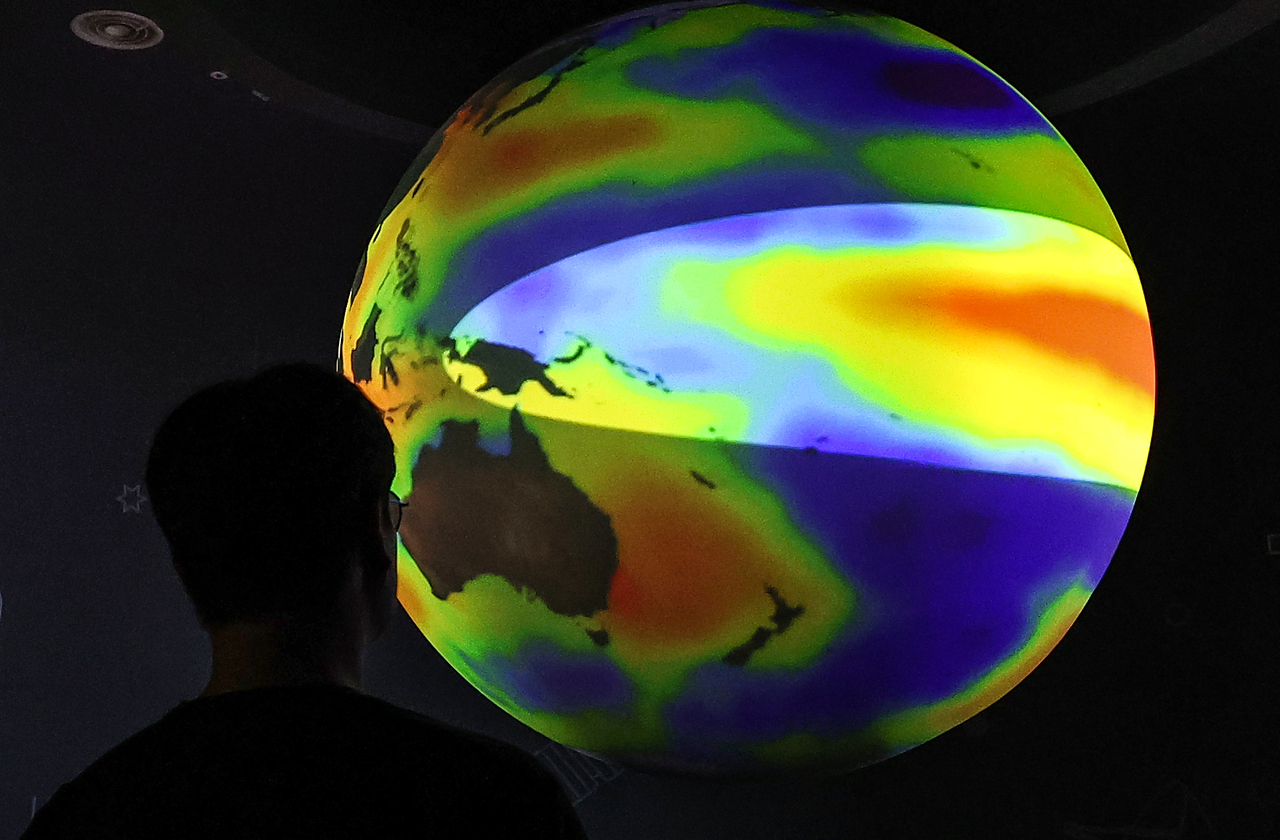
Global climate conditions this year have reached unprecedented levels, surpassing all previous observational records, according to a new analysis.
The World Meteorological Organization's "State of the Global Climate 2026" report, released Monday at the 31st Conference of the Parties to the UN Framework Convention on Climate Change (COP31), found that the global average temperature from January through September was 1.47 degrees Celsius (±0.13 degrees) above pre-industrial levels (1850–1900). While lower than 2024 — the hottest year on record — it is comparable to the annual averages recorded in 2023 and 2025.
As a result, the four most recent years (2023–2026) are on track to be the four hottest ever recorded. The past 12 years (2015–2026) are likewise expected to rank as the 12 warmest on record.
South Korea also recorded above-normal temperatures. The country's average temperature from January through October stood at 15.5 degrees Celsius, 1.3 degrees above the long-term average of 14.2 degrees. That makes it the second-highest reading for the same period since records began, trailing only 2024's 16.2 degrees.
El Niño development is expected to push temperatures even higher. La Niña brought a temporary cooling effect early this year, but El Niño subsequently developed and offset those gains. The phenomenon is forecast to persist into early 2027. El Niño typically raises the global annual average temperature by about 0.1 to 0.2 degrees Celsius, meaning this year's full-year average could end up higher than the January-to-September figure.
Greenhouse gas concentrations in the atmosphere continue to climb. Carbon dioxide concentrations reached approximately 426.8 parts per million (ppm) in 2025, a 53 percent increase from the 278 ppm recorded in 1750. Methane concentrations rose 167 percent over the same period, from 729 parts per billion (ppb) to 1,948 ppb, while nitrous oxide concentrations increased 26 percent, from 270 ppb to 339.1 ppb. Major monitoring stations confirmed that greenhouse gas concentrations continued rising into 2026.
South Korea's greenhouse gas concentrations also hit record highs. The country's background carbon dioxide concentration reached 432.7 ppm in 2025, up 3.2 ppm from the previous year — the second-largest annual increase in the past decade (2016–2025).
Heat accumulating in the Earth system is also growing rapidly. Earth's energy imbalance — the difference between energy entering the planet and energy radiated back into space — hit its highest level in 2025 since measurements began in 1960. Preliminary data for January through July 2026 also showed record-high levels.
Ocean heat content, sea levels hit all-time highs
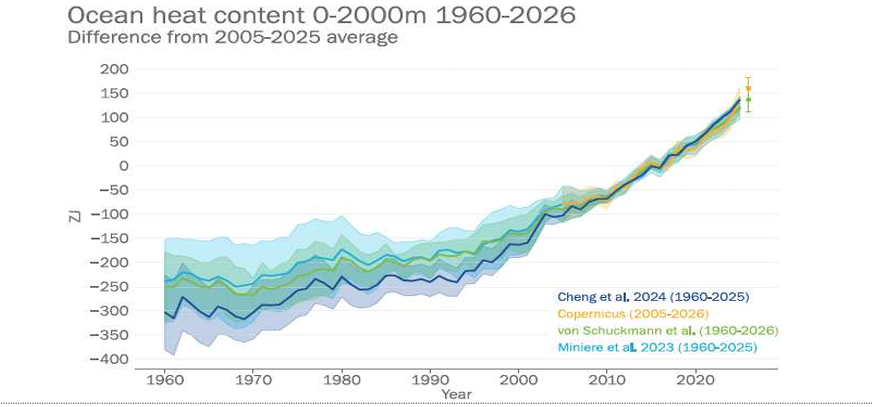
Ocean heat accumulation was particularly pronounced. Global ocean heat content set a record high in 2025, and the upward trend continued through July of this year. Global mean sea levels in 2026 also reached all-time highs, driven by the melting of glaciers and ice sheets adding water volume to the oceans and by thermal expansion as water temperatures rise. Ocean warming affects not only marine ecosystems and biodiversity but also the intensification of tropical and subtropical storms and the reduction of polar sea ice.
Waters surrounding the Korean Peninsula followed a similar pattern. Sea surface temperatures in those waters averaged 18.6 degrees Celsius from January through October, 0.6 degrees above the 10-year average of 18.0 degrees — the second-highest reading for that period on record, behind only 2024's 18.9 degrees.
Glaciers and sea ice are also shrinking rapidly. Global glaciers lost more than 400 gigatons of mass in 2025, enough to raise sea levels by approximately 1 millimeter. The maximum annual extent of Antarctic sea ice in 2026 was the third smallest since satellite observations began, while Arctic sea ice maximum extent ranked among the lowest one or two on record.
Extreme weather events continued to exact a heavy toll in lives and economic damage. In Europe, more than 30,000 excess deaths are estimated to have resulted from heat waves, drought and wildfires. In India, a heat wave in April exposed about 146.5 million people to extreme heat. In late August, the collapse of a Himalayan glacier in Nepal triggered a massive flash flood that killed more than 1,300 people.
WMO Secretary-General Celeste Saulo said El Niño and the 2026 global conditions represent "unprecedented levels that go beyond the observational record," adding that "heat waves, tropical cyclones and heavy rainfall are intensifying at a faster rate than historical data would have led us to expect."
newday@heraldcorp.com