Annual harvest stands at just 26 tons — a stark contrast to the affordable new cockle widely available nationwide.
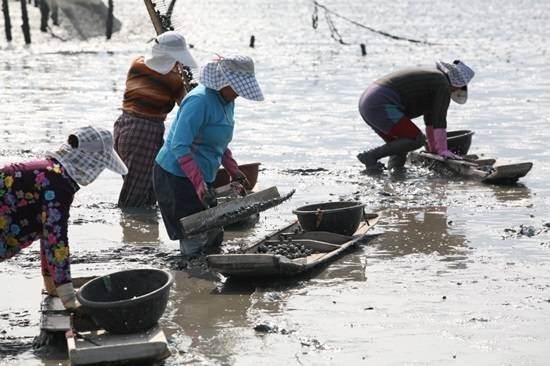
Beolgyo's true cockles — described in the novel "The Tae Baek Mountains" as "briny and faintly fishy" — have become a delicacy on the verge of disappearing.
Boseong-gun (County Executive Kim Cheol-woo) is pushing a three-year "Beolgyo Cockle Reborn Project" to revive the near-depleted shellfish.
The initiative targets the true cockle, which accounts for 70 percent of national production and holds the No. 1 designation under Korea's geographic indication system for seafood. The shellfish is harvested entirely by hand from tidal mudflats using traditional mud-sleds.
Climate change and overfishing have steadily eroded the catch. Output from the Beolgyo area fell from 8,500 tons in 2010 to just 26 tons last year.
The collapse in supply has driven retail prices for a single net — based on a 20 kg standard — to between 700,000 and 800,000 won ($518), prompting most producers to sell in smaller units of 1 kg, 5 kg or 10 kg. The price has made true cockles a dish found almost exclusively at traditional Korean set-meal restaurants.
Unlike true cockles, which must be gathered by hand, the closely related new cockle is netted in bulk. About 3,851 tons were produced in 2025 from waters around Beolgyo, Goheung, the Suncheon Bay area of Byeollyang, and the Yeoja Bay coast of Yeosu's Yulchon — supplying markets nationwide at far lower prices. Even so, connoisseurs say the new cockle cannot match the texture of the true cockle.
Boseong-gun plans to invest 2.1 billion won this year across three programs — the Beolgyo Cockle Reborn Project, a provincial and county-funded initiative to build a mass-production base for true cockles, and a fishing-ground development support project. The funds will go toward seed production, resource release and habitat management, carried out in stages.
The county office scattered four tons of broodstock cockles (shell length 2.5 centimeters) in April. From June through July, it is releasing a combined 18 tons of artificially produced seed cockles (shell length 1.5 millimeters) and juvenile cockles (shell length 1.5 centimeters) — raised at the county's shellfish hatchery — across 19 sites covering 30 hectares in the Yeoja Bay area.
To verify the effectiveness of the restoration effort scientifically, the county has also signed an MOU with the South Jeolla Province Marine and Fisheries Science Institute. Over the next three years, the two bodies will systematically monitor growth conditions and changes in the cockles' habitat.
"High water temperatures in summer are what determine survival for new cockles, but for true cockles, I've been told it's cold damage in winter that drives mortality," an official from the county's marine and fisheries promotion team said. "Through this project, we aim to rebuild the fishing foundation so that Beolgyo cockles can reclaim their reputation and breathe new life into the local economy."
parkds@heraldcorp.com