Sinan Cheonsa Kim exports canned seaweed to US Costco stores, with marketing support from the South Jeolla Province-Gwangju integrated special city and the South Jeolla Creative Economy Innovation Center.
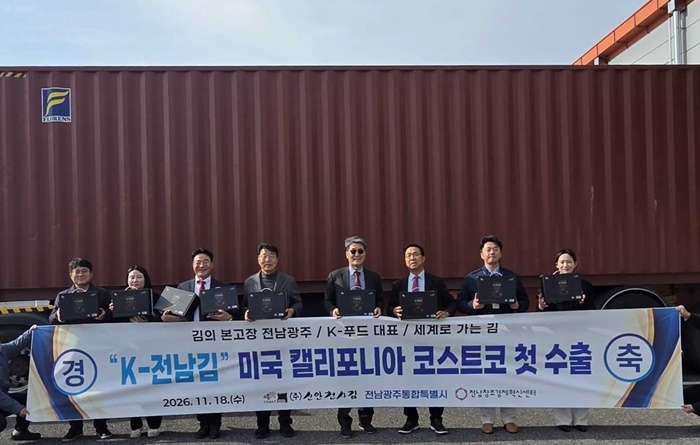
Riding the K-food wave, canned seasoned seaweed — designed for long-term storage — is heading to Costco, the largest retail chain in the United States.
The export marks a significant achievement for the South Jeolla Province-Gwangju integrated special city and the South Jeolla Creative Economy Innovation Center, whose active marketing support made the deal possible.
The South Jeolla Creative Economy Innovation Center held a container loading ceremony together with the South Jeolla Province-Gwangju integrated special city and Sinan Cheonsa Kim Co., a company established with the goal of taking Korean seaweed global, to mark the shipment of the product bound for Costco stores in California.
The export consists of two containers of canned seaweed made from South Jeolla Province-grown raw seaweed, which accounts for about 80 percent of national seaweed output, making the province the country's top seaweed-producing region.
The canned seaweed was developed through the "K-Jeonnam Seaweed Brand and Marketing Support Project," funded by the South Jeolla Province-Gwangju city government and operated by the South Jeolla Creative Economy Innovation Center, and will be supplied directly to Costco stores in the United States.
Unlike conventional seaweed packaging made from polypropylene or polyethylene, the metal can seals out oxygen completely, preserving maximum crispness upon opening and preventing the seaweed from crumbling — advantages that also make it well suited for long-distance distribution.
In South Korea and Japan, where rice is a staple, seaweed is typically eaten wrapped around rice as banchan, or a side dish. In the United States and Europe, however, it is consumed as a crispy, health-conscious snack.
Sinan Cheonsa Kim, South Korea's top seaweed exporter, produces seasoned seaweed and snacks such as seaweed and kelp bugak — deep-fried crisps — made from select South Jeolla Province raw seaweed. The company exported 1,800 containers (40-foot standard) last year alone.
Sinan Cheonsa Kim, which recently built a new factory in Aphae-eup, Sinan-gun — a county of 1,004 islands — posted sales of 140 billion won ($105 million) last year with an operating profit margin of around 20 percent, establishing itself as a dedicated seaweed export company.
South Jeolla Province accounts for about 80 percent of the country's raw seaweed output, but most of it has historically been shipped to manufacturers in South Chungcheong Province or Gyeonggi Province for processing and retail distribution. In recent years, however, seasoned seaweed manufacturers have been setting up operations closer to the source, in areas such as Mokpo, Sinan-gun, Wando, Jindo, Hampyeong and Naju.
"Supplying our newly developed canned seaweed product to Costco this year has drawn attention as an opportunity to raise consumer brand awareness in the US market," said Kang Jeong-beom, head of the South Jeolla Creative Economy Innovation Center. "We will continue to strengthen tailored support so that outstanding local companies can establish themselves in global markets."
parkds@heraldcorp.com