Tax revenue statistics on imported goods released — W7.6tr in customs duties, W53.1tr in VAT collected in 2025
Annual tax revenue statistics on imported goods, including customs duties collected last year, have been made public.
The Korea Customs Service said Thursday it had published its customs statistics yearbook, which classifies taxes levied and collected on imported goods by tax type, commodity category and country of origin.
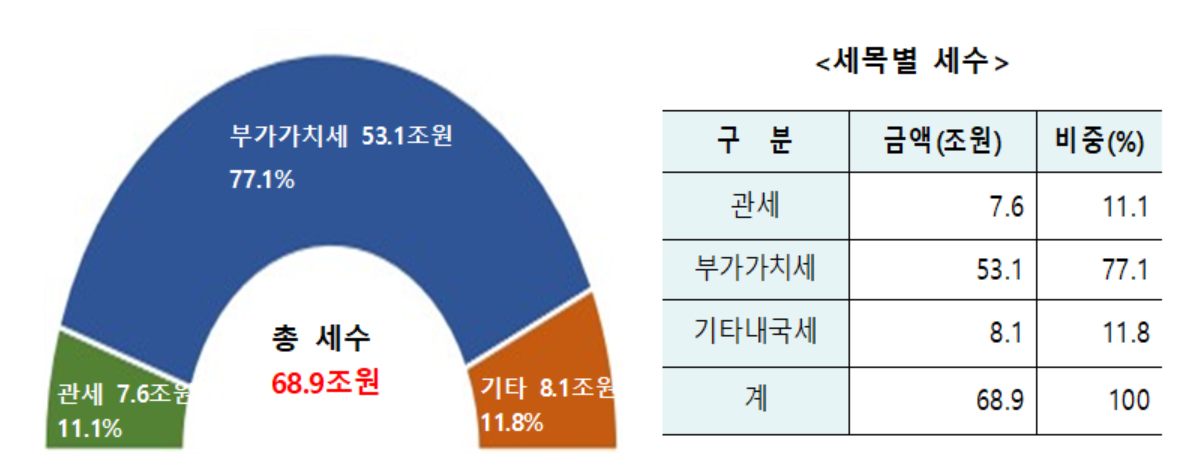
According to the yearbook, the Korea Customs Service collected a total of 68.9 trillion won ($44.8 billion) in taxes on imported goods in 2025, equivalent to 18.4 percent of the country's total national tax revenue of 373.9 trillion won last year.
By tax type, customs duties accounted for 7.6 trillion won, or 11.1 percent of the total, value-added tax for 53.1 trillion won (77.1 percent), and other domestic taxes for 8.1 trillion won (11.8 percent).
By commodity category under the Harmonized System, petroleum and coal products led with 2.5 trillion won in duties collected (HS Chapter 27, 19.7 percent of the total), followed by machinery and computers at 1.4 trillion won (Chapter 84, 10.8 percent), electrical equipment at 900 billion won (Chapter 85, 6.9 percent), automobiles at 700 billion won (5.4 percent) and fish at 500 billion won (4.3 percent).
By country of origin, China topped the list at 3.3 trillion won (25.8 percent), followed by the Middle East at 2.1 trillion won (16.8 percent), Japan at 2 trillion won (15.6 percent), Southeast Asia at 1.3 trillion won (9.8 percent), the EU at 1.1 trillion won (8.9 percent) and the United States at 800 billion won (6.2 percent).
The Korea Customs Service first published the customs statistics yearbook in July 2022, compiling tax revenue data based on the 2021 fiscal year. It has since released the previous year's figures every June, with this year marking the fifth edition.
The customs revenue statistics in the yearbook are also available through the Korean Statistical Information Service portal, where users can view, print and download the data free of charge.
"We plan to distribute printed copies of the customs statistics yearbook to more than 150 institutions, including the National Assembly, the Ministry of Economy and Finance, major research institutes and libraries nationwide, and to post the data on the Korean Statistical Information Service portal and the trade statistics system," a Korea Customs Service official said. "We expect this yearbook to serve as a reliable reference for sound decision-making in the public sector and to support corporate activities such as investment."
kwonhl@heraldcorp.com