About 92,000 apply for SH's Happy Housing units
Yongsan complex posts highest competition rate since 2023
![A view of the Imun IParc Xi complex in Dongdaemun-gu, Seoul. [Hyundai Development Co]](https://wimg.heraldcorp.com/news/cms/2026/06/23/news-p.v1.20251224.37615d25910543a0813839b8e499c479_P1.jpg)
I moved up to Seoul in a hurry from the provinces for work, so I applied with a sliver of hope — I never expected this level of competition even for a unit with no appliances included. With a rate of over 600-to-1, I'll have to keep pounding the pavement looking for a rental, but there's hardly anything on the market and I'm worried.
— A man surnamed Park in his 30s who applied for the first round of 2026 Happy Housing
As Seoul's jeonse and monthly rent crisis deepens, competition for public rental housing has grown fiercer. About 92,000 people applied for the first round of Happy Housing units offered this year by the Seoul Housing and Communities Corp. (SH), with one complex recording a competition rate exceeding 2,000-to-1 — the highest since 2023. The scramble is most intense at preferred complexes in central Seoul, where young adults and newlywed households are concentrated, making it increasingly difficult for those without homes to gain a foothold on the housing ladder.
According to the final subscription competition rate data for the first round of 2026 Happy Housing recruitment published by SH on Tuesday, 1,884 units were offered in this round, drawing 91,772 applicants. The average competition rate was 48.7-to-1, up from the 29.7-to-1 rate recorded in the third round of 2025 — held in late December last year — when 2,368 units drew 70,272 applicants.
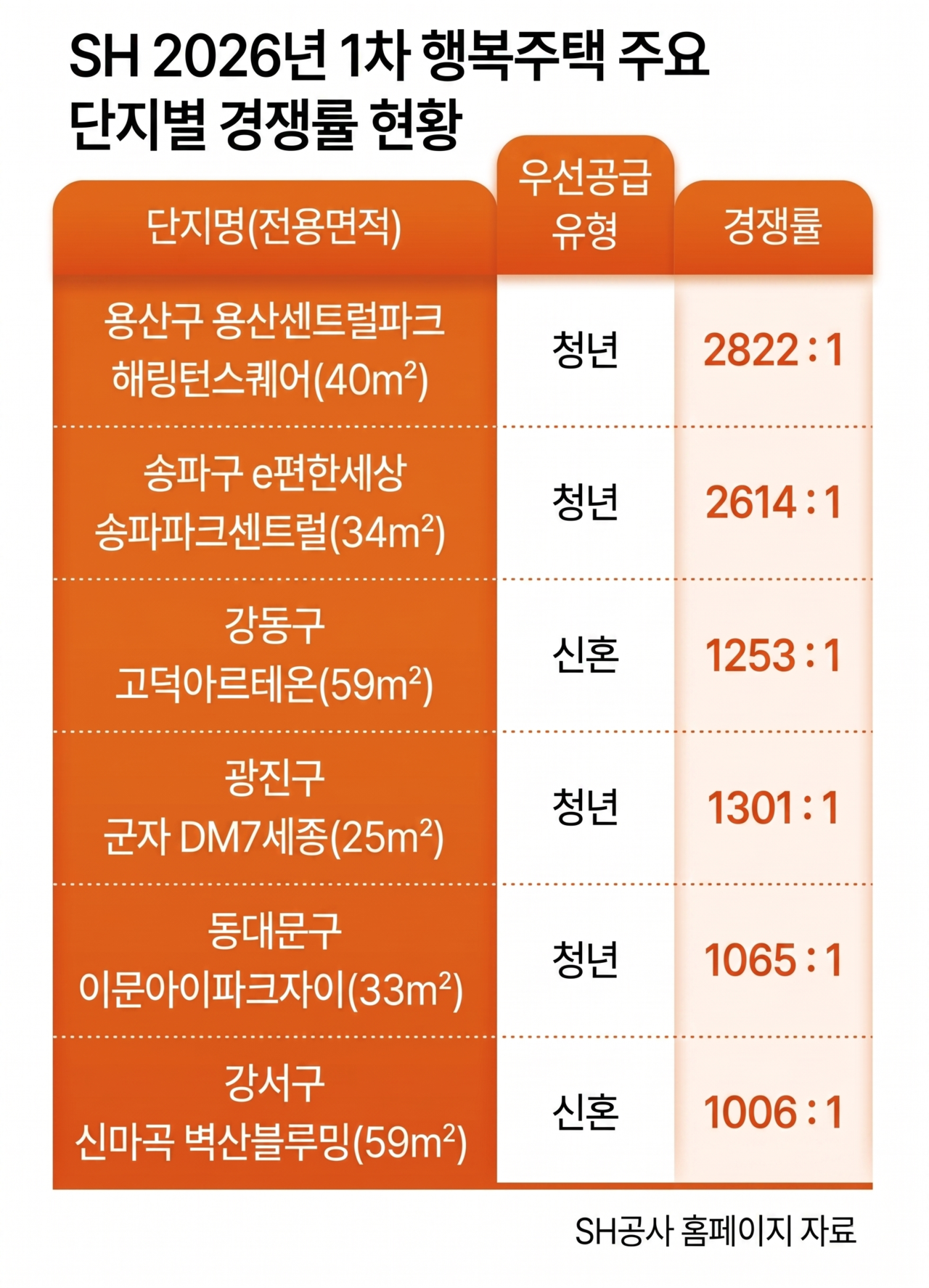
Breaking down competition rates by complex, two units exceeded 2,000-to-1 under the priority supply category. A 40-square-meter unit at Yongsan Central Harrington Square in Yongsan-gu drew 2,822 applicants for a single youth priority-supply slot — the highest competition rate for any Happy Housing complex since the first round of 2023, when a 38-square-meter youth priority unit at Ahyeon Prugio Classity in Seodaemun-gu recorded 3,661-to-1. Also in this round, a 34-square-meter unit at e-Convenience World Songpa Park Central in Songpa-gu drew 2,614 applicants for a single youth-designated slot.
At Godeok Arteon, the flagship complex in Gangdong-gu, two Happy Housing units designated for newlyweds drew 2,506 applicants, a rate of 1,253-to-1. A 33-square-meter unit at Imun IParc Xi in Dongdaemun-gu attracted 2,130 applicants for two youth slots, while a 59-square-meter unit at Sinmakok Byeoksan Blooming in Gangseo-gu drew 1,006 applicants for a single newlywed-designated unit.
Even in Daechi-dong, one of Seoul's most sought-after school districts, a 35-square-meter unit at Daechi Le El drew 3,580 applicants competing for four youth reserve-resident spots, a rate of 895-to-1. The pattern held across the city: the more prominent the location and the more desirable the complex, the higher the competition rate — reaching into the hundreds or thousands to one.
Across the 88 complexes included in this first-round announcement, only one — Godeok Onbitchae in Gangdong-gu, designated for senior residents — fell short of its subscription target.
The surge in interest from young adults and newlyweds in public rental housing reflects a broader spike in jeonse deposits and monthly rents not only for apartments but also for row houses, multi-family homes and officetels across Seoul. Happy Housing is a public rental program designed to ease housing insecurity among college students, early-career workers and newlyweds in their 20s and 30s, with units offered at transit-oriented locations in central areas at 60 to 80 percent of market price. The appeal is tangible: the first-round listing for a 59-square-meter unit at Godeok Arteon showed a deposit of 156.8 million won ($102,000) and a monthly rent of 628,000 won, while a comparable unit on the private market was listed at a deposit of 100 million won and a monthly rent of 2.9 million won — still cheaper even after accounting for the deposit difference.
With supply shortfalls now affecting both private rentals and public housing, calls are growing for a broad expansion of overall housing supply through measures such as deregulation of redevelopment projects to stabilize housing conditions for lower-income residents.
Ko Jun-seok, a professor at Yonsei University's Sangnam School of Management, said the fundamental demand is for apartments in desirable locations. "It is important to ease existing regulations to revitalize redevelopment projects and thereby increase the absolute volume of supply to match that demand," he said, adding that expanding public housing programs such as Happy Housing must go hand in hand with those efforts.
Seoul's average monthly rent hit a record high of 1,566,000 won in May, up 10.67 percent from 1,415,000 won a year earlier, according to the Korea Real Estate Board — a sign of the side effects that can emerge when rental supply remains constrained.
hwshin@heraldcorp.com