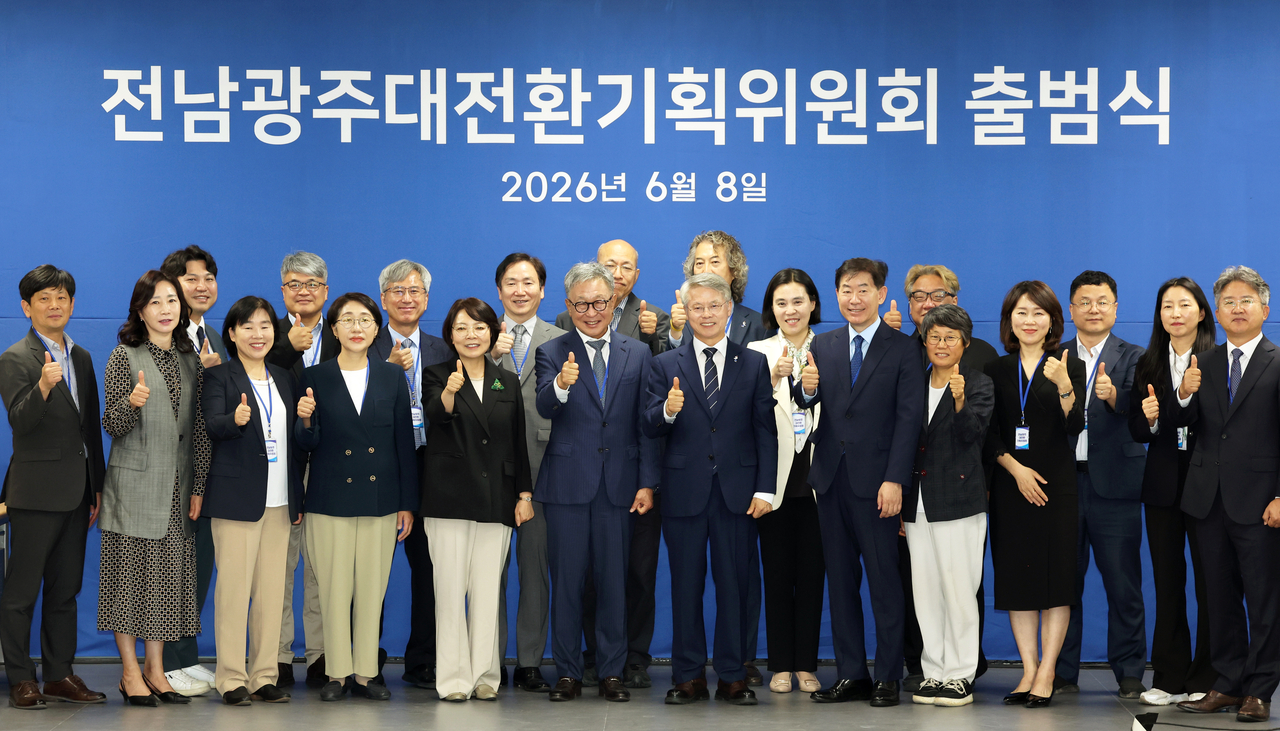
Yang Eun-suk, spokesperson for the Jeonnam-Gwangju Grand Transformation Planning Committee, unveiled Monday a plan being considered by Mayor-elect Min Hyeong-bae to distribute functions across three city halls — the Eastern, Muan and Gwangju offices — on an equal basis.
Under the proposal, the Eastern office would serve as the legal address of the new city, the Muan office would handle civic sovereignty functions, and the Gwangju office would take charge of political affairs and agency recruitment. The plan is subject to review by the transition committee and public consultation before being finalized.
"The Jeonnam-Gwangju integrated special city is a new national development model that overcomes the limitations of the Greater Seoul-centered system and allows regions to become their own engines of growth," Yang said. "Balance without bias is an absolute principle of the integrated special city."
The legal basis cited for the plan is Article 7, Paragraph 3 of the special act governing the establishment of the integrated special city, which explicitly requires the three offices to be utilized and operated in a balanced manner.
In terms of functions and staffing, the Eastern office would hold the city's legal address and serve as a hub for future growth, centered on industrial and economic functions.
One vice mayor is to be assigned there, and plans to expand its functions during organizational restructuring are also under review.
The Muan office would serve as the center of civic sovereignty, drawing on the administrative capacity of the existing South Jeolla Provincial Government to handle a broad range of functions closely tied to residents' daily lives.
Assigning two vice mayors to the Muan office is under discussion as a way to strengthen the weight and accountability of its administrative functions.
The Gwangju office is being considered as the hub for coordination and connectivity across the integrated special city, as well as for attracting political institutions.
The mayor plans to rotate among all three offices and approve decisions on-site at each location as a way to put balanced governance into practice.
"We aim to build a smart special city where administrative work can be handled from anywhere through advanced video conferencing systems and digital platforms," Yang said. "The mayor-elect's basic position is that all three locations are substantive main offices."
Yang did not specify a timeline, saying the final decision would come "once we determine, through the transition committee's review, public and expert consultations, and a pilot operation, that the system can be stably established on the ground."
sij@heraldcorp.com