Who is Team Leader Kang?
Born in 1980, she is a mother of three and a dual-income civil servant.
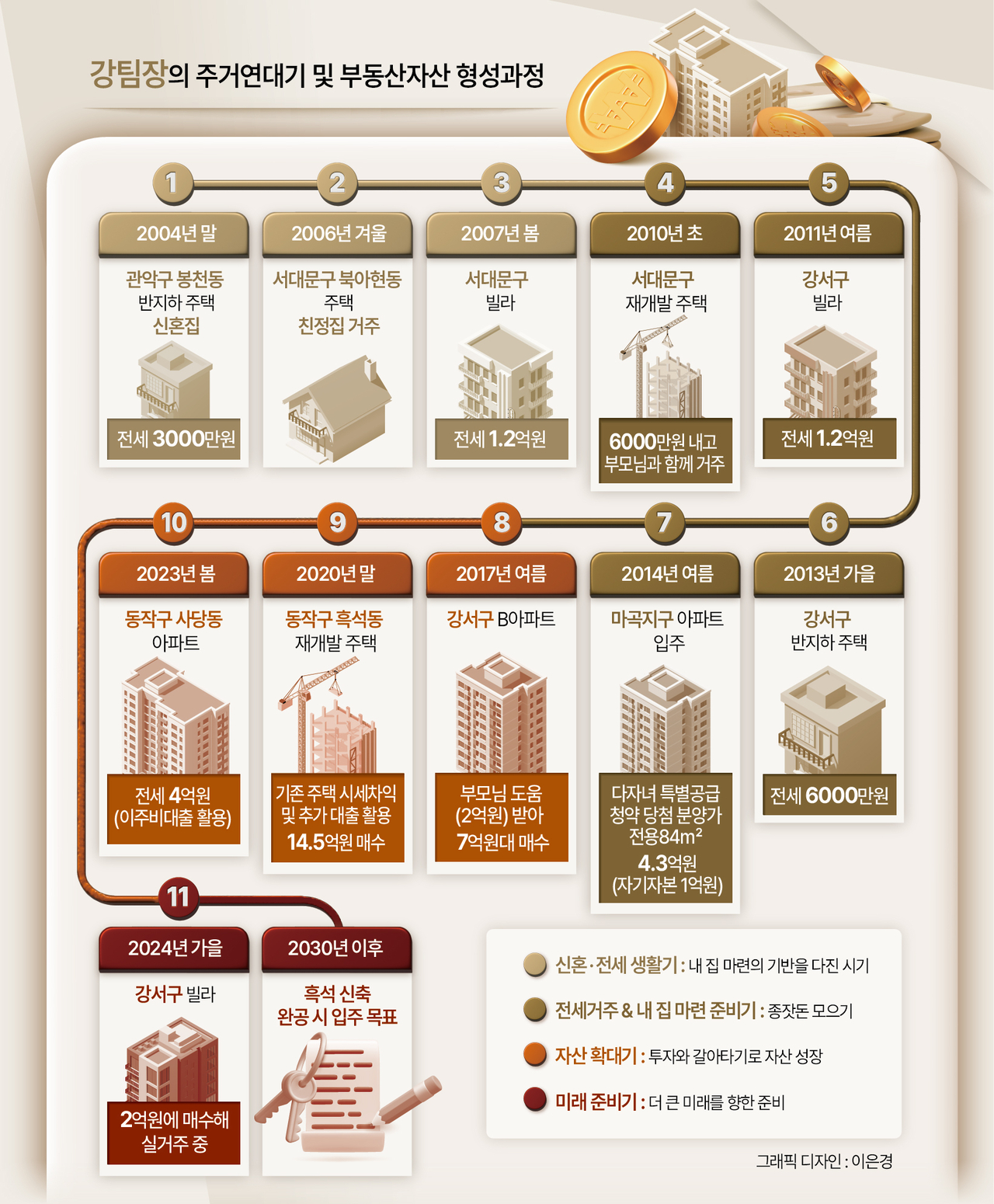
Starting from a 30 million won ($19,600) jeonse home, she won a multi-child special supply apartment subscription in the Magok district in 2013, then parlayed a series of upgrades and a redevelopment zone investment into a move-in right to a newly built apartment in Heukseok-dong now valued at over 3 billion won.
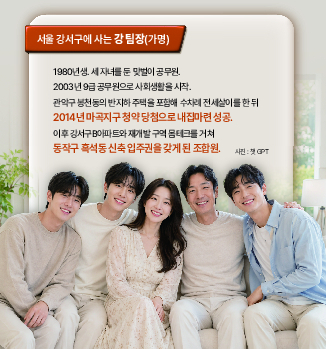
"People are always surprised when I tell them I have a move-in right to a new apartment in Heukseok-dong," said Kang Mi-so (pseudonym). "But I'm not an investment expert, and I never set out to plant myself along the Han River belt. I just moved more than 10 times while raising my kids — there was no other way."
Kang, born in 1980, is a 24-year civil servant and mother of three. Her husband is also a civil servant, and the couple started their working lives on a combined monthly salary of under 2 million won. They began married life in a below-ground-floor jeonse home for 30 million won. How did they end up as union members holding a move-in right to a newly built apartment along the Han River belt valued at over 3 billion won?
![An image evoking Kang's childhood. [Image generated with ChatGPT]](https://wimg.heraldcorp.com/news/cms/2026/06/14/news-p.v1.20260612.7d9e09217087449186004ca0d050bcc2_P1.png)
Getting a job, getting married, having children — all ahead of her peers
"Do you know what the belly of an airplane looks like? When I was a child, planes would pass close overhead all the time. The engines were so loud I used to cover my ears."
Kang grew up in Sinwol-dong, Yangcheon-gu, Seoul — a neighborhood near Gimpo Airport where, even today, half the area falls within a noise-damage zone and development has long been restricted by flight-path height limits.
Her family struggled financially, and she wanted to start earning money as soon as possible. It was no accident that she became a civil servant in 2003 at 23, two to three years ahead of most of her peers.
A year after joining the workforce, Kang married a workplace sunbae she had fallen for at first sight and moved out of her parents' home. The two had, as she puts it, nothing but love — they had almost no savings to speak of.
The couple's first home together was a below-ground-floor unit in Bongcheon-dong, Gwanak-gu. The jeonse price was 30 million won, a sum her husband had taken out a loan to cover. "We loaded two clothing racks, a computer, a printer and a bed onto a truck and moved in," Kang recalled. "We were young, and the idea of starting a family with someone I loved made the small, uncomfortable place feel like it didn't matter much."
From that point on, Kang would move more than six times before finally buying her own home a decade later.
![Every weekend at the below-ground-floor newlywed home, Kang had to air out her clothes to keep mold at bay. [Image generated with ChatGPT]](https://wimg.heraldcorp.com/news/cms/2026/06/14/news-p.v1.20260612.febbefb6947c4826ab363df7e1839283_P1.png)
Life in the below-ground unit, which began in late 2004, came with its own particular rhythms.
The biggest challenge was mold. Moisture made short work of clothing.
Every weekend she had to take her clothes outside and shake them in the sun — though she says it never felt like a burden. "Doing it all at once would have been too much, so I made it a routine: one row from the wardrobe, one row from the rack, a set amount each weekend."
Cutting housing costs by moving in with family
Pregnancy and childbirth changed the equation.
Needing help with childcare, the couple moved in February 2006 — with their first child in tow — to Bukahyeon-dong, Seodaemun-gu, where Kang's parents were living at the time. By then, the couple had been saving about 1 million won a month since getting married, slowly building a nest egg.
They would not leave Seodaemun-gu for the next five years.
Two more children arrived during that time, making her parents' support indispensable. It was only when the second child was old enough to walk independently that the couple decided to set up their own household again.
In the spring of 2007, combining their savings with a jeonse loan of nearly 60 million won, they moved into a top-floor unit in a villa building near her parents' home. Top-floor units were slightly cheaper than those on middle floors.
Kang said she was happy to have so much more space than the below-ground newlywed home. "We had to take out another loan, but this time we had a three-bedroom place. It was on a hill with no elevator, but the height gave us a great view and good ventilation."
Now parents of three, the couple began to feel they needed a place of their own. But their annual savings topped out at around 10 million won, and there seemed to be no clear path forward. Around that time, Kang's parents said they wanted to buy a redevelopment-designated property in Bukahyeon-dong. The couple decided to join them in what Koreans call "momtech" — tolerating difficult living conditions in exchange for a stake in a redevelopment project.
They contributed 60 million won — all the savings accumulated since their marriage — to help her parents with the purchase and received one room in return. Three generations ended up sharing a two-bedroom home with a living room. It was early 2010, and Kang had just turned 30.
![Kang's family and her parents lived together in a two-bedroom home in a redevelopment zone in Seodaemun-gu. [Image generated with ChatGPT]](https://wimg.heraldcorp.com/news/cms/2026/06/14/news-p.v1.20260612.83983faa3c0f418e827625bfd38ec2fd_P1.png)
Redevelopment bet fails, back to renting
But the "momtech" gamble did not pay off.
"I think my parents got cold feet when they saw how high the additional contribution fees would be to receive a move-in right," Kang said. "If they had held on, they would have ended up with both an asset and a new apartment. But the project moved slowly and there were a lot of obstacles. In the end, they sold for roughly what they paid."
As an investment, it was a failure.
Even so, the experience opened Kang's eyes to real estate.
The family needed a new place to live.
In the summer of 2011, with her eldest child's elementary school enrollment approaching, Kang decided to put down roots in Gangseo-gu — close to her hometown and the church she attended. Adding 20 million won saved while living with her parents, she found a third jeonse home: a three-bedroom, 28-pyeong (about 92 square meters) unit for 120 million won.
Without the funds to buy, the best the couple could manage was again a top-floor villa unit. Kang, characteristically upbeat, said she loved having access to the rooftop. "It felt like having my own yard — I could hang out the bedding and grow plants."
Her children saw it differently.
"Mom, when will we ever live somewhere with an elevator?"
That was what her eldest said.
With no playground nearby, the children would play at the apartment complex next door — until they were chased away. "It broke my heart," Kang recalled. "From then on, even at church, I started praying: 'Please give us a home.'"
On parental leave at the time while raising three children, Kang began looking for a way to buy an apartment. With no time to study real estate between work and childcare, it was then that she first learned about the apartment subscription system.
The children who made the winning subscription possible
Living in Gangseo-gu, she heard that the Magok district public pre-sale was worth a shot. With three children, Kang saw the special supply category as her opportunity — at the time, a household needed at least three children to qualify for the multi-child special supply. (From March 25, 2024, the threshold was lowered to two children.)
In the fall of 2013, Kang took all three children by the hand and went to Daecheong Station, where the Seoul Housing and Communities Corporation (SH) office was located, to submit her application in person.
She was selected for an 84-square-meter unit at Magok N Complex.
On her very first application, she had become one of only about 10 Seoul residents to win that particular allocation.
![Kang Mi-so after winning the apartment subscription. [Image created with ChatGPT]](https://wimg.heraldcorp.com/news/cms/2026/06/14/news-p.v1.20260612.aed36f83ea5547f7be54f0e9d420e2e1_P1.png)
At 33, Kang had her first pre-sale right to a brand-new apartment.
The joy was short-lived. The couple had saved about 100 million won over the 10 years since their marriage, and the prospect of taking on more than 300 million won in debt was frightening.
The pre-sale price was 430 million won.
To cover the installment payments, they would have to tap even the jeonse deposit from their current home.
Kang decided to move the family into a below-ground-floor unit in Naebalsan-dong, Gangseo-gu — a three-bedroom place for 60 million won in jeonse.
As Kang described it, the unit was built on a slope: "ground floor from one side, below-ground from the other." Earwigs, slugs and cockroaches made regular appearances — she joked with the kids that the family had "new members" — but the cramped conditions were genuinely difficult. Moving from a 28-pyeong villa to an 18-pyeong below-ground unit, there was simply nowhere to put everything.
![After winning the subscription, Kang and her husband moved back into a below-ground-floor home to scrape together the installment payments. [Image created with ChatGPT]](https://wimg.heraldcorp.com/news/cms/2026/06/14/news-p.v1.20260612.1f290eff103648a69211692a1f308f38_P1.png)
Back below ground to make the installment payments
A veteran of countless moves, Kang bought white storage boxes, divided up the household belongings and stacked them to ceiling height. Tools, picture frames and sundry items were sorted and labeled to carve out as much usable space as possible for five people. Retrieving a kindergarten photo album meant unloading and restacking several boxes, so frequently used items had to live permanently on top of the pile.
"Below-ground units vary, but that place was so damp we had to stuff newspaper under the floor mat. Still, the family got through it well enough. The kids even had friends over. I think it was the hope — knowing that next year we'd be moving into an apartment."
Even so, the couple worried constantly.
The Magok apartment required what Koreans call "yeongkkul" — stretching every last resource to the limit. Once they moved in, the debt of over 300 million won would mean monthly outlays of around 2 million won in loan principal, interest and maintenance fees. Education costs for three growing children were only going to rise, and a dual civil servant income had its ceiling.
"Even sparrows have a nest" — the words that kept Kang from selling
The idea of selling the pre-sale right for a premium crossed her mind. As the one-year transfer restriction period neared its end, Kang raised the dilemma with colleagues and older acquaintances — and they all told her not to.
One colleague urged her to hold on, saying she needed at least one home to call her own. "I had applied for the subscription because I needed a place to live, but I was genuinely scared about carrying that much debt," Kang said. "Then I saw that even real estate agents I'd never met were telling me 'not now' — and that's when I made up my mind to move in."
In the summer of 2014, Kang, her husband and their three children moved into their own apartment at Magok N Complex.
The one who was happiest was the eldest child.
"When we lived in the villa, I used to carry the youngest and hold the second one's hand, but the eldest always had to walk up alone. In my eyes, that child was still a baby. When she said she was happy there was an elevator, I knew we'd made the right call."
The family lived there for about three years.
The apartment had come to them thanks to their children — and it was for their children that they would soon have to move on to a second home.
When they eventually sold the Magok apartment during the period of surging Seoul apartment prices, it yielded a capital gain of more than 600 million won.
The Magok apartment purchased for 430 million won — funded by 100 million won in savings accumulated over 10 years of marriage — had risen enough in value to generate a capital gain of more than 600 million won within four years of move-in. The reason the Kang family decided to trade up will be revealed in Part 2.
hope@heraldcorp.com